The research team led by Professor Won-Young Choi from the Department of Chemistry at UNIST focused on metal clusters found in porous materials and discovered important clues for designing future porous materials.
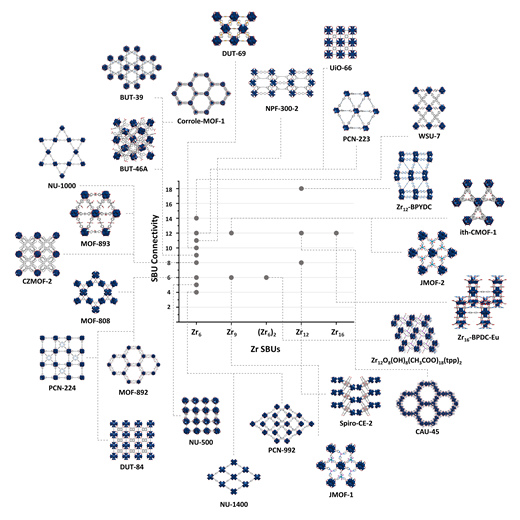
Zirconium metal-organic porous nanostructures are representative metal-organic porous materials with excellent stability and a wide range of applications. In this study, it was revealed that 14 new types of metal clusters utilizing these structures can be implemented in carbon-neutral porous frameworks.
The research team proposed various molecular metal clusters that have not yet been realized as "metal clusters for future porous materials" and also presented practical synthetic strategies for them.
Unlike previous synthetic strategies that focused on new organic linkers, this study suggested a new candidate group of metal clusters whose structures were difficult to predict.
Nam Dong-sik, the first author, said, "Considering that zirconium metal clusters exhibit different molecular adsorption and catalytic properties depending on their structure, the properties that new zirconium metal clusters will bring are highly anticipated."
Professor Won-Young Choi from the Department of Chemistry expressed, "Metal clusters that have not yet received attention will provide clues to rapidly accelerate the discovery of next-generation porous materials used in the carbon-neutral field."
The results of this study, in which Nam Dong-sik and Kim Ji-yeon from Professor Choi’s research team participated, were published on the 4th in Trends in Chemistry, a sister journal of the prestigious international journal Cell.
The research was conducted with support from the National Research Foundation of Korea (NRF) through the Mid-Career Researcher Support Program, Future Hydrogen Source Technology Development Project, Professional Research Information Utilization Project, Support Project for Leading Research Centers (SRC), Global Ph.D. Training Program (GPF), and support from Ulsan National Institute of Science and Technology (UNIST).
© The Asia Business Daily(www.asiae.co.kr). All rights reserved.












