Continued Controversy Including Political Circles and Successive Statements
Yoon "No Fukushima Seafood Will Enter... No Compromise on Safety"
The Presidential Office has refrained from mentioning the import of seafood from Fukushima and the discharge of radioactive wastewater from nuclear power plants, but as Japan's media play has continued for two weeks, it is drawing a firm line. The Presidential Office explained that this is to emphasize that President Yoon Seok-yeol prioritizes the health and safety of the people above all else. However, it is also interpreted as an effort to prevent the government's consecutive diplomatic battles from being undervalued, given criticism from the opposition about diplomatic failures and the fact that only three weeks remain before the state visit to the United States.
On the 31st, President Yoon stated regarding the domestic inflow of seafood from Fukushima, "There can be no compromise on the health and safety of the people." This clearly indicates that seafood from Fukushima will not enter the domestic market, prioritizing public safety above all.
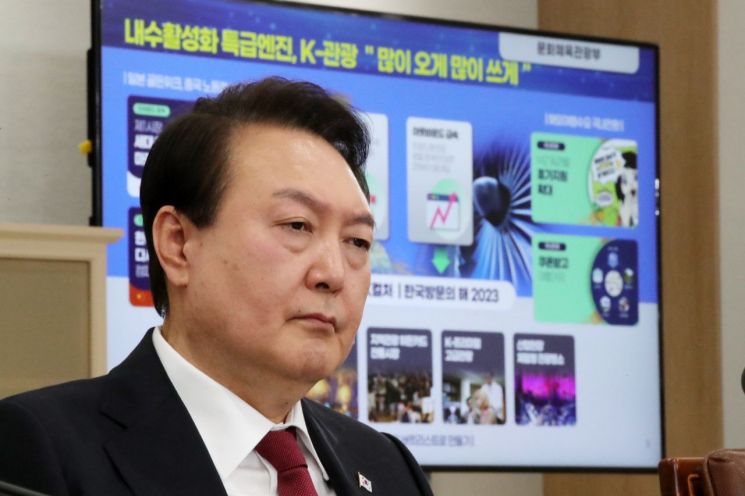
The Presidential Office spokesperson conveyed the president's position through a press release that day, emphasizing, "During the summit, the president clearly stated three conditions regarding Fukushima wastewater: an objective and scientific approach, verification in accordance with international standards, and the participation of Korean experts in the process."
The Presidential Office officials, who had shown a passive response to foster a cooperative atmosphere with Japan, opened fire after the release of an elementary school textbook on the 29th that distorted claims about forced labor and territorial sovereignty over Dokdo. A senior official of the Presidential Office told Asia Economy on the 29th, "For a future-oriented Korea-Japan relationship, Japan should refrain from unreasonable claims on territories effectively controlled by the Republic of Korea and properly inform future generations," adding, "We cannot concede an inch regarding the sovereignty and territory of the Republic of Korea."
Regarding the report by Japan's Kyodo News that President Yoon told former Prime Minister Yoshihide Suga on the 17th, "Even if it takes time, we will seek the understanding of the Korean people" about the discharge of contaminated water from the Fukushima Daiichi Nuclear Power Plant, the Presidential Office has strongly denied this since the previous day. A Presidential Office official said, "The reporter was not present at that meeting (Korea-Japan summit, meeting between a Japanese senior official and President Yoon), but I was," calling it Japan's 'media play' and 'repetition.'
The official added, "Regarding the contaminated water, more precisely the discharged water, safety is the most important. Objective and scientific verification is absolutely necessary," emphasizing the need for Korean experts' participation. Regarding the import of Japanese seafood, the Presidential Office spokesperson unusually issued a press release reaffirming, "The government's position that the health and safety of the people is the top priority remains unchanged," and "Seafood from Fukushima will never enter the domestic market."
The shift from a quiet response immediately after the Korea-Japan summit to a tough stance is also interpreted as a sign of determination not to appear swayed domestically or internationally ahead of important diplomatic schedules such as the upcoming Korea-US summit and the Group of Seven (G7) summit starting next month. President Yoon has set a strategy to achieve early results different from the previous administration in the economic and security fields through Korea-US-Japan cooperation. Recently, he replaced the diplomatic and security team and started preliminary work such as directly meeting Katherine Tai, the US Trade Representative (USTR), to discuss exports and supply chains.
There is also speculation that the decline in President Yoon's approval rating for national governance after the Korea-Japan summit has raised concerns about its impact on the government's diplomatic capabilities. According to a regular public opinion survey conducted by Gallup Korea from the 28th to the 30th targeting 1,000 people aged 18 and over nationwide (±3.1 percentage points, 95% confidence level, telephone interviewer response rate 10.3%; for details, refer to the Central Election Poll Deliberation Commission website), the positive evaluation of President Yoon's performance dropped 4 percentage points from the previous survey to 30%. This is the lowest figure since the fourth week of November last year when it also recorded 30%. Negative evaluations returned to the 60% range after two weeks. The reasons cited for negative evaluations include diplomacy (21%) and Japan relations/forced labor compensation issues (20%), indicating a lack of public consensus on diplomatic matters.
© The Asia Business Daily(www.asiae.co.kr). All rights reserved.












