Concerns Over Major Disasters Amid Rising Electric Vehicle Fires
As electric vehicle fire incidents have increased recently, public anxiety about fires at electric vehicle charging facilities in underground parking lots is also growing. Underground parking lots are enclosed and densely packed with vehicles, making secondary fire damage highly likely.
Additionally, fire truck access is difficult, and fire suppression is more challenging than above ground due to the generation of flammable toxic gases. As the market share of electric vehicles increases, the supply rate of charging stations in parking lots is also rising, highlighting the urgent need for safety measures.
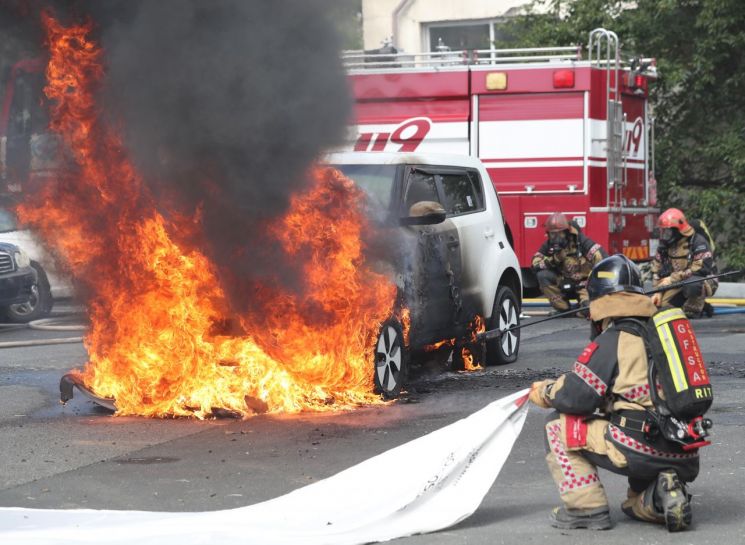 An experiment is being conducted at the Gyeongbuk Fire Academy training ground in Andong-si, Gyeongbuk, in September 2022 to study suppression techniques for electric vehicle fires. [Image source=Yonhap News]
On the 29th, the Citizens' Coalition for Consumer Sovereignty emphasized the urgent need for safety measures against electric vehicle fires in underground parking lots, stating, "The government should, in the short term, limit the full charge rate of electric vehicles to around 85% per charge, and in the long term, mandate the installation of above-ground charging stations."
With the expansion of electric vehicle distribution and the increase of underground charging facilities, concerns about fire damage are growing. In fact, in November 2021, an electric vehicle caught fire while charging in the underground parking lot of an apartment complex in Hoam-dong, Chungju-si.
After the apartment management staff reported the fire, the fire brigade arrived and initially extinguished the fire, but the vehicle had to be moved outside for a cooling process to cool the battery. This case clearly demonstrated how difficult it is to suppress electric vehicle fires in underground spaces.
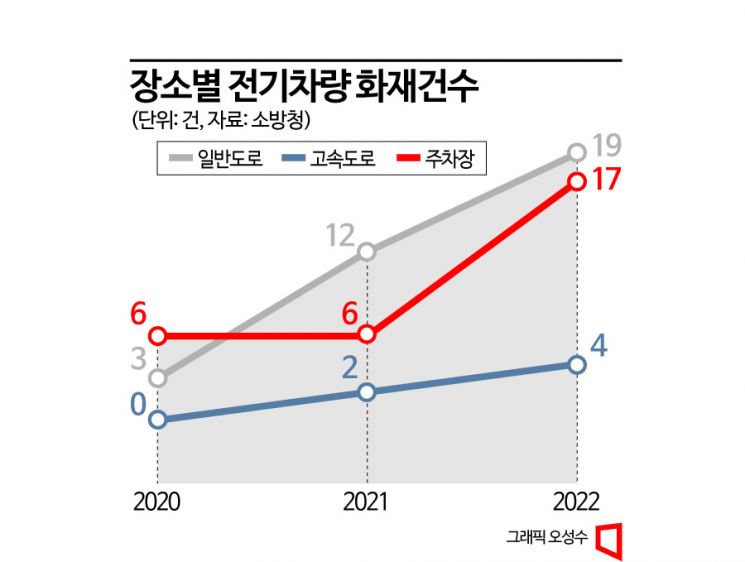
According to the "Annual Electric Vehicle Fire Status for the Past Three Years" released by the National Fire Agency, a total of 44 electric vehicle fires occurred last year. There were 11 cases in 2020 and 24 cases in 2021, showing a steady increase of about double each year. By location, fires on general, express, and other roads accounted for 43 cases (54.4%), but fires occurring while parked for charging also reached 29 cases (36.7%).
Due to the nature of underground parking lots, fire truck access is difficult, and there is insufficient space to install portable water tanks for fire suppression. Most electric vehicle fires originate from battery temperatures rising up to 1000 degrees Celsius, making portable water tanks essential to cool the battery and extinguish the fire.
Moreover, vehicles are tightly parked in narrow spaces, increasing the likelihood of secondary accidents and large-scale fires. Smoke also struggles to escape during a fire. If flammable toxic gases generated by battery fires fill the poorly ventilated indoor space, it could lead to secondary explosions.
The Citizens' Coalition for Consumer Sovereignty pointed out, "It is a serious problem that electric vehicle charging facilities, which are difficult to extinguish in case of fire, are continuously being installed underground without safety equipment regulations."
They noted that the 16 articles of the "Act on the Development and Promotion of Environmentally Friendly Automobiles" related to electric vehicles focus on the development and distribution of eco-friendly cars but contain no regulations on fire and safety. They also pointed out that related administrative rules on underground fire safety standards and the Fire Services Act do not include relevant provisions.
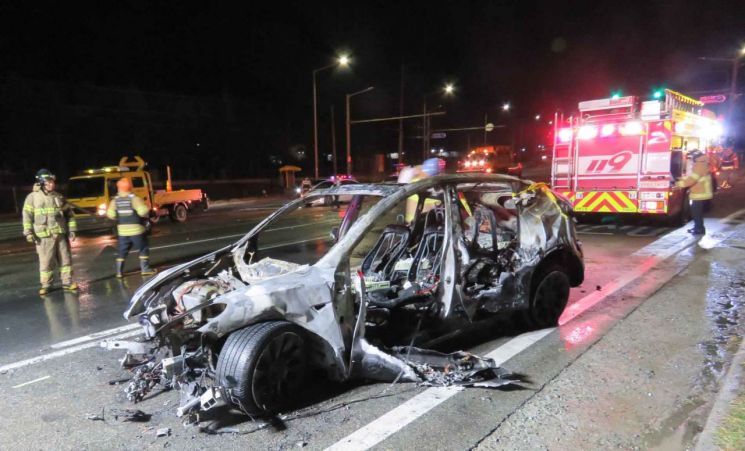 On the afternoon of January 10th, a Tesla electric car traveling on National Route 1 in Undang-ri, Sojeong-myeon, Sejong City, was completely burned in a fire, leaving only the frame.
 [Photo by Sejong Fire Department]
The Citizens' Coalition for Consumer Sovereignty emphasized, "Short- and long-term measures to prevent electric vehicle fires in underground parking lots are urgently needed," adding, "In the short term, before technological innovations such as all-solid-state batteries are realized, efforts should be made to prevent fires by considering lowering the full charge rate to around 85%, even if it somewhat reduces the driving range per charge."
They continued, "In the long term, regulations should be introduced to restrict charging stations to be installed only near the entrances of above-ground and underground parking lots," and "Fire safety standards for the installation of electric vehicle charging facilities underground must also be established."
© The Asia Business Daily(www.asiae.co.kr). All rights reserved.













