Major indices on the U.S. New York Stock Exchange started higher on the 21st (local time) ahead of the Federal Reserve's (Fed) interest rate decision, led by a rally in bank stocks.
As of 10:05 a.m. at the New York Stock Exchange (NYSE), the Dow Jones Industrial Average was up 262.91 points (0.82%) from the previous close, trading around the 32,507 level. The S&P 500, which focuses on large-cap stocks, rose 39.30 points (0.99%) to the 3,990 level, while the tech-heavy Nasdaq index gained 125.13 points (1.07%) to reach 11,800.
Currently, all sectors except utilities within the S&P 500 are showing gains. Energy and financial stocks have risen more than 2%, driving the rally. Shares of First Republic, which had been caught up in crisis rumors, also surged. First Republic jumped more than 36% from the previous close, temporarily halting trading. PacWest Bancorp rose over 10%. The SPDR S&P Regional Banking ETF is also trading up more than 4%.
This follows UBS's decision to acquire Credit Suisse, reports of additional support being considered by major U.S. banks led by JPMorgan, and this morning’s remarks by U.S. Treasury Secretary Janet Yellen about further intervention, which have helped ease concerns about banking risks. The Chicago Board Options Exchange (CBOE) Volatility Index (VIX), known as Wall Street’s “fear gauge,” dropped more than 7% to the 22 level compared to the previous close.
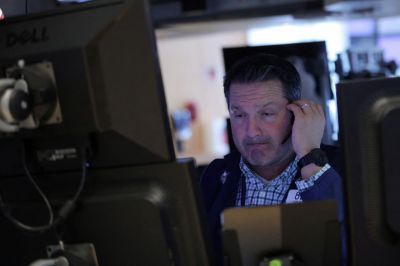
Investors are currently focusing on Secretary Yellen’s remarks, the movements in bank stocks, and the two-day March Federal Open Market Committee (FOMC) meeting starting today.
In a speech released ahead of her address to the American Bankers Association, Secretary Yellen stated, "The actions we have taken are not focused on supporting any specific bank. We intervened to protect the broader banking system," adding, "If smaller banks experience deposit withdrawals that pose contagion risks, similar (additional) measures could be taken." She confirmed that if a banking crisis escalates sharply, deposits exceeding the insured limit of $250,000 per person could be protected across all banks. Bloomberg News also reported, citing sources, that authorities are considering options to guarantee full deposits. However, the Treasury currently does not believe such measures are necessary.
If banking risk concerns, which surged sharply after the Silicon Valley Bank (SVB) collapse, subside, the likelihood of the Fed raising interest rates at this month’s FOMC meeting increases. According to the Chicago Mercantile Exchange (CME) FedWatch tool, as of this morning, federal funds futures markets reflect an over 83% probability that the Fed will raise rates by 0.25 percentage points at the March FOMC, up from the previous day’s 73% range. The probability of a rate hold is 16.6%, and the chance of a larger hike is 0%.
In the New York bond market, Treasury yields rose ahead of the FOMC. The 2-year U.S. Treasury yield, sensitive to monetary policy, climbed to 4.14%. The 10-year yield is trading around 3.57%.
Jim Reid, strategist at Deutsche Bank, said, "With sentiment turning positive, investors expect the Fed to raise rates tomorrow," forecasting a 0.25 percentage point increase. On the other hand, Bill Ackman, CEO of Pershing Square Holdings, and Elon Musk, CEO of Tesla, argued against a rate hike. Ackman tweeted, "The Fed should hold rates steady," adding, "This is not an environment for the Fed to raise rates and put pressure on the system. Financial stability is the Fed’s first responsibility." In response, Musk tweeted further, "The Fed should cut rates by at least 0.5 percentage points."
International oil prices are on the rise. April West Texas Intermediate (WTI) crude oil is trading up 2.05% from the previous close, at the $69-per-barrel level.
European stock markets are also rising, supported by the bank stock rally. Germany’s DAX index is up 2.06%. The UK’s FTSE index has gained 1.93%, and France’s CAC index is up 1.86%.
© The Asia Business Daily(www.asiae.co.kr). All rights reserved.












