[Wise Review]
Steven Spielberg Biographical Film 'Pavelmans'
The Master's Purest Love and Desire
An Elegant and Passionate Tribute to Cinema
Love arrives without warning and shakes life to its core. It cannot be predicted or avoided. Soon, one becomes a slave to uncontrollable emotions. The mind becomes entangled with thoughts of the other person, surrendering and collapsing.
In 1952, New Jersey, USA, a boy named Sammy (played by Mateo Zoryan) falls in love with movies. Arriving at the theater with his parents, young Sammy is frightened by the dark cinema. His mother, Mitch (played by Michelle Williams), holds his hand and says, "Movies are unforgettable dreams." Gathering courage, they enter the theater and watch the film The Greatest Show on Earth, leaving Sammy deeply shocked. This is how he falls in love with movies for the first time in his life. There is no turning back. Just as a train crashes into a car on the screen, Sammy is struck by the movie.
"I love movies"... A master's confession
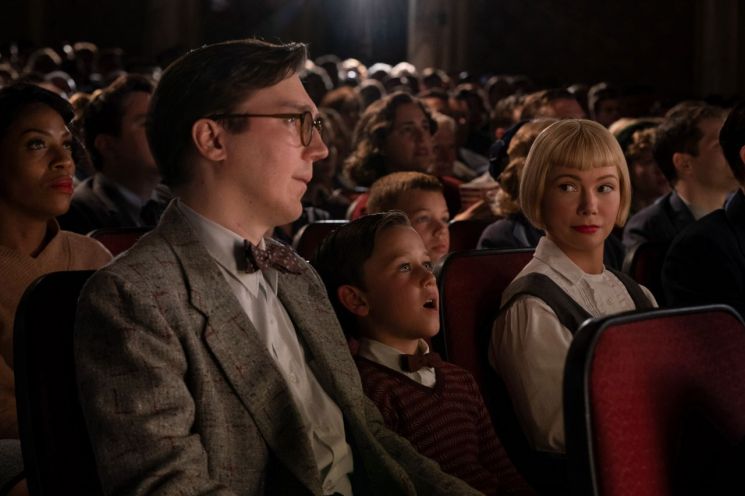
The train crash scene from the movie keeps replaying in Sammy's mind. Unable to sleep because of the endless replay, he decides to recreate the scene with a model train. His engineer father, Burt (played by Paul Dano), cannot understand Sammy's behavior, but his mother Mitch, a former pianist, understands her son. Mitch tells Sammy to record the moment of the train crash with an 8mm film camera and watch it repeatedly. She explains that this will make the fear disappear and the train won't have to be destroyed, handing him his father's camera.
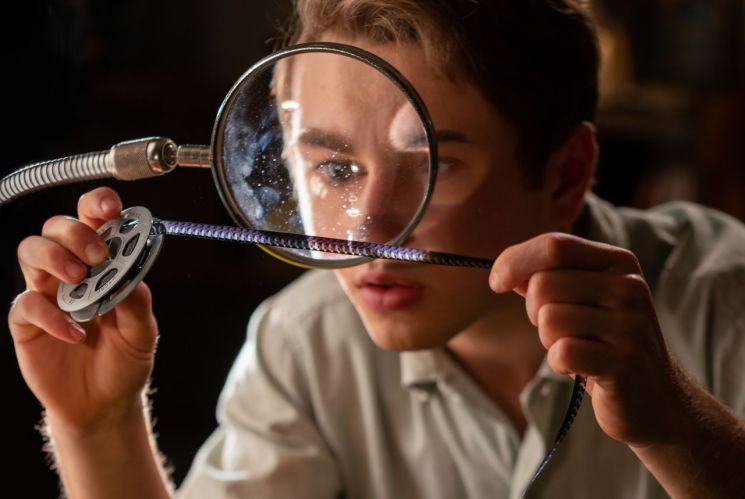
Sammy looks at the multiple photos printed on the film born from the movie. Using a magnifying glass, he examines the small 8mm film, cutting and pasting to create his own movie. Through these photos, Sammy realizes the essence of cinema. This is an important scene that indicates how director Steven Spielberg views movies.
The film The Fabelmans depicts the autobiographical story of director Steven Spielberg (76). Spielberg pioneered the blockbuster genre with the massive success of Jaws (1976), which grossed over $200 million in North America. He is regarded as a leading Hollywood master, having directed E.T. (1982), Indiana Jones and the Temple of Doom (1984), Jurassic Park, Schindler's List (1993), Saving Private Ryan (1998), A.I. (2001), and War of the Worlds (2005).
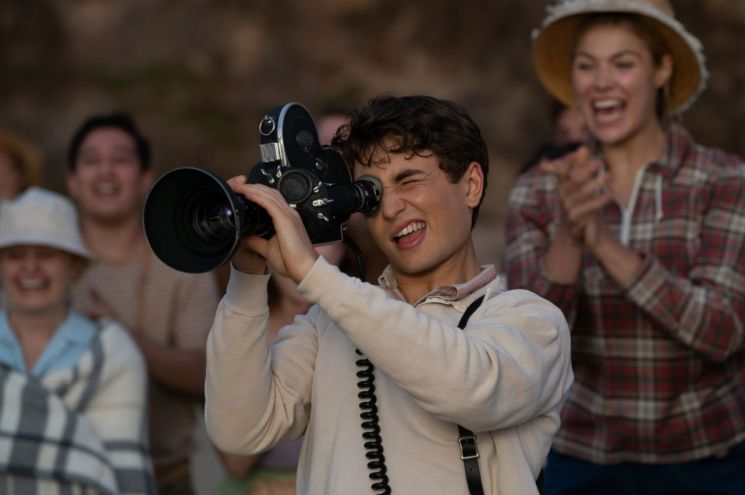
Spielberg began filming movies with his father's 8mm camera at the age of eight and screened a film he directed at a local theater when he was sixteen. In The Fabelmans, the director arranges his story in chronological order. While dealing with autobiographical content, he does not direct the narrative or achievements in an extraordinary way. The film follows the pure yearning and dreams of movies before he made money from films and before his debut as a commercial film director. It calmly observes a clumsy, poignant yet lovable childhood shining with passion and curiosity.
The movie is Spielberg's life itself and everything to him. It is joy, pain, and happiness. The work reveals how significant falling in love with movies was for him. Clear memories of his parents and love for his family are also glimpsed. Family was the support that sustained him and the driving force that allowed him to walk alongside movies.
The depiction of the trials faced during adolescence is also impressive. Honest emotions and moments encountered through movies are connected like photographs. There are scenes that reveal how Spielberg views movies as a director.
Spielberg, a master approaching his eighties, confesses that he is still just a boy who loves movies deeply. The Fabelmans is a heartfelt confession and tribute to cinema.
Steven Spielberg's 'Cinema Paradiso'
'Click, click! Click, click!'
'Whirrrrr'
There are many scenes that warm the hearts of movie fans. The sound of cutting film with an editor and the projector running make the heart race and stir something deep inside.
Scenes of people wearing different clothes sitting together in a movie theater watching a film appear repeatedly, which is why The Fabelmans must be seen in theaters. The moment it meets the audience in the cinema, the "movie" is truly complete. This is a special point where the master’s contemplation and love for cinema at the center of change can be read.
Since the COVID-19 pandemic, the number of theatergoers has decreased. This change is due to the option of watching movies at home and rising ticket prices. It is an unstoppable trend accelerated by the pandemic. Spielberg speaks about the existence of theaters and cinema.
The movie reminds us why and how much we love theaters and movies. It makes us recall the moments when we were struck by movies.
For various reasons, movies lift the audience up. They do not force any emotion. Spielberg captivates the audience with just his love for movies. The film is romantic, cute, touching, and funny all at once. The 2-hour and 31-minute runtime flies by like a dream.
The ending elicits a sigh. The scene where young Sammy meets the "King of Westerns," director John Ford (1894?1973), features a surprise cameo by director David Lynch as John Ford, adding fun. This very cool and meaningful line is short but awe-inspiring. It is Spielberg’s lifelong realization and a milestone in filmmaking.
The impressive final scene will likely linger in the mind for quite some time, like the train scene that shocked Sammy. Whatever you imagine, it is a movie as enjoyable and happy as expected. Runtime: 151 minutes. Rated 12 and over. Opens March 22.
© The Asia Business Daily(www.asiae.co.kr). All rights reserved.

![Clutching a Stolen Dior Bag, Saying "I Hate Being Poor but Real"... The Grotesque Con of a "Human Knockoff" [Slate]](https://cwcontent.asiae.co.kr/asiaresize/183/2026021902243444107_1771435474.jpg)
















