January Seoul Apartment Actual Transaction Price Index Turns Up After 6 Months
Average Number of Bidders Increases but Winning Bid Rate Remains Weak
Subscription Market Competition Rises but Polarization Deepens
Market indicators are showing mixed signals, with bullish and bearish views evenly matched. While key barometers of the real estate market such as Seoul apartment transaction volumes, subscription competition rates, and the average number of bidders in the auction market are on the rise, when considering transaction prices, contract rates, and winning bid ratios, opinions suggest it is still difficult to say the market has truly bottomed out.
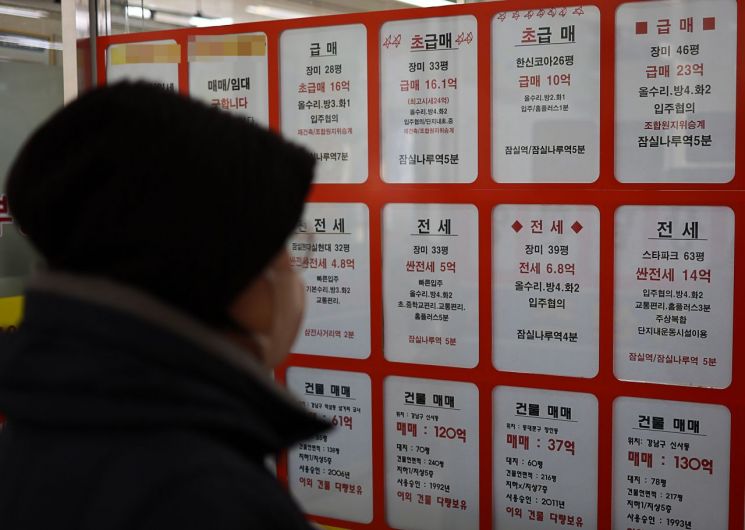
According to the Korea Real Estate Board on the 17th, the Seoul apartment actual transaction price index in January rose 0.81% compared to the previous month, marking the first increase since June last year (0.23%). This is the result of the government's real estate regulation easing announced last January combined with recent market interest rate cuts. In fact, half of the Seoul apartments traded in the first quarter of this year were sold at higher prices than in the fourth quarter of last year. According to Real Estate R114, out of 531 Seoul apartment transactions so far this year, 277 transactions (52.5%) were at higher prices compared to the previous quarter, the fourth quarter of last year.
Seoul apartment transaction volumes are also showing signs of recovery. Although the transaction cliff deepened due to interest rate hikes that began in the second half of last year, various regulatory relaxations, including the removal of regulation zones except for the Gangnam 3 districts and Yongsan district in January, have led to an increase in quick-sale transactions. According to the Seoul Real Estate Information Plaza, as of February 16, the number of apartment transactions in Seoul reached 2,223, surpassing 2,000 units per month for the first time in 1 year and 4 months since October 2021. As of February 16, 2,223 transactions have been reported this month. The Seoul apartment prices this week (as of the 13th) fell 0.16% compared to last week, marking the fifth consecutive week of narrowing declines. This is also the lowest rate of decline in six months since the second week of September last year (-0.16%).
However, some argue that it is difficult to conclude that the market situation has reversed based solely on the reduced rate of price decline and increased transaction volume and proportion of rising transactions. To prove the bottoming out of housing prices, not only must low-priced listings be exhausted in the market, but a follow-up buying momentum must also be established immediately.
A Korea Real Estate Board official said, "If follow-up transactions occur, sellers raise their asking prices and withdraw listings from the market, leading to a price increase trend, but currently, quick-sale properties are being sold without additional rising transactions following." Rather, a volatile market is unfolding where actual transaction prices fluctuate within a box range.
There are even claims that a statistical illusion has recently spread in the market, making it appear as if the government’s regulatory easing policies have successfully achieved a soft landing in real estate. One example is the increase in the average number of bidders in the auction market, which is considered a leading indicator of the overall real estate market.
According to the ‘February Auction Trend Report’ released by Gigi Auction, the average number of bidders rose to 10.4, an increase of 2.1 from 8.3 a month earlier. This is the first time since September 2021 (10.2) that the figure has returned to double digits. However, despite this, both the winning bid rate and winning bid ratio (the ratio of winning bid price to appraised value) declined. Last month, there were 1,652 apartment auctions nationwide, of which 547 were successful, resulting in a winning bid rate of 33.1%.
Experts point out that in the current auction market, bidders are concentrating only on certain properties depending on the ‘price.’ Senior researcher Joo Hyun Lee of Gigi Auction said, "As auctions fail repeatedly, prices have dropped significantly, and bidders are concentrating on properties with good locations," adding, "It is difficult to say the auction market is active simply because the number of bidders has increased."
In the subscription market, polarization is deepening depending on complexes and regions. Since the removal of regulation zones except for the Gangnam 3 districts and Yongsan district in January, anyone in a household, regardless of home ownership, can apply for subscriptions. However, while competition rates soar in some Seoul areas considered to have high investment value, undersubscription is occurring frequently nationwide.
In fact, after the large-scale deregulation of the 1.3 measures, the first Seoul pre-sale complex, ‘Yeongdeungpo Xi Dignity’ in Yeongdeungpo-gu, attracted nearly 20,000 applicants for 98 units, resulting in a first-priority competition rate of 198 to 1. On the other hand, according to the Korea Real Estate Board’s Subscription Home, among 59 apartment complexes that conducted general sales nationwide from December last year to February 8 this year, 32 complexes, more than half, experienced undersubscription.
Park Won-gap, Senior Real Estate Specialist at KB Kookmin Bank, said, "Interpreting this as a sign that the housing market is revitalizing is an overinterpretation," and added, "The favorable conditions in some subscription markets are more influenced by the government's stimulus effect rather than a fundamental change in market trends."
© The Asia Business Daily(www.asiae.co.kr). All rights reserved.












