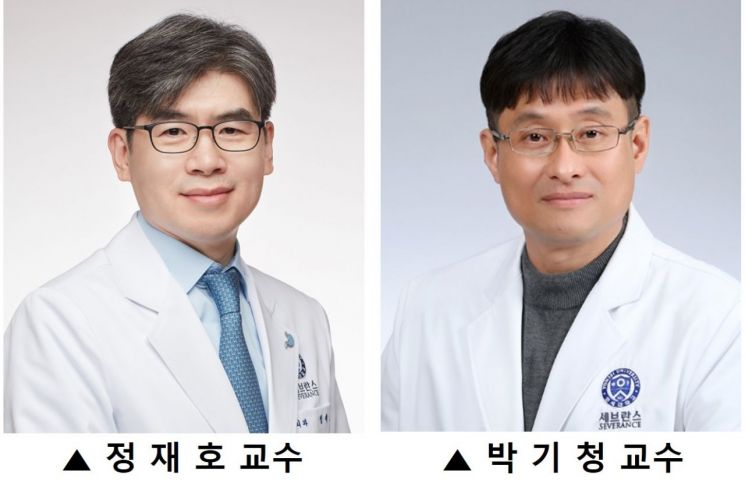
Yonsei University College of Medicine Professors Jaeho Jeong and Kicheong Park's Team
Uncover Mechanism of Chemotherapy-Resistant Cancer Cells
Cancer Cell Growth Decreases with Combined Administration of Inhibitory Substances
A new drug candidate has been developed that shows therapeutic effects when cancer recurs or metastasizes and cannot be treated with anticancer drugs.
The research team led by Professors Jaeho Jung and Kicheong Park from the Department of Surgery at Yonsei University College of Medicine announced on the 13th that they identified the survival mechanism of cancer stem cells, which could not be treated with existing anticancer drugs, and found a lead compound to overcome it. This study was published in the latest issue of the international medical journal BMC Medicine (IF=11.8).
In the case of general cancer cells, administering anticancer drugs worsens the tumor microenvironment, causing cell death. However, certain patients exhibit activation of cancer stem cells and strong resistance to anticancer drugs. In such cases, treatment with existing anticancer therapies is ineffective, classifying the cancer as refractory.
The research team first confirmed the survival mechanism of anticancer drug-resistant cancer cells. Analysis of cancer cells taken from patients who experienced recurrence or metastasis during anticancer drug treatment revealed the presence of anticancer drug-resistant cancer cells possessing cancer stem cells. They also discovered that the protein PMCA, significantly increased in cancer stem cells, lowers intracellular calcium ion concentration to sustain survival.
Accordingly, the research team developed a lead compound (candidate 13) to inhibit PMCA. They then confirmed the therapeutic effect through animal experiments combining the lead compound with existing standard anticancer drugs. First, cancer cells from patients who showed resistance to the standard anticancer drugs oxaliplatin and sorafenib after recurrence or metastasis were implanted into animal models. Each anticancer drug was administered alone to the tumors, and tumor size changes were observed. When oxaliplatin was administered alone, the average tumor size, initially 200㎣, increased to 354.44㎣ after 20 days, 1593.2㎣ after 30 days, and 2756.36㎣ after 40 days. Similar results were observed with sorafenib alone, with tumor sizes increasing to 365.26㎣ after 20 days, 1116.26㎣ after 30 days, and 2998.77㎣ after 40 days, demonstrating anticancer drug resistance.
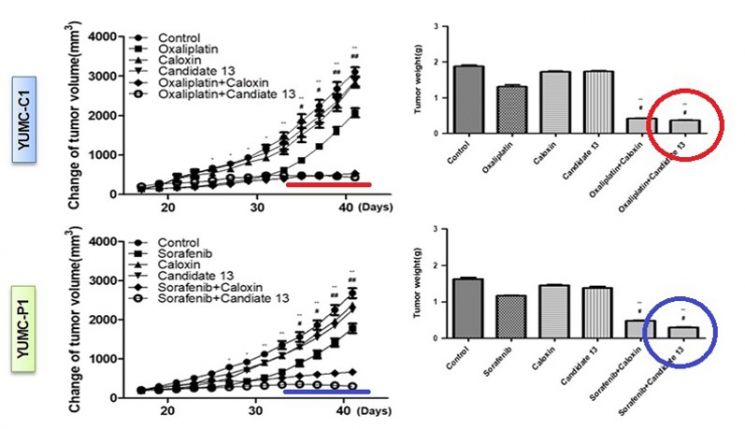 When the lead compound (candidate 13) was administered in combination with oxaliplatin (marked in red) and sorafenib (marked in blue), unlike other comparison groups, the tumor growth rate significantly slowed down. [Data provided by Yonsei Medical Center]
Subsequently, when oxaliplatin or sorafenib was administered together with the lead compound, tumor growth rates decreased. For tumors initially sized 200㎣, combined administration of oxaliplatin and the lead compound resulted in tumor sizes of 254.32㎣ after 20 days, 288.41㎣ after 30 days, and 283.44㎣ after 40 days, showing suppression. Similarly, combined administration of sorafenib and the lead compound resulted in tumor sizes of 274.33㎣ after 20 days, 303.14㎣ after 30 days, and 298.97㎣ after 40 days, with tumor sizes even decreasing compared to single administration, indicating a significantly reduced growth rate.
The results of this study can be applied not only to anticancer drug-resistant cancers but also to other refractory cancers exhibiting characteristics of stem cell-like cancers. This is because they share the mechanism of avoiding cell death by regulating intracellular calcium ion concentration when the tumor microenvironment deteriorates. Professor Jaeho Jung stated, "Through this study, we confirmed the effect of simultaneous administration of existing anticancer drugs and the lead compound (candidate 13) for treating anticancer drug-resistant cancers," adding, "We will continue research on therapeutics for refractory cancers."
Based on this research, the team has filed patents domestically and internationally. They have also transferred the technology to the Korean company 'Verabus' and the U.S.-based company 'CKP Therapeutics' in Boston to accelerate the discovery of additional lead compounds. Centered on the research team, Yonsei Medical Center continues collaborative research with domestic and international companies and is preparing for further technology transfers and commercialization in clinical settings. This research was also selected for the 'People Who Illuminate Korea' by the Pohang University of Science and Technology (POSTECH) Biological Research Information Center (BRIC).
© The Asia Business Daily(www.asiae.co.kr). All rights reserved.












