Public School Teachers Stage Sit-in Protest Over Poor Treatment
Bloomberg: "A Threat to the Maduro Regime"
Venezuelan teachers, suffering from poor conditions such as receiving salaries of around $20 per month, are becoming a threat to the Nicol?s Maduro regime.
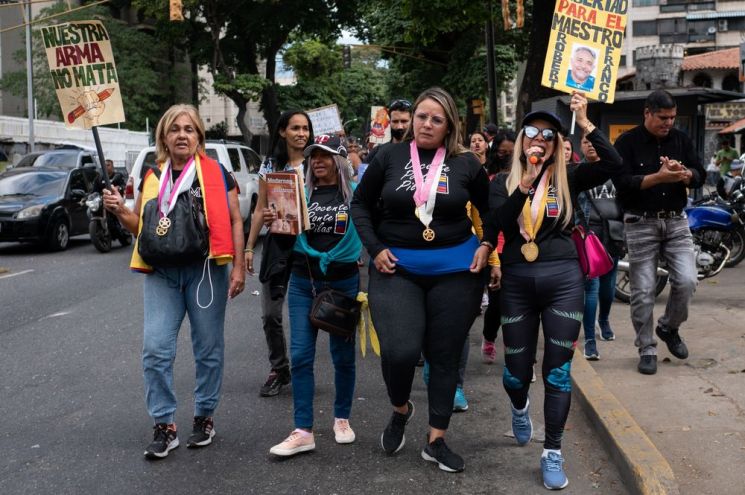
On the 12th, major foreign media including Bloomberg cited global consulting firm DevTech Systems, reporting that from 2018 to 2021, 68,000 elementary, middle, and high school teachers left Venezuela.
The reason they left their homeland is that although the national economy is gradually recovering from its worst state, it is difficult to make a living solely as a teacher. Rosemary Nive, a special education teacher with 20 years of experience working in the capital Caracas, receives a salary of only $20 per month. That is about 26,000 Korean won per month. Despite holding a master's degree, she earns only 5% of the cost needed for a family of five to eat and live each month in Venezuela. Fellow teachers barely maintain their livelihoods by doing private tutoring or side jobs such as cooking, beauty services, and nail art. Even so, it is insufficient to cope with the murderous inflation rate of 538% per year. Nive said, "I have gone through hard times, including days without a single thing to eat."
The educational environment is also poor. Dr. Enrique Delgado Palacios Public Elementary School in southern Caracas has had its walls and ceiling collapse due to leaks five months ago, and all 612 students attend classes twice a week in a nearby warehouse. Some students cannot read even at the age of 12.
Exhausted by such poor salaries and working conditions, public school teachers are ultimately taking to the streets. They are holding large-scale protests demanding salary increases and expanded investment in the education system. Some teachers are demanding their monthly salaries be raised to $600, but due to the fragile finances of the state government, salary increases are difficult.
Bloomberg reported that this is emerging as a serious threat to President Nicol?s Maduro, who is marking 10 years in power and preparing for re-election.
During the past Hugo Ch?vez administration, when the global economy was booming and South American raw materials sold at high prices, the treatment of public school teachers was not lacking. However, as the economy declined, government spending decreased, and the oil industry was shaken by poor investment and management, Venezuela's public expenditure drastically fell. Now that the Maduro government cannot fulfill its previously declared promise to raise public servant salaries, the anger of many teachers remains unresolved.
Bloomberg pointed out, "Venezuelan teachers receive salaries of $20 per month and suffer from hunger," while "the Venezuelan economy is slowly recovering, but social inequality remains widespread."
© The Asia Business Daily(www.asiae.co.kr). All rights reserved.












