September 9 Deputy Prime Minister Choo Kyung-ho Press Briefing
"Semiconductor Special Act, Government Will Also Take a Progressive Approach"
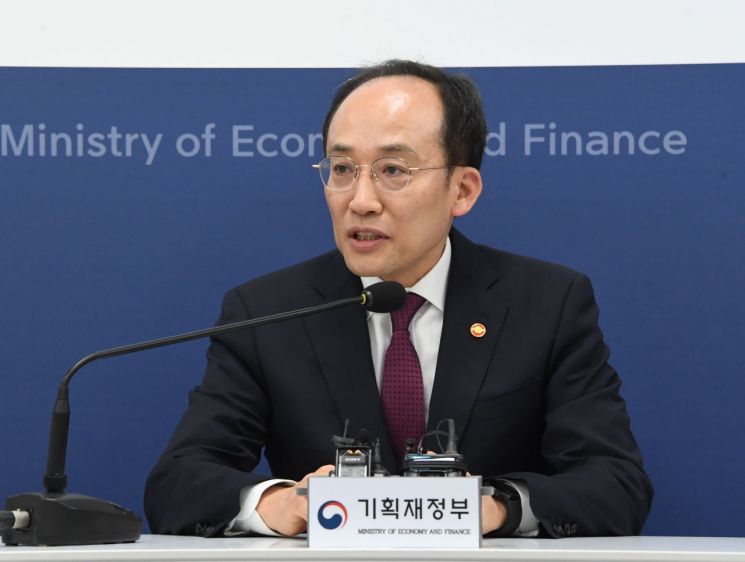 Deputy Prime Minister and Minister of Economy and Finance Choo Kyung-ho is answering questions at the Ministry of Economy and Finance press room in the Central Building of the Government Complex Sejong on the 9th.
Deputy Prime Minister and Minister of Economy and Finance Choo Kyung-ho maintained his previous stance that the economic conditions at home and abroad, although worse than expected, will follow a "low in the first half, high in the second half" trend. Regarding the somewhat pessimistic outlook that inflation may not be curbed as quickly as anticipated, he stated that inflation could fall to the 3% range.
On the 9th, Deputy Prime Minister Choo Kyung-ho responded to a question at a briefing held at the Ministry of Economy and Finance press room in Jungang-dong, asking, "Do you still think the 'low in the first half, high in the second half' trend is possible as expected?" by saying, "I still believe so." He explained, "Even if external conditions appear unfavorable, the overall global economic trend is 'low in the first half, high in the second half,' and this is not just the Ministry of Economy and Finance's view but also the official stance of leading domestic institutions and the International Monetary Fund (IMF)."
Currently, in the United States, concerns are rising that the Federal Reserve (Fed) may continue to raise interest rates contrary to plans due to higher-than-expected inflation. Fed Chair Jerome Powell also stated at a Senate hearing on the 8th (local time), "If faster tightening is needed based on overall indicators, we are prepared to accelerate the pace of rate hikes." Since the U.S. base interest rate hike is a factor that could worsen the economy, it may disrupt growth in the second half of the year.
However, Deputy Prime Minister Choo dismissed this by saying, "It is unclear how quickly and by how much Chair Powell will raise interest rates." He added, "Although inflation in the U.S. remains high and the labor market is still strong compared to initial expectations in January, uncertainty remains, so we will remain cautious, closely monitor the situation, and respond to various variables."
"Inflation Still High, But 3% Range Possible in Q2"
He also expressed a positive view on inflation forecasts. Deputy Prime Minister Choo said, "Inflation remains high, and the difficult situation for the people continues," but predicted, "Inflation in February recorded a decline to the 4% range, and I think the slowdown in inflation will continue for some time." He further predicted, "I think inflation will appear within a range not significantly different from the Bank of Korea's forecast, and in the second quarter, inflation could be much lower, possibly in the 3% range."
Regarding the domestic demand stimulation policy ordered by the Presidential Office, Deputy Prime Minister Choo said, "There is a recognition that consumption should be somewhat more activated because the livelihood field is difficult," but added, "It does not mean a major change in macroeconomic policy." This was a subtle rebuttal to concerns that the domestic demand stimulation policy might stimulate consumption and raise inflation again.
On the Semiconductor Special Act, which the government is promoting to increase the tax credit rate for semiconductor facility investment and to which the Democratic Party of Korea has indicated acceptance, he responded, "We will listen to the opposition party's opinions." Deputy Prime Minister Choo said, "We have not yet confirmed the exact level of the opposition party's plan and are seeking cooperation," adding, "If the opposition party takes a progressive stance to expand investment and discusses it, we will also take a progressive approach."
Regarding the recently rapidly rising exchange rate and foreign exchange market, he said, "It is difficult to find any special pattern unique to the Korean won," and stated, "The supply and demand measures for stabilizing the foreign exchange market, such as the swap arrangements between the National Pension Service and foreign exchange authorities last year, will continue to operate effectively."
© The Asia Business Daily(www.asiae.co.kr). All rights reserved.












