Research Team Led by Professor Son Seok-su of Korea University
Domestic researchers have developed an ultra-high-strength metal alloy method that can be used in extreme environments such as spacecraft and accelerators. This is a new way to simultaneously improve strength and ductility.
The National Research Foundation of Korea announced on the 9th that Professor Son Seok-su's research team at Korea University has secured technology to develop a novel ultra-high-strength maraging medium-entropy alloy that overcomes the conventional strength-ductility trade-off.
Maraging is a method that increases strength by maintaining rapidly cooled metal at a low temperature for a certain period to precipitate fine particles. It has high strength and excellent toughness, making it useful in various high value-added fields such as automotive, aerospace, space, defense, and tool materials. High/medium entropy alloys deviate from the traditional alloy design method based on a single type of element, with multiple elements acting as principal components, resulting in high mixing entropy and the ability to form single-phase solid solutions at high temperatures.
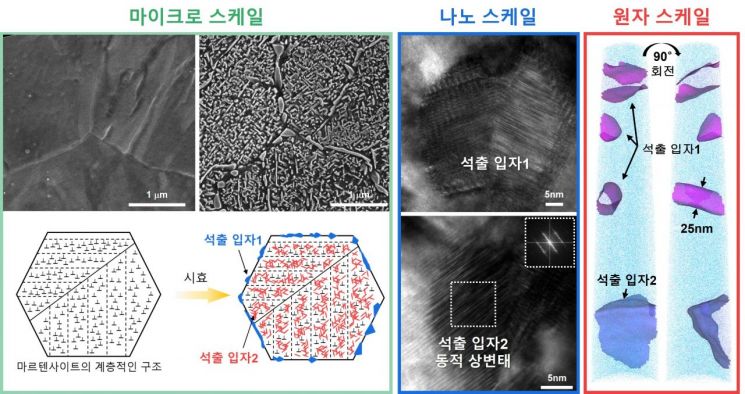
In typical ultra-high-strength alloy design, two strengthening methods are used together: rapidly cooling high-temperature metal to form a hard fine microstructure matrix (the phase that constitutes all or most of the material), and heat-treating the supersaturated elements formed by rapid cooling to generate particles. This method has a great effect on strength improvement but has the limitation of reduced ductility, lowering resistance to load.
Maraging alloys are representative alloys that use both strengthening mechanisms, making them very hard and tough. However, the interface between the matrix and particles is weak, so when a large external force is applied, stress concentrates at the interface leading to fracture, requiring precise design to overcome this.
The research team succeeded in developing a medium-entropy alloy that simultaneously secures ultra-high strength and ductility by departing from the traditional maraging design method and utilizing intermetallic compounds that undergo real-time structural changes during deformation as precipitated particles (a second phase precipitated from the supersaturated solid solution). By designing the hard intermetallic precipitate particles to undergo phase transformation through first-principles calculations and thermodynamic simulations, they relieved stress concentrated at the interface, preventing cracks while maintaining high strengthening effects. The medium-entropy metal material using real-time structurally changing metal compounds achieved a tensile strength of 2.1 GPa, comparable to ultra-high-strength steel sheets, and a uniform ductility of 4%, twice the limit ductility (2%) of commercial materials. Follow-up research plans include developing alloys that improve various functional properties such as corrosion resistance, electrical and magnetic properties, as well as mechanical properties under extreme environments like ultra-high and ultra-low temperatures.
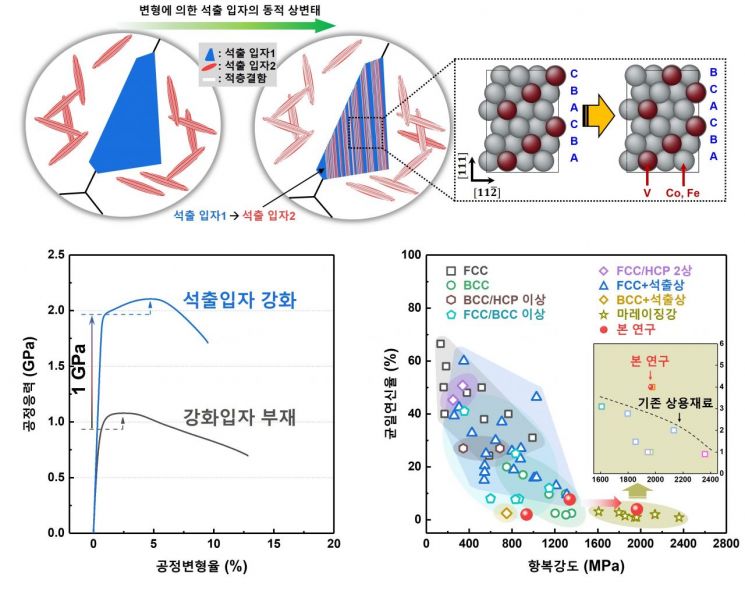
Professor Son said, “The significance lies in suggesting that strength improvement using precipitated particles in ultra-high-strength structural material development does not necessarily have to come at the cost of a significant reduction in ductility,” adding, “It is expected to be utilized for special purposes in advanced fields such as aerospace, space, and defense, which must withstand extreme loads and shocks in harsh environments.”
The research results were published on January 10 in the international journal Nature Communications.
© The Asia Business Daily(www.asiae.co.kr). All rights reserved.













