The Korea Bio Association announced on the 6th that it visited local European institutions, companies, and production facilities to proactively grasp the industrial policy trends of Europe, a leading country and the largest market in the white bio sector, and to establish a cooperative network. The visit, which took place from the 27th of last month to the 3rd of this month, was attended by government research and development (R&D) support agencies, companies, and experts related to white bio.
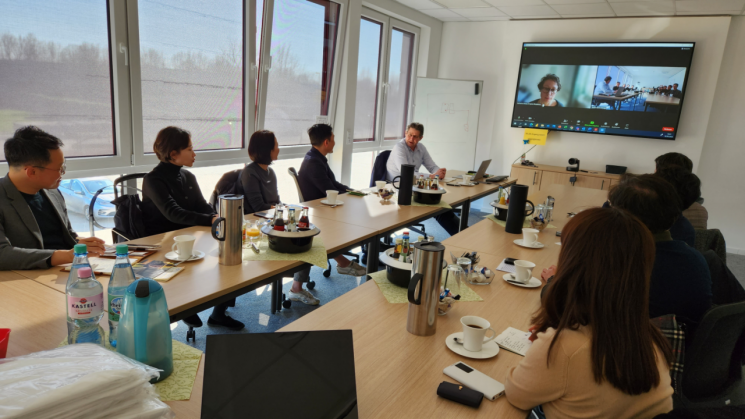 The Korean Bio Association delegation is visiting a German biotech company and holding a video conference with the European Bioplastics Association.
 [Photo by Korean Bio Association]
First, the delegation visited Biogas Zurich and AXPO in Switzerland, which produce renewable energy from waste through biological eco-friendly methods, to observe the production processes including waste input, sorting, and fermentation. They then visited the Korean Mission in Geneva to explain industry information on the characteristics of the bioplastic industry, European regulations, and testing and certification trends.
In Germany, they visited the headquarters factory of BASF, which produces bioplastics, and Biotec, a biodegradable plastic manufacturer. At this meeting, a video conference was held with representatives of the European Bioplastics Association, chaired by Barrot, CEO of Biotec and also president of the European Bioplastics Association. The meeting shared institutional trends regarding bioplastics, such as European single-use plastic regulatory guidelines and packaging regulations, as well as the industry's response directions.
In Belgium, through meetings with the Embassy of the Republic of Korea to the European Union in Belgium, the Korea Trade-Investment Promotion Agency (KOTRA) Brussels office, and law firms, they exchanged opinions on the impact of single-use plastic and packaging regulations on bioplastics, future procedures, and approaches domestic companies should consider when entering the European market. They also identified institutional trends that domestic companies should consider when entering Europe, such as greenwashing guidelines, deforestation laws, and supply chain ESG due diligence guidelines.
Oh Ki-hwan, head of the Industrial Policy Division at the Korea Bio Association, stated, "We examined whether various European policies on plastics, promoted within the broader framework of the European Green Deal and circular economy action plan, would act as opportunities or regulations for our companies." He evaluated, "We have established an information-sharing cooperative network with our government and related institutions located in Europe so that domestic bioplastic companies can proactively respond to European policies."
© The Asia Business Daily(www.asiae.co.kr). All rights reserved.












