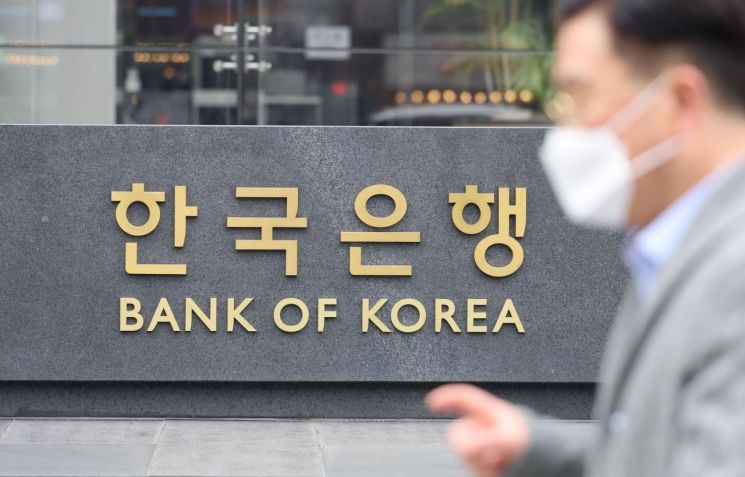
The Bank of Korea explained that the significant outflow of foreign bond investment funds, mainly from overseas public institutions, since December last year is not due to the interest rate differential between Korea and the United States.
On the 3rd, Son Seunghwa, head of the Capital Movement Analysis Team at the Bank of Korea's International Department, stated in a post titled "Background and Evaluation of Recent Foreign Bond Investment Fund Outflows" on the Bank of Korea blog, "Foreign bond investors decide on bond investments in a country by considering various factors such as the target country's interest rates, economic growth prospects, exchange rate expectations, arbitrage incentives, and global risk appetite."
According to the Bank of Korea, foreign bond funds showed large inflows in 2020?2021 and generally continued to show net inflows last year, but from December, they recorded a sharp net outflow. The net outflow amount expanded from $2.73 billion in December last year to $5.29 billion in January this year, marking the largest monthly outflow on record.
Because of this, some analyses suggested that the inversion of the Korea-US base interest rates influenced the bond fund outflows. Currently, Korea's base interest rate is 3.5%, while the US rate is between 4.50% and 4.75%, resulting in a 1.25 percentage point difference. If the US Federal Reserve (Fed) raises rates by 0.25 percentage points in March and May, the gap will widen further to a record 1.75 percentage points.
Regarding this, Son explained, "The Korea-US interest rate inversion has already occurred since July last year, and during this period, bond funds temporarily showed net outflows, but mainly private funds generally showed net inflows, and it was only in December that the outflow scale expanded." He added, "In the past, since 1999, even during periods of Korea-US interest rate inversion, bond funds generally showed net inflows."
He further noted, "The recent outflows of bond funds are mainly driven by the public sector, which is generally known to be medium- to long-term investors and less sensitive to short-term interest rate differentials."
In particular, foreigners showed significant net sales in the cash bond market but net purchases of even larger scale in the government bond futures market. Son said, "In January, expectations of a slowdown in the Fed's rate hike pace led to expectations of a decline in domestic bond yields, which appears to have significantly increased net purchases of government bond futures." He added, "This behavior of futures investors indicates that, in the short term, the future direction of interest rates is more important for bond investment than the current domestic-foreign interest rate differential."
Additionally, Son explained that due to the Fed's sharp policy rate hikes last year, the dollar strengthened, and global stock and bond prices fell significantly, causing major sovereign wealth funds to record large losses. To offset these losses, it is estimated that some of the bond investment funds in Korea were withdrawn. In some public institutions, it appears that portfolio adjustments at the beginning of the year also reflected China's reopening, leading to adjustments in country-specific investment proportions.
Moreover, as expectations for the end of the Fed's rate hikes strengthened, bond yields in Korea and several other countries fell, and currency values appreciated. This domestic bond yield decline (bond price increase) and won appreciation (increased returns when exchanging to dollars) may have increased profit-taking sales by bond investors with a high tendency for mid-term sales.
Son stated, "Since February, the outflow trend of overseas public institution bond funds has slowed, and private institution funds have turned to net inflows, significantly reducing the overall scale of bond fund outflows." He explained, "It seems that the portfolio adjustments by overseas public institutions at the beginning of the year are nearing completion, and some public and private institutions have resumed domestic bond investments."
© The Asia Business Daily(www.asiae.co.kr). All rights reserved.
















