"Price War Intensifies Due to Demand Collapse"
Deepening Gloom in the Global Shipping Industry
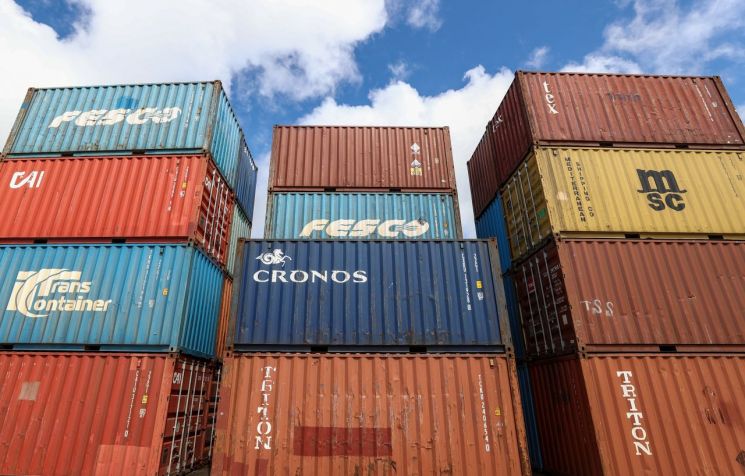
Port of Long Beach, California, USA. In the vast harbor, empty containers are stacked six layers high, stretching endlessly. Trucks that have ceased operation are densely parked from the terminal to the yard, and cranes and tractors with no cargo to move appear idle. Compared to three years ago, when over 100 vessels waited in line off the California coast during the early pandemic boom in shipping, the change is dramatic. A port worker said, "There used to be 16,000 registered truck drivers here, but now only 3,000 are working," adding, "This year looks like it will be the worst ever."
"No clever solution" Shipping companies halt operations amid recession
The global shipping industry is facing a deepening crisis due to a collapse in demand caused by a contraction in world trade volume. Intensified competition over freight rates amid declining maritime cargo volume is expected to bring about the worst shipping industry downturn ever this year. Maersk and MSC, the world's first and second largest shipping companies, have significantly reduced the number of scheduled voyages in the past three months. 35% of scheduled services on the Asia-West Coast US route and 20% on the Asia-Europe route have been canceled. The industry estimates that about 7% of global container shipping companies have suspended operations.
On the 2nd (local time), The Wall Street Journal (WSJ) reported that during crises such as the 2008 global financial crisis and the 2016 shipping industry restructuring, shipping companies responded by suspending operations. This is because it is considered more advantageous not to operate at all amid the endless plunge in freight rates. WSJ predicted that as the recession deepens and freight rates fall below the break-even point, a repeat of past crises?when maritime cargo volume and freight rates experienced prolonged declines, putting the entire shipping industry to the test of survival?will occur.
With inflation and recession deepening the consumption slump, inventories of US retailers are piling up. The National Retail Federation (NRF) estimated that US maritime import cargo volume in February decreased by 26% compared to the same month last year, and by 12% compared to the previous month. Vincent Clerc, CEO of Maersk, said, "Orders from US retailers dropped significantly in February," and predicted that "it will take at least 6 to 8 months for demand to recover." In a conference call on earnings released on the 8th of last month, CEO Clerc forecasted that profits would decline by about 80% this year due to weakening demand. MSC's CEO Soren Toft also expressed concerns about slowing performance at the annual shipping and logistics industry conference held last month in Long Beach, noting that "(US retailers') inventory levels remain high."
Alliance dissolution also hinders freight rate recovery... SCFI falls below 1000
The dissolution of the world's largest shipping alliance, '2M,' is also negative for the shipping market. The increase in supply and intensified competition caused by the alliance breakup leads to a vicious cycle of further freight rate declines.
With Maersk and MSC's shipping alliance 2M announcing their split in January 2025, it is expected that a domino effect of global shipping alliance dissolutions will follow, starting with 2M. Other major shipping alliances include 'Ocean Alliance,' composed of France's CMA CGM, China's COSCO, Taiwan's Evergreen, and Hong Kong's OCCL, and 'THE Alliance,' which includes South Korea's HMM. These alliances account for 75% of the global container transport market share.
The Shanghai Containerized Freight Index (SCFI), a global maritime freight rate indicator, fell below 1000 to 946.68 as of the 24th of last month. This is an 81% decrease compared to the record high of 5109.60 on January 7th last year. Lars Jensen, CEO of container transport consulting firm Vespucci Maritime, said, "The collapse in demand over the past five months means the price war has already begun."
Due to supply-demand imbalances giving shippers the upper hand in transport contracts, freight rate declines are expected to deepen this year. Large shippers have signed long-term freight contracts this year at rates about 35% cheaper than last year. Peter Sand, senior analyst at shipping data provider Xeneta, pointed out, "Shipping companies and large shippers usually negotiate freight rates on an annual basis, but due to continuous rate declines, contract periods have recently shortened to 2-3 months," adding, "Such short freight contracts are unprecedented."
© The Asia Business Daily(www.asiae.co.kr). All rights reserved.












