[Barcelona=Asia Economy Reporter Oh Su-yeon] Qualcomm showcased the ultra-high frequency (mmWave) 5G, known as '20 times faster 5G' and 'dream 5G,' at the Mobile World Congress (MWC) 2023 exhibition hall, allowing visitors to experience it. However, there was little difference in speed compared to the 5G service operating on the 3.5 GHz band in South Korea.
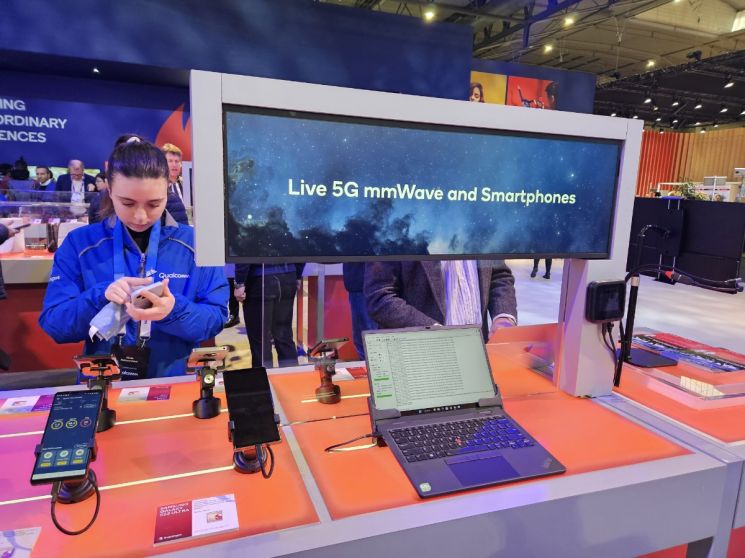
On the 27th (local time), I visited the Qualcomm booth at MWC 2023 held in Barcelona, Spain, to experience mmWave.
Although mmWave is called 'dream 5G' due to speeds up to about 20 times faster than LTE, it has a shorter reach and weaker diffraction compared to the 3.5 GHz band currently used nationwide in South Korea. It cannot pass through obstacles such as people standing in the middle. Domestically, the 28 GHz band is used, but due to these drawbacks, the three major telecom companies faced difficulties in utilization. Ultimately, SKT shortened the usage period, and KT and LG Uplus had their allocations canceled.
Qualcomm exhibited 22 devices equipped with its components supporting mmWave at the booth. However, as of that day, only one monitor in the center of the exhibition corner and two Sony Xperia 1 IV smartphones were actually connected to the mmWave frequency. The remaining 20 devices were not connected to wireless internet.
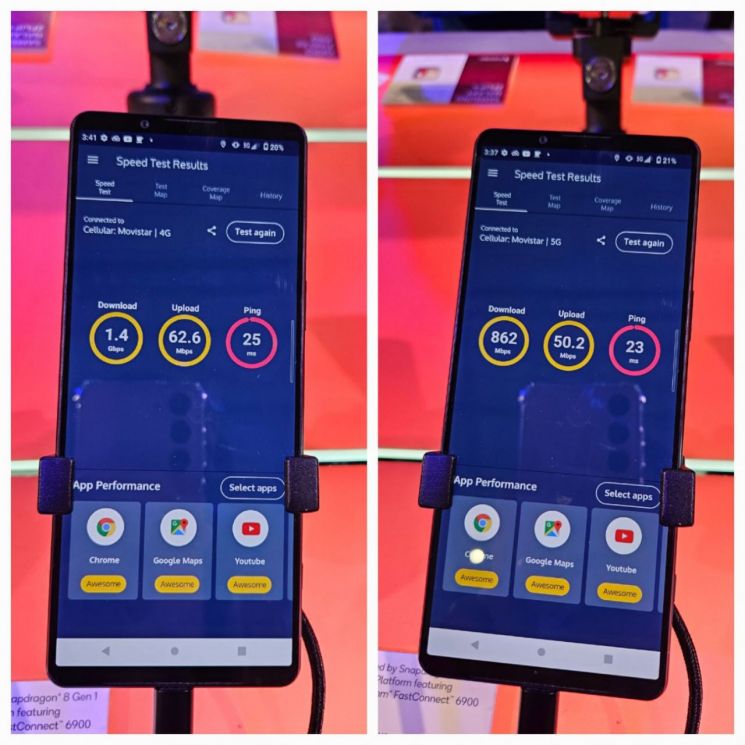
I tried using mmWave with the Sony smartphone. Speed could be measured through a speed test application (app). The fastest download speed recorded after several checks was 1.4 Gbps, while the slowest was only 862 Mbps. Upload speeds were relatively consistent, ranging from 50.2 to 62.6 Mbps. Apps requiring large data transfers, such as metaverse or virtual reality (VR), were not separately supported.
The speed is slower than 28 GHz but similar to the stable 3.5 GHz 5G speeds used by the three Korean telecom companies. According to the '2022 Communication Service Coverage and Quality Evaluation Results' announced by the Ministry of Science and ICT in December last year, the average 5G download speed of the three telecom companies was 896.10 Mbps. The fastest, SK Telecom, recorded 1002.27 Mbps.
When considering only the highest speeds, the gap narrows further. The top 30% average download speed of the three telecom companies is 1178.18 Mbps. The average highest download speed is 1557.41 Mbps. SKT recorded a peak of 1873.99 Mbps during the survey period last year.
This appears to be due to the characteristics of the 28 GHz frequency, which has a short reach and low diffraction. In the early days of 5G commercialization in 2020, U.S. telecom company Verizon recorded a download speed of 792.5 Mbps with mmWave in a global telecom market survey by Ookla, but the speed dropped to 67.07 Mbps, less than one-tenth, in the very next quarter. The quality was inconsistent until the introduction of the C-band (3.7?4.2 GHz).
However, this is explained as an incident that occurred during Telef?nica's process of securing the 26 GHz frequency and preparing for commercialization. Since they hurriedly provided the frequency for MWC without having started commercial service, there were limitations in the prepared devices and technology. Qualcomm stated that in demonstrations with U.S. Verizon, which commercialized mmWave early, speeds of up to 3?4 Gbps were recorded.
© The Asia Business Daily(www.asiae.co.kr). All rights reserved.

![Clutching a Stolen Dior Bag, Saying "I Hate Being Poor but Real"... The Grotesque Con of a "Human Knockoff" [Slate]](https://cwcontent.asiae.co.kr/asiaresize/183/2026021902243444107_1771435474.jpg)















