TV and Newspaper Ads for Two Weeks Since Last December
However, Resident Opposition Remains... Cesium Detected in Nongo Fish
[Asia Economy Reporter Jeon Jinyoung] A Japanese government official sparked controversy both inside and outside Japan by stating that the proportion of respondents in favor of the release of radioactive contaminated water into the ocean has increased due to advertising and promotional activities. It is known that the Japanese government is actively responding to critical articles and opinions regarding the contaminated water release by spending a huge budget.
According to the Fukushima Minyu Newspaper, a local media outlet in Fukushima, on the 14th, at a meeting related to Tokyo Electric Power Company's Fukushima Daiichi Nuclear Power Plant held on the 2nd in Iwaki City, Fukushima Prefecture, an official from the Ministry of Economy, Trade and Industry said, "The approval rate for the release of contaminated water has risen to 46% through advertising and promotional activities," adding, "There has been a certain effect in promotional activities aimed at fostering understanding."
According to the official, a nationwide internet survey commissioned by the Japanese government to a company in December last year showed that 46.0% of 3,600 respondents nationwide supported the release of contaminated water. This figure increased by 2.3 percentage points compared to the survey conducted in September last year before the promotional activities. Opposition dropped by 2.9 percentage points to 23.8%, while the "don't know" category increased by 0.6 percentage points to 30.2%.
 Promotional material for ALPS presented by the Ministry of Economy, Trade and Industry. It reads, "Let's all learn and think about ALPS treated water."
Separately, the Japanese government conducted the same survey on 1,200 residents of Fukushima Prefecture and 1,200 residents of nearby prefectures Iwate, Miyagi, and Ibaraki. Among them, the proportion of Fukushima Prefecture residents who expressed support increased by 5.0 percentage points to 50.9% compared to the September survey, while residents of Iwate, Miyagi, and Ibaraki prefectures showed a 2.8 percentage point increase to 49.3%.
The Japanese government has been conducting nationwide promotional activities since December 13 last year for two weeks under the slogan "We will inform the scientific safety of Fukushima contaminated water," placing TV and newspaper advertisements. Various types of advertisements were produced, including videos featuring Minister of Economy, Trade and Industry Nishimura Yasutoshi himself and animations.
The Japanese government allocated 30 billion yen (2.88 billion KRW) to the "Rumor Countermeasure Fund" to deal with baseless rumors related to the nuclear accident, and it is known that this fund was also used for the recent promotional expenses. In addition, the Japanese government is trying to erase the negative image by calling the contaminated water "treated water."
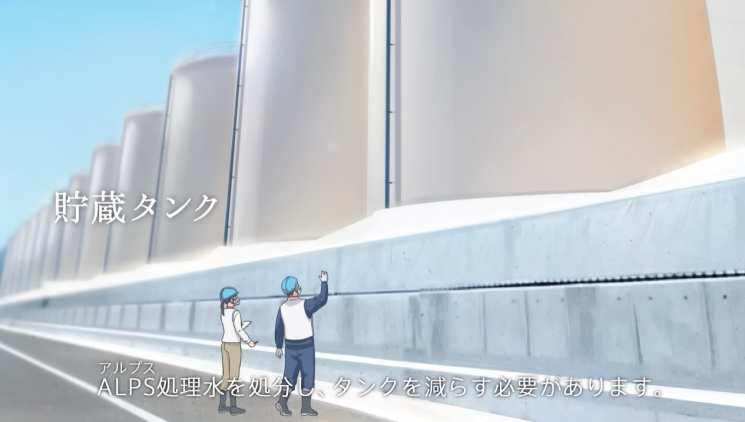 ALPS promotional animation by the Ministry of Economy, Trade and Industry. It explains the need for discharge due to the necessity of disposing of treated water and reducing the number of treated water storage tanks. (Photo by Ministry of Economy, Trade and Industry of Japan YouTube)
The TV advertisements aired by the Japanese government included lines such as "What is the Advanced Liquid Processing System (ALPS)?" "Is it really safe?" and "Is it okay to release it into the sea?" along with graphs explaining that the tritium concentration in the contaminated water is lower than international standards, thus safe. The slogan "Let's learn everything about ALPS treated water. Let's think about it" was displayed.
The Japanese government plans to dilute the contaminated water treated by ALPS with seawater in front of the nuclear power plant to reduce the concentration to less than 1,500 becquerels (Bq) per liter (ℓ), which is 1/40th of the national regulatory standard, before releasing it.
However, ahead of the contaminated water release, Tokyo Electric Power Company submitted a revised plan to the Nuclear Regulation Authority (NRA) of Japan, drastically reducing the number of evaluated radionuclides from 64 to 31, including tritium, raising ongoing safety concerns.
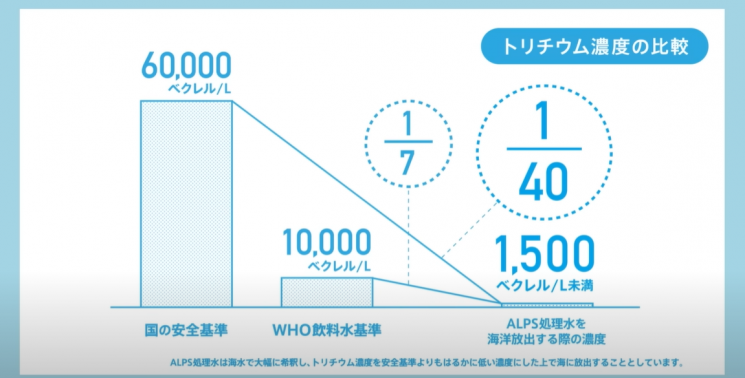 Part of the ALPS promotional video by the Ministry of Economy, Trade and Industry. It explains that the tritium concentration in the discharged contaminated water is 1/40 of the national safety standard and 1/7 of the WHO safety standard. (Photo by Ministry of Economy, Trade and Industry of Japan YouTube)
Contrary to the survey results, opposition continues within Japan. Last month, Hiroyuki Uchida, mayor of Iwaki City, Fukushima Prefecture, held a press conference and said, "The process is proceeding without the consent of local residents," adding, "Neither officials nor citizens can understand this. I oppose releasing it under these circumstances."
In 2015, Tokyo Electric Power Company promised not to dispose of contaminated water without the understanding of related parties such as the local fishermen's cooperative (Gyoren), but ultimately decided to release it, breaking that promise.
Additionally, the Japanese government announced plans to bury 10 tons of decontamination soil used to remove radioactive materials generated by the nuclear accident in the famous Tokyo tourist spot "Shinjuku Gyoen," cover it with other soil, and use it as a flower bed. In response, about 150 residents held a protest rally.
Recently, concerns have grown further due to issues with Fukushima seafood. On the 7th, the Fukushima fishermen's cooperative reported that cesium measuring 85.8 becquerels per kilogram was detected in sea bass caught in nearby waters, deciding to recall all sea bass caught in Fukushima Prefecture and to refrain from shipping sea bass.
© The Asia Business Daily(www.asiae.co.kr). All rights reserved.














