[Asia Economy Reporter Ryu Tae-min] This year, a 'Public Hanok Global Lounge' will be established in the Bukchon and Seochon Hanok Villages. Additionally, over the next 10 years, 10 Hanok villages will be created by utilizing damaged greenbelt areas and other restricted development zones within Seoul. The review criteria for Hanok construction will also be significantly relaxed or abolished, and incentive plans will be introduced to provide additional support of up to 20% of construction costs.
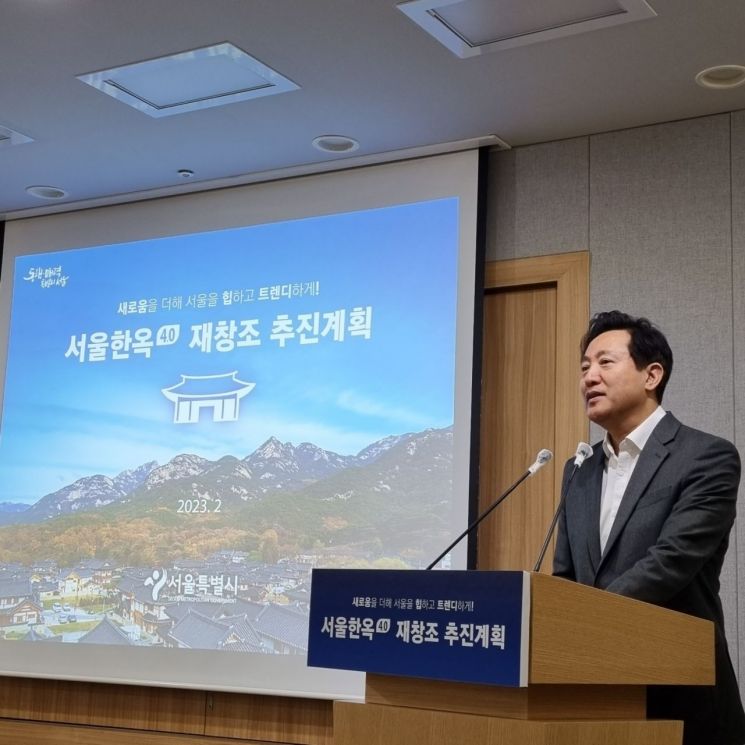 Seoul Mayor Oh Se-hoon is announcing the 'Seoul Hanok 4.0 Re-creation' plan on the morning of the 14th at Seoul City Hall in Jung-gu, Seoul.
 [Photo by Ryu Tae-min]
Seoul City announced on the 14th that it has established a long-term comprehensive plan for Hanok policy called ‘Seoul Hanok 4.0 Re-creation’ and will begin full-scale implementation this year. Following the urban Hanok villages in Bukchon, Seochon, and Eunpyeong, the city plans to create 10 additional Hanok villages in natural settings over the next decade. The plan targets small-scale Hanok complexes of more than 10 houses on leftover damaged greenbelt areas and park release zones ranging from 800 to 1000 pyeong in size.
Seoul Mayor Oh Se-hoon explained, “There are damaged greenbelt areas scattered throughout Seoul, but after a full survey, the total area is not large. Since these areas are linear, they have limitations as large-scale housing sites, so we judged that creating small-scale Hanok villages is appropriate.” He added, “We will proceed with public development through SH Corporation following procedures proposed by autonomous districts.”
Expanding the ‘Concept of Hanok’... Relaxing Review Criteria and Strengthening Incentives
‘Seoul Hanok 4.0 Re-creation’ is a policy aimed at enhancing Seoul’s urban competitiveness through Hanok. The main points include ▲expanding the concept of Hanok ▲relaxing review criteria ▲strengthening incentives.
First, to encourage creative Hanok designs, the concept of Hanok will be expanded. The traditional definition limited Hanok to ‘Hanok buildings,’ but now it will be extended to include ‘Hanok architectural styles’ and ‘Hanok design buildings’ that incorporate modern materials and technologies, supporting more diverse and distinctive Hanok creations. Furthermore, commercial Hanok buildings, which have been difficult to support for construction and repair until now, will be eligible for support under the ‘Hanok architectural style’ category if they meet only the minimum essential criteria, even if they combine modern structures and materials.
Review criteria will also be relaxed. Of the existing 73 items in the ‘Hanok Construction Review Criteria,’ 44 items will be either relaxed or abolished. Thirty-three criteria related to structure, windows, roof tiles, eaves length, yard upper structures, and yard height differences will be relaxed. Eleven criteria concerning furniture arrangement, window frames, gates, etc., will be abolished. To implement this, the cost support review criteria will be revised and immediately enforced by the end of this month. The city aims to amend related ordinances by July.
Incentives will be strengthened as well. Hanok that preserve traditional construction methods, spatial arrangements, Korean-style windows, wooden structures, street and roofscape will receive additional support of up to 20% of construction costs as incentives.
Actively Creating ‘Hanok Villages in Nature’... Also Establishing ‘Public Hanok Global Lounge’
The city formulated this plan because modern Hanok or contemporary architecture reinterpreting Hanok has recently emerged. Therefore, a policy shift and approach reflecting user convenience and preferences toward modern Hanok and Hanok design are necessary.
Seoul City stated that it collected opinions from experts and residents over the past year to revitalize modern Hanok. Accordingly, the plan reflects the need for ▲regulatory relaxation for creative design ▲discovery of Hanok value elements ▲landscape management and creation of new Hanok villages suited to regional characteristics ▲and the spread of Hanok and Korean residential culture.
Over the next 10 years, the city plans to create 10 Hanok villages within Seoul. New Hanok villages will expand beyond existing urban Hanok villages like Bukchon and Eunpyeong to areas currently lacking Hanok. The plan will utilize park release zones and damaged greenbelt areas through autonomous district competitions. The creation of Hanok villages will be promoted via public development led by SH Corporation, and construction support will also be provided for some public-purpose buildings such as nursing homes, senior facilities, and art museums.
This year, a ‘Public Hanok Global Lounge’ will be established in the Bukchon and Seochon Hanok Villages to allow foreign visitors to experience Hanok and residential culture. The Global Lounge will provide information related to Hanok and offer experiential programs such as tea ceremonies and pottery. It will also feature interior showrooms exhibiting Hanok furniture, lighting, and crafts.
Mayor Oh said, “Until now, the focus was on preventing the demolition of existing Hanok, which resulted in many inconvenient places. Going forward, we will relax strict standards for newly built Hanok and newly set criteria for internal structures and windows.” He added, “Even if it is not strictly Hanok, we will expand Hanok culture so that buildings with Hanok-inspired designs can blend into everyday life.”
© The Asia Business Daily(www.asiae.co.kr). All rights reserved.












