2023 ESG Trend Survey for Top 500 Companies by Revenue
[Asia Economy Reporter Han Yeju] The scale of ESG management is expected to expand compared to last year.
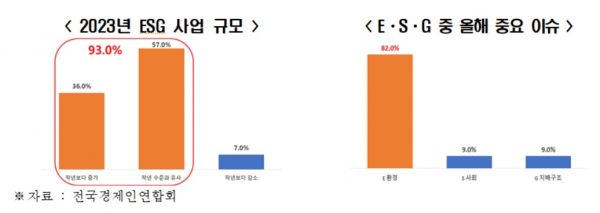
The Federation of Korean Industries (hereinafter FKI) commissioned the public opinion research firm Monoresearch to survey ESG practitioners at the top 500 companies by sales (100 companies responded) on the '2023 ESG Trends.' As a result, 93.0% of respondents said they would maintain the scale of ESG management at least at last year's level this year (57.0% similar to last year, 36.0% increased from last year, 7.0% decreased from last year).
FKI analyzed the background for the expansion of ESG business scale this year as the spread of global consensus to overcome the climate crisis and the establishment of an ESG management environment through business structure transformation.
Among E·S·G, the most important issue was E (Environment) at 82.0%. S (Social) and G (Governance) were each 9%. The top environmental issue this year was carbon emission reduction at 47.0%, followed by ▲transition to renewable energy 17.1%, ▲development of eco-friendly technologies 17.1%, ▲air and water pollution management 9.7%, and ▲activation of the circular economy 9.1%. It was found that companies have also established climate change response strategies and specific reduction targets to achieve the NDC 2030 greenhouse gas reduction goals. About half of the companies (48.0%) have established climate change response strategies, and 58.0% have set specific carbon reduction targets.
The main social issue was industrial accidents (safety and health management) at 31.1%. Next, labor-management relations (15.3%) and supply chain ESG risk management (14.4%) were cited as major social issues, followed by ▲human rights management (12.0%), ▲human resource management (9.1%), product and service quality management (6.7%), ▲diversity and inclusion (4.8%), and ▲community relations (4.3%) (others 2.3%).
One in two companies either implements or plans to implement ESG management for partners and supply chains (27.0% implementing, 29.0% planning). Regarding major supply chain ESG management contents, overall supply chain ESG management was 50.0%, environmental due diligence such as carbon emission management 27.6%, and human rights due diligence such as prohibition of forced labor 9.2%.
FKI expects that supply chain ESG management by companies will become even more important in the future, as Germany will mandate supply chain human rights due diligence starting this year and major global countries are expected to enforce supply chain ESG-related regulations.
Companies cited the diversification and sophistication of ESG-related regulations (35.4%) as the biggest difficulty in performing ESG management. Lack of ESG-related expertise such as professional personnel (21.7%) followed, and other issues included ▲increased burden of ESG evaluation (16.8%), ▲excessive cost consumption (15.5%), and ▲low business relevance (9.9%).
Regarding ESG support policies that the government and National Assembly should promote, strengthening capabilities to respond to global ESG regulations was 30.3%, followed by ▲training ESG professionals (27.0%), ▲expanding tax support such as tax reductions and deductions (24.3%), and ▲expanding financial support such as funding (17.8%).
Companies also expressed difficulties in responding to ESG evaluations. The biggest difficulty in responding to ESG evaluations was reduced predictability due to different evaluation results from each evaluation firm (56.0%), followed by difficulty in preparing for evaluations due to undisclosed evaluation factors (21.0%) and the burden of ESG consulting costs (17.0%). FKI diagnosed that this is because as the number of evaluation agencies increased, specific evaluation factors were not disclosed, and argued that disclosure of evaluation factors should be made to enhance companies' ability to respond to ESG evaluations.
Additionally, for support to activate ESG information disclosure, simplification and unification of domestic disclosure systems was the highest at 38.0%, followed by support for training disclosure professionals (32.0%) and granting grace periods for disclosure preparation (20.0%).
© The Asia Business Daily(www.asiae.co.kr). All rights reserved.












