Analysis of 12,521,553 Reported Cases
[Asia Economy Reporter Kiho Sung] The National Fire Agency announced on the 13th the analysis results of 12,521,553 nationwide 119 emergency call reports received last year.
The total number of reports increased by 445,998 cases (3.7%) compared to the previous year, and emergency calls to 119 in urgent situations have shown a steady increase over the past three years since 2020. Last year, the average daily number of 119 emergency calls was 34,305, which means the phone rang once every 2.6 seconds.
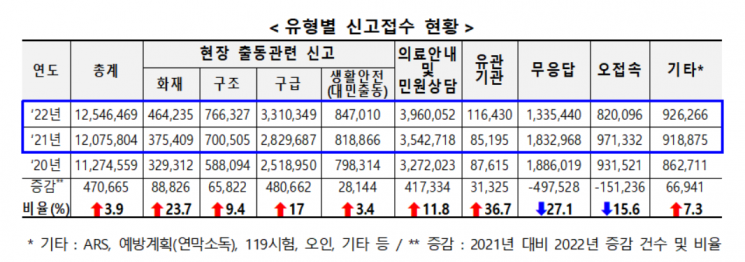
The types of reports included on-site dispatch, medical guidance and civil consultation, and requests for joint response with related agencies. Among the non-dispatch cases, the number of reports due to no response and misconnection decreased by 27.2% (no response) and 15.7% (misconnection) respectively compared to the previous year.
This is analyzed as the result of preventive measures such as 119 call reception agents making so-called ‘reverse calls’ to inform the reporters about 119 connection details and requesting their cooperation.
Additionally, reports received through joint response with related agencies increased by 36.7% compared to the previous year, showing the highest growth rate among report types. This reflects the growing importance of interdepartmental cooperative response for rapid and effective on-site action during various disasters and accidents.
Regarding on-site dispatch types, the numbers were ▲ambulance dispatch 3,302,106 cases ▲daily safety 844,037 cases ▲rescue dispatch 765,283 cases ▲fire dispatch 463,517 cases, confirming that one out of every four on-site dispatches was an ambulance dispatch.
Also, fire reports increased by about 23.5% (88,108 cases) compared to the previous year. This is analyzed as a result of last year’s weather characteristics with continued dry conditions increasing fire risks, and concentrated reports due to large-scale disasters such as forest fires.
By region, Daegu showed the largest increase in fire reports (51.5%), followed by Sejong (48.3%) and Gwangju (39.2%).
In particular, forest fire reports in Daegu increased more than fourfold compared to the previous year, which appears to have caused the significant rise in fire reports.
The month with the highest number of rescue and ambulance reports was August, with ▲ambulance 326,698 cases ▲rescue 140,011 cases concentrated in that month. This is analyzed as a result of record heavy rains in the central region causing a surge in safety-related reports such as rescue, drainage, and fallen street trees.
Furthermore, the easing of COVID-19 quarantine guidelines (such as social distancing) combined with the summer vacation season seems to have influenced the increase in outdoor and leisure activities that had been suppressed for two years.
Accordingly, the National Fire Agency is making efforts to secure budgets and personnel, such as expanding the number of call reception agents, to prepare for surges in reports like the heavy rains in August. In addition, in anticipation of a sharp increase in resident reports during natural disasters, the agency will activate an emergency reception system by increasing personnel in the 119 situation room through emergency mobilization and expanding the reception desks* that receive 119 calls.
Um Junwook, head of the National Fire Agency 119 Comprehensive Situation Room, stated, “We will enhance the call reception system and situation management functions to ensure that emergency dispatches are not delayed during disaster situations when 119 calls surge.” He added, “In particular, to prepare for large-scale disasters such as wildfires crossing city and provincial boundaries, we will strengthen joint responses to enable rapid communication and dispatch among related agencies.”
© The Asia Business Daily(www.asiae.co.kr). All rights reserved.












