Establishing Future Education Environment with Smart Device Distribution and Expanding Universal Educational Welfare
Lee Jeong-seon, Superintendent of City Education, "We Must Prepare for the Future with Diverse Education Suited to Children"
[Asia Economy Honam Reporting Headquarters, Reporter Yoon Jamin] Lee Jeongseon, Superintendent of Gwangju Metropolitan Office of Education, held a press conference on the 7th and stated that 2023 will be the inaugural year for realizing the goal of ‘Diverse Abilities as the Future of Gwangju Education.’
The superintendent emphasized, “Gwangju education must move beyond standardized education to diverse education tailored to children to prepare for the future society,” adding, “There is no value more precious than preparing for the children’s future.”
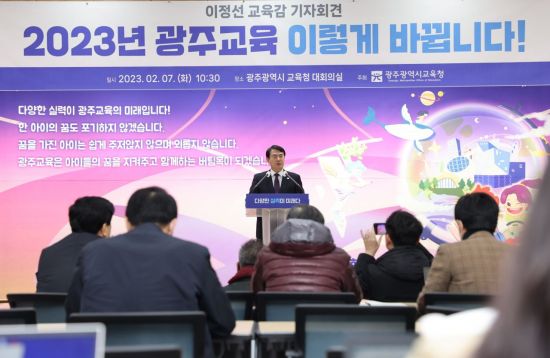
He then explained the changes in Gwangju education for the new semester of 2023, focusing on each school level.
First, kindergartens will support young children’s learning and healthy growth through expanded after-school programs and various support projects. Public kindergartens will support play instructors and operate play learning centers to extend operations until 7 p.m. during vacations.
Elementary schools aim to realize a high-quality educational environment through strengthening basic academic skills education and adapting to changed classroom environments. From the first semester of 2023, the number of students per class in the first grade has been set to 20.
Starting with the deployment of 68 basic academic skills teachers this year, one teacher will be assigned to each elementary school, and efforts will be made to strengthen basic academic skills through the operation of the Gwangju Basic Academic Skills Support Center.
Middle schools will support guaranteeing basic academic skills and improving abilities through the reorganization of the free semester system and resolving educational deficits. The free semester system will be operated in the first semester of the first grade to strengthen school-level transition education from elementary to middle school, and written exams will be conducted from the second semester of the first grade. Additionally, the ‘Bitgoeul Together Supplementary Curriculum Program,’ a Gwangju-type educational deficit resolution program, will be operated to ensure basic academic skills and improve abilities simultaneously.
The Metropolitan Office of Education will open an online school to fully prepare for the high school credit system starting in 2025. The online school is expected to play a central role in the Gwangju-type high school credit system, with a pilot operation beginning in March and official opening scheduled for September.
For general high schools, emphasis was placed on building customized learning environments and infrastructure to enhance students’ diverse abilities. A 365-study room operated by students will be installed, and a dedicated college admission director will be trained for each high school to establish an in-school college admission support system.
Vocational high schools plan to actively support students in realizing their dreams by enhancing competitiveness through gradual restructuring of departments and other projects.
Special schools will realize special education that supports students to stand on their own and live together.
The Metropolitan Office of Education also proposed measures to realize Gwangju-type future education. It will establish a future education environment through the distribution of smart devices, which are modern textbooks, and the construction of an AI factory. The number of AI and software education classes for elementary and middle school students will be increased, and the ‘Student Global Leader World Tour’ program will be operated to strengthen students’ internationalization capabilities.
Furthermore, universal educational welfare will be expanded. Following Superintendent Lee Jeongseon’s educational philosophy that “education must be a ladder of hope,” the plan is to gradually complete universal educational welfare so that all children can receive education equally without discrimination.
Support for graduation album fees has been newly established, field trip expenses for all students will be supported, and support for school trip expenses and entrance preparation fees has been expanded, increasing both the number of beneficiaries and the amount of support to reduce parents’ educational expenses.
Meanwhile, the Metropolitan Office of Education is preparing for an organizational restructuring effective March 1. By streamlining the headquarters and expanding the functions and personnel of the education support offices, the focus will be on supporting schools in the field. Additionally, a new Career and College Admission Division will be established to provide step-by-step customized career and college admission education.
The superintendent said, “Our Gwangju education is at an important moment, standing at the gateway to a leap forward as we prepare for the new school year in 2023,” and raised his voice, “2023 must be the inaugural year to achieve the goal of ‘Diverse Abilities as the Future of Gwangju Education.’”
He added, “We will not give up on any child’s dream. Gwangju education will protect children’s dreams and be a supporting pillar together.”
© The Asia Business Daily(www.asiae.co.kr). All rights reserved.












