The Bank of Korea Should Strengthen Its Strategy to Target Intermediate and Capital Goods Markets
[Asia Economy Reporter Seo So-jeong] As India has emerged as a production base replacing China after COVID-19, there is a suggestion that the government needs to actively support domestic companies entering India to adapt to local government regulations and an unfriendly business environment.
On the 5th, the Bank of Korea stated in its report titled "Current Status of the Indian Economy, Growth Potential, and Risk Assessment," published in Overseas Economic Focus, "India is emerging as a reflection of the reduced role of China in the global supply chain due to conflicts between Western countries and China-Russia."
According to the United Nations (UN), India is expected to surpass China this year to become the world's most populous country. In particular, amid US-China conflicts and the spread of COVID-19, there is a movement to diversify production bases to countries other than China, leading to an increase in companies expanding production within India.
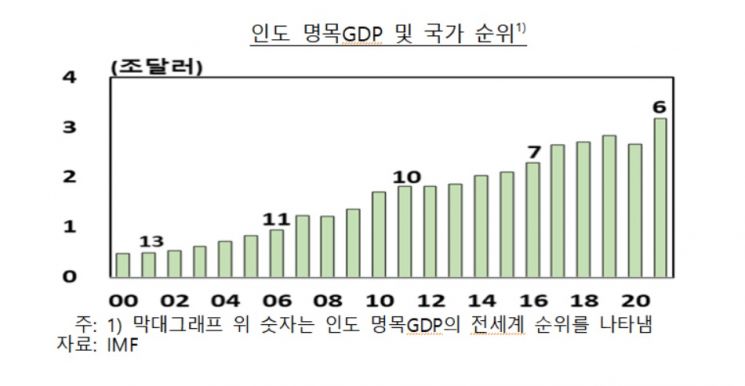
Since economic reforms in 1991, India has continued to grow and risen to become the world's 6th largest economy, with recent potential benefits highlighted as a production base replacing China. Considering demographic changes and the expanding role as a global production base, India’s economy is expected to maintain high growth in the mid to long term; however, environmental pollution and government regulations act as risk factors.
India experienced high growth rates in the early years of Prime Minister Modi’s administration (2014), but the momentum did not sustain. After COVID-19, relatively favorable results have been shown through active fiscal policies. However, during this process, the current account deficit has widened, and national debt has increased. In particular, growth rates have declined since 2017 due to a weak manufacturing base, side effects of currency reforms, and conflicts arising from Hindu-centric policies, with high inflation and high interest rates also constraining growth.
According to the report, India is strengthening security alliances with the West amid anti-China sentiment while actively participating in China-led multilateral organizations economically and maintaining friendly relations with Russia. Following military confrontations and border clashes with China (2017, 2020), India has enhanced military and security cooperation with the United States while actively engaging in China-led multilateral economic organizations.
Russia has been an ally supporting India in the India-Pakistan wars and Kashmir disputes, maintaining close ties in military and science and technology fields, while India has maintained a lukewarm stance on the Ukraine crisis.
The report analyzed, "India has high growth potential in the mid to long term, but risks such as environmental pollution persist, and an unfriendly business environment may act as a constraint for our companies’ entry." It added, "Since Western competitors have already entered and government regulations make the business environment worse compared to neighboring countries (China, ASEAN), this acts as an obstacle for our companies’ entry." It emphasized, "While strengthening the targeting of intermediate and capital goods markets, efforts should be made to diversify and upgrade consumer goods exports, and especially support measures are needed to help domestic companies in India adapt to local government regulations and an unfriendly business environment."
© The Asia Business Daily(www.asiae.co.kr). All rights reserved.












