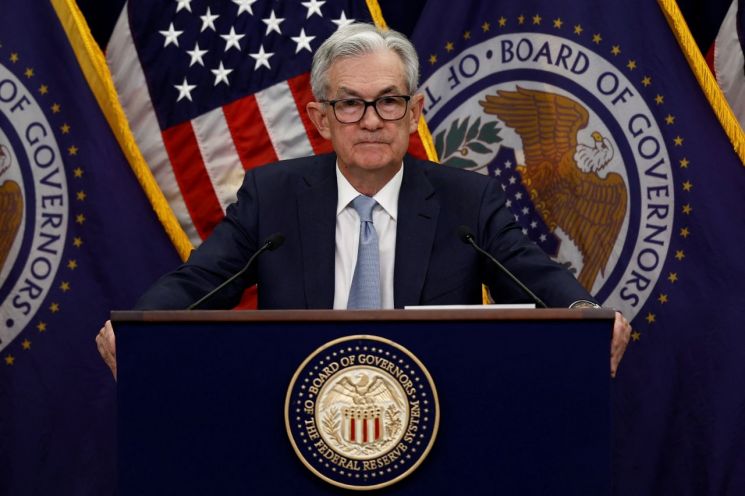
On the 2nd, the won-dollar exchange rate plummeted by more than 10 won. Although the U.S. Federal Reserve (Fed) raised the policy interest rate by 0.25 percentage points, the dollar weakened as Chairman Powell assessed that inflation had somewhat eased.
On that day, in the Seoul foreign exchange market, the won-dollar exchange rate opened at 1,220 won, down 11.3 won from the previous day's closing price. As of 9:30 a.m., it was trading in the low 1,220 won range. This is the lowest level in about 10 months since April 7 of last year (1,216.6 won).
The Fed raised the policy interest rate by 0.25 percentage points to 4.50?4.75% on the 1st (local time). At a press conference following the Federal Open Market Committee (FOMC) regular meeting, Chairman Powell said, "Inflation has recently eased but remains too high," and emphasized that tightening policies must be maintained to achieve the target inflation rate of 2%.
He further explained, "While recent developments are encouraging, much more evidence is needed to be confident that inflation is on a sustained downward path."
However, the market evaluated that the Fed's tightening monetary policy was nearing its end. The New York stock market narrowed its losses and then turned to an upward trend after the 0.25 percentage point rate hike was decided. The Nasdaq index, which is tech-stock heavy, rose by more than 2%.
Although the Fed emphasized that additional rate hikes would be appropriate, it stated that it would decide the future direction of monetary policy after reviewing the cumulative effects of past rate increases. Charlie Ripley, senior investment strategist at Allianz Investment Management, assessed that the U.S. rate hikes have now entered the final stage.
© The Asia Business Daily(www.asiae.co.kr). All rights reserved.












