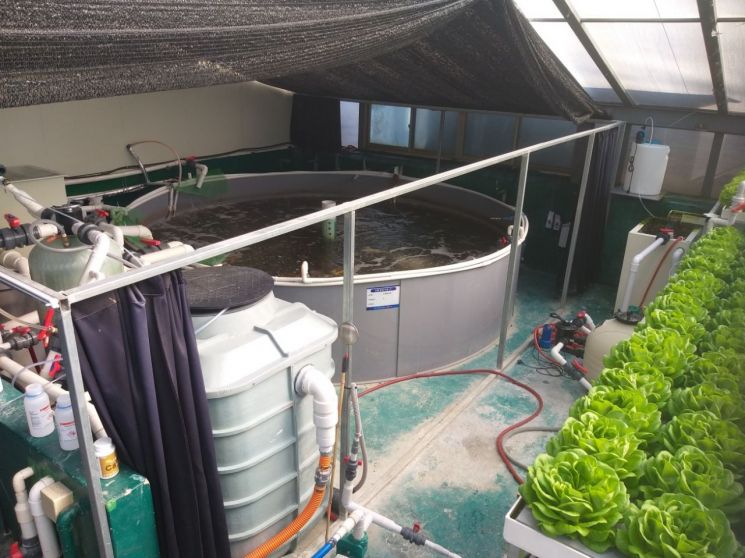
 Gyeonggi-do Marine and Fisheries Resources Research Institute will establish aquaponics pilot farms focused on fisheries in two locations, Gimpo and Icheon, this year and will begin pilot operations by next year. Photo by Gyeonggi-do Marine and Fisheries Resources Research Institute
[Asia Economy (Suwon) = Reporter Lee Young-gyu] The Gyeonggi-do Marine and Fisheries Resources Research Institute will install pilot aquaponics farms focused on fisheries in two locations, Gimpo and Icheon, this year and begin pilot operations by next year.
Aquaponics is a compound word of Aquaculture and Hydroponics, referring to a method of cultivating fish and crops together for harvest.
The organic matter generated while raising fish becomes nutrients for plants, and the plants purify the water quality, maintaining an environment suitable for fish farming.
The pilot farms to be installed this year are significant in that they represent fisheries-centered aquaponics, moving away from the existing agriculture-centered aquaponics.
Fisheries-centered aquaponics pilot farms refer to farms where fish sales are possible, but so far, domestic aquaponics production has focused on agriculture, mainly leafy vegetables, with no fish sales performance.
Accordingly, the institute decided to start pilot operations by adding hydroponic facilities to existing fish farms that have tank area and water quality management technology.
This approach allows the addition of hydroponic facilities at about one-fourth the cost compared to having separate tanks, achieving the original purpose of aquaponics installation: fish production and crop production.
Considering these factors, the institute called for applicants to participate in the operation of fisheries-centered aquaponics pilot farms targeting fish farms in the province last October.
As a result of the call, two locations were selected: Heungsin-dong Jagae Fish Farm in Gimpo City and Saengginara Farm Fish Farm in Icheon City, and on January 30 this year, agreements on pilot farm operations were signed.
Heungsin-dong Jagae Fish Farm will cultivate Dongjae fish, and Saengginara Farm will cultivate eels while challenging leafy vegetable production.
Meanwhile, the institute plans to apply a fish-centered system (DAS), developed for the first time in Korea last year to complement the existing agriculture-centered system (CAS), to this year’s pilot farming.
The agriculture-centered system (CAS) consists of a single circulation process that sends nutrient-rich water from fish to plants or vice versa. Since the same water is used, there is a limitation in that plants and fish must be farmed in a compromised environment. On the other hand, the fish production-centered system (DAS) collects pollutants produced by fish in a separate device before sending them to the plant cultivation area, mechanically or chemically treating the nutrients so that plants can utilize them well. Also, if productivity problems occur due to pathogens or other environmental factors, the systems can be controlled separately.
Kim Bong-hyun, director of the Gyeonggi-do Marine and Fisheries Resources Research Institute, said, "We will promote this pilot project to succeed so that fish farms in the province can gain opportunities to generate additional income not only through fish sales but also through crop harvests."
© The Asia Business Daily(www.asiae.co.kr). All rights reserved.












