PIF "Deadly for Pacific Island Nations"
Japan, "Plans to Start Discharge This Spring or Summer"
[Asia Economy Culture Intern Reporter Young] Pacific island countries urged the Japanese government, which plans to discharge contaminated water from the Fukushima nuclear power plant into the ocean this year, to postpone the discharge. This is due to concerns that the discharge of contaminated water into the ocean could have a significant adverse effect on the marine ecosystem. Earlier, Japan announced plans to discharge the water in spring or summer this year.
On the 19th (local time), according to Reuters, the Pacific Islands Forum (PIF) argued that Japan's plan to discharge nuclear contaminated water could greatly affect the tuna fishing grounds, which are the economic foundation of the Pacific island countries, and called for postponing the discharge plan. PIF is an organization consisting of 17 Pacific island countries including Fiji, Tuvalu, Solomon Islands, Tonga, Papua New Guinea, Palau, Marshall Islands, Cook Islands, Australia, and New Zealand.
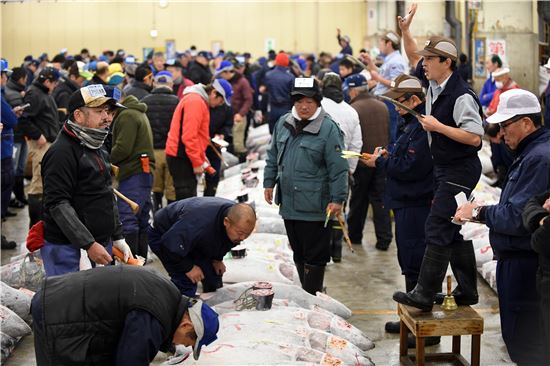 Participants are inspecting the condition of tuna at an auction held at the Tsukiji Market in Japan.
 [Photo by EPA Yonhap News]
Henry Puna, Secretary-General of PIF, said at a public meeting held in Fiji on the day, "Our position remains that there should be no discharge until all parties recognize it as safe." He added, "We must prevent actions that could bring about another nuclear contamination disaster," noting that Pacific island residents have endured long-term effects from past nuclear tests.
Spanish news agency EFE reported that after the meeting, PIF posted on social media (SNS) that "independent experts believe more data and information are needed to verify the safety of the (contaminated water)."
Meanwhile, on March 11, 2011, the Great East Japan Earthquake caused an explosion accident at the Fukushima Daiichi Nuclear Power Plant, resulting in large-scale contaminated water due to inflowing groundwater and rainwater. In response, the Japanese government decided to dilute the treated water purified by a multi-nuclide removal facility with seawater to lower the concentration of the radioactive substance tritium and discharge it, announcing that the planned discharge period would be spring or summer this year.
© The Asia Business Daily(www.asiae.co.kr). All rights reserved.











