[Asia Economy Reporters Bu Aeri and Yoo Jehoon] The amount involved in embezzlement and breach of trust incidents in the banking sector last year increased approximately sevenfold compared to the previous year. As embezzlement and breach of trust incidents repeatedly occur in commercial banks, criticism is mounting that banks need to improve their internal control systems.
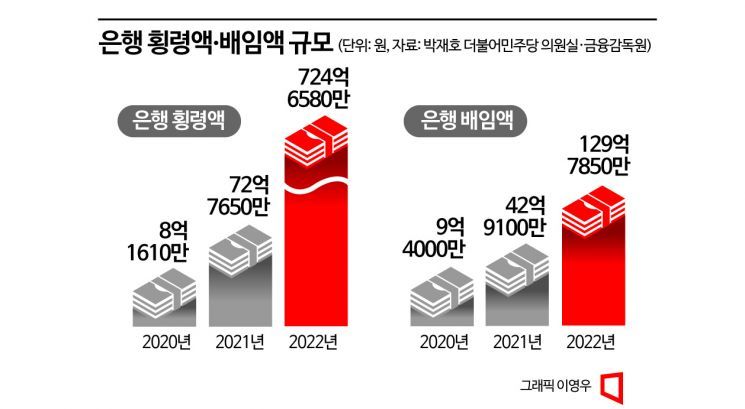
According to the Financial Supervisory Service's "Details of Embezzlement and Breach of Trust Incidents in the Banking Sector" obtained by Asia Economy on the 16th through the office of Park Jae-ho, a member of the National Assembly's Political Affairs Committee from the Democratic Party of Korea, the total amount of embezzlement and breach of trust incidents nationwide last year was 85.4443 billion KRW. This is an increase of 73.8768 billion KRW compared to 2021.
The scale of embezzlement last year was 72.4658 billion KRW, but the amount recovered was only 999.3 million KRW, resulting in a recovery rate of just 1.4%. Looking at individual banks, Woori Bank, which caused a stir last year, had the largest embezzlement amount at 70.13 billion KRW. In Woori Bank's case, the recovered amount was only 497.9 million KRW, with a recovery rate of about 0.7%.
Next was Busan Bank, where embezzlement incidents amounted to 1.4934 billion KRW last year, and Shinhan Bank also experienced embezzlement of 308 million KRW. Daegu Bank (206 million KRW), IBK Industrial Bank (160 million KRW), Hana Bank (115.4 million KRW), Kyongnam Bank (46 million KRW), and SC First Bank (14.2 million KRW) followed.
The amount related to breach of trust incidents in the banking sector last year was 12.9785 billion KRW. By bank, Kookmin Bank had the largest amount at 12.3785 billion KRW, and Hana Bank also experienced a breach of trust incident amounting to 600 million KRW.
In particular, over the past three years, the scale of embezzlement and breach of trust incidents has increased annually, confirming that such incidents within banks are becoming increasingly large-scale.
The scale of embezzlement in the banking sector increased from 816.1 million KRW in 2020 to 7.2765 billion KRW in 2021, and to 72.4658 billion KRW last year, with a nearly tenfold increase last year due to the impact of a 70 billion KRW embezzlement incident by a Woori Bank employee. The amount of breach of trust incidents increased from 940 million KRW in 2020 to 4.291 billion KRW in 2021, and to 12.9785 billion KRW last year. Notably, a 12 billion KRW breach of trust incident by a Kookmin Bank employee at the end of last year caused a public uproar.
Strengthening Internal Controls in the Banking Sector... Calls for Systematic Improvements by Financial Authorities
As embezzlement and breach of trust incidents continue, banks have also taken steps to strengthen internal controls.
Shinhan Bank established the 'Compliance Management Department,' an internal control control tower, through an organizational restructuring at the end of last year. Additionally, compliance monitoring personnel were deployed to regional headquarters to provide on-site, proactive control and prevent incidents at branches. Woori Bank, which was embroiled in controversy due to a 70 billion KRW embezzlement incident by a head office employee, also established a 'Head Office Audit Department.' This separated the audit function of the head office organization from the internal audit office, assigning it to conduct continuous audits.
However, since efforts by individual banks alone have limitations in preventing financial accidents, voices advocating for improvements in internal control systems are gaining strength. The Financial Services Commission has been conducting related discussions since last year by forming an 'Internal Control System Improvement Task Force (TF)' and plans to announce legislative proposals in the first quarter of this year.
The core of the TF discussions is to strengthen the accountability of financial company executives such as the Chief Executive Officer (CEO). For example, it proposes that the CEO be responsible for major financial accidents, while other general financial accidents be the responsibility of the relevant executives, thereby imposing management obligations. The plan also includes imposing supervisory duties related to internal controls on the board of directors.
A financial authority official stated, "Although internal controls have been strengthened for over 20 years, financial accidents, big and small, have not ceased. There may be problems with the attitudes of financial companies and employees toward accidents and organizational culture," adding, "To make internal controls more substantive, authority, performance, and responsibility must go hand in hand."
Calls for improvements directed at the Financial Supervisory Service and others have also emerged. Representative Park pointed out, "Strengthening internal controls in the banking sector is important, but it is also necessary to establish a system that can detect and manage these during the investigation and inspection processes of financial authorities to enhance preventive effects."
© The Asia Business Daily(www.asiae.co.kr). All rights reserved.












