KDCA Publishes In-Depth Report on Obesity
[Asia Economy Reporter Lee Gwan-ju] Over the past decade, the prevalence of obesity among adult men of all ages has increased by about 2%. In particular, the prevalence of stage 2 or higher obesity, classified as severe obesity, increased by 6%.
The Korea Disease Control and Prevention Agency (KDCA) announced on the 30th that it will publish the "In-depth Obesity Report Based on the National Health and Nutrition Examination Survey," which contains these findings, utilizing the results of the National Health and Nutrition Examination Survey.
The report includes an analysis of long-term trends and related factors of major obesity indicators among adults aged 19 and older since 2008, as well as changes before and after the COVID-19 pandemic. The report focuses on the prevalence of obesity (body mass index of 25 kg/m² or higher) and stage 2 or higher obesity (body mass index of 30 kg/m² or higher).
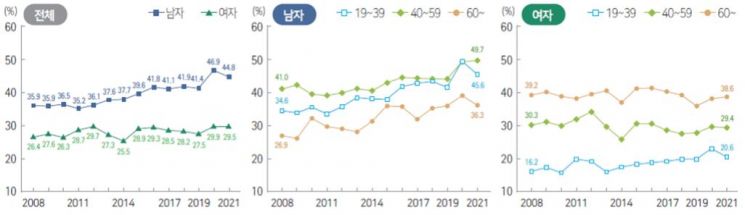
First, the prevalence of obesity among men increased from 35.9% in 2008 to 44.8% last year, rising by 2.1% annually. The prevalence of stage 2 or higher obesity increased from 4.1% to 7.6% during the same period, rising by 6.3% annually. Comparing the periods before (2018?2019) and after (2020?2021) the COVID-19 pandemic, obesity increased significantly among those aged 30?49, and stage 2 or higher obesity notably increased among those aged 40?49.
Common obesity-related factors across all ages included ▲high education level ▲office work ▲high-risk drinking. For those aged 19?39, smoking and lack of strength training were additional factors, while for those aged 40?59, lack of strength training, excessive fat intake, and sitting time (over 8 hours) were additionally associated with obesity.
Obesity among adult women showed little change compared to men. However, the prevalence of stage 2 or higher obesity increased by 3.1% annually since 2008. Particularly, among those aged 19?39, both obesity (increasing by 2.0% annually) and stage 2 or higher obesity (increasing by 10.3% annually since 2014) showed marked increases.
Obesity-related factors for women commonly included 'low education and income levels' across all ages, differing from men. For those aged 19?39, smoking was a factor; for those aged 40?59, high-risk drinking, lack of strength training, and poor dietary quality (dietary quality index); and for those aged 60 and older, lack of strength training and sitting time (over 8 hours) were additionally related to obesity.
Ji Young-mi, director of the KDCA, stated, "Obesity is a major risk factor for chronic diseases such as hypertension and diabetes," adding, "Since obesity-related factors differ between men and women, differentiated management measures considering these differences are necessary." She further emphasized, "Active interventions to improve health behaviors such as high-risk drinking, physical inactivity, and dietary imbalance are needed, targeting men in their 30s and 40s and women in their 20s and 30s, where obesity increases are particularly pronounced."
© The Asia Business Daily(www.asiae.co.kr). All rights reserved.













