Seoul Yakryeongsi Korean Medicine Museum to Hold Special Exhibition "100 Years of Haengnim Seowon" from the 27th to October 1 Next Year, Reexamining Haengnim Seowon and Founder Haengpa Lee Tae-ho, Introducing the History of Korean Medicine Development... Eunpyeong History Hanok Museum Special Exhibition "Hanok Gwanjo" Display
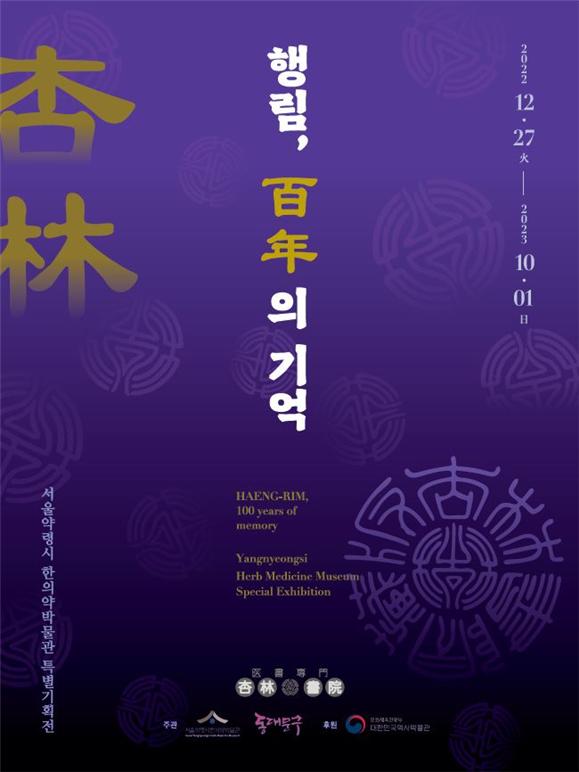
[Asia Economy Reporter Park Jong-il] Dongdaemun-gu (Mayor Lee Pil-hyung) Seoul Yakryeongsi Oriental Medicine Museum (Seoul Korean Medicine Promotion Center) is holding a special exhibition "Haengnim, Memories of a Hundred Years" from the 27th until October 1st next year at the 2nd floor special exhibition hall of the Seoul Korean Medicine Promotion Center.
This special exhibition "Haengnim, Memories of a Hundred Years" was planned to commemorate the 100th anniversary of Haengnim Seowon (杏林書院), a specialized publisher of Korean medicine books, and to re-examine the efforts and history of Haengnim Seowon and its founder Haengpa (杏坡) Lee Tae-ho (李泰浩) in spreading knowledge of Korean medicine.
Haengnim Seowon was established in 1923 in Anguk-dong, Jongno-gu, Seoul by Haengpa Lee Tae-ho, who contributed to the development of Korean medicine through publishing Korean medicine books. It served as a vital nourishment that breathed life into Korean medicine, which was at risk of disappearing under continuous Japanese oppression during the Japanese colonial period. It has maintained its legacy to this day and has greatly contributed to the flourishing of our traditional medicine in its current form as a specialized Korean medicine publishing company.
The special exhibition "Haengnim, Memories of a Hundred Years" offers a glimpse into the footsteps of Haengnim Seowon preserving and inheriting classical Korean medicine texts to the present day.
▲ The history of Haengnim Seowon by era and its founder Lee Tae-ho ▲ Haengnim Seowon during the Japanese colonial period ▲ Haengnim Seowon and Sambangchallyo ▲ The superiority of Donguihak (Oriental medicine) ▲ The practical and modern historical value of Haengnim books and medical texts, and the story of Haengnim Seowon that has carried on the meaning and history of traditional Korean medicine are all fully presented, providing visitors with an engaging experience.
The Seoul Yakryeongsi Oriental Medicine Museum collaborated with various experts for the special exhibition. Thanks to the advice and special contributions of Professor Kim Nam-il and Professor Cha Woong-seok from Kyung Hee University College of Korean Medicine, the exhibition contains more professional content.
Also, through the donation of materials by the current representative of Haengnim Seowon, Lee Jeong-ok, and collaboration with Yonsei University Dong-eun Oriental Medicine Museum, Heo Jun Museum, and Chunwondang Oriental Medicine Museum, the exhibition was able to be enriched with more abundant content.
A representative of the Seoul Yakryeongsi Oriental Medicine Museum said, "We hope this special exhibition prepared by the Seoul Yakryeongsi Oriental Medicine Museum will serve as a catalyst to remember Haengnim Seowon and Lee Tae-ho," and added, "We hope many people visit this exhibition reflecting on the history of Korean medicine and have a good time."
Eunpyeong-gu (Mayor Kim Mi-kyung) announced that it will hold a special exhibition "Hanok Gwanjo" at the Eunpyeong History Hanok Museum until March 19th next year.
"Hanok Gwanjo" (韓屋觀照) is a special exhibition where visitors can experience the beauty of hanok (traditional Korean houses) as seen by a carpenter through photographs and sculptures by Ban Gwang-cheon, a master carpenter ("Daemokjang").
"Daemokjang" refers to a master craftsman who oversees the entire process from design to construction of traditional hanok. It is designated as a National Intangible Cultural Heritage and is also registered as a UNESCO Intangible Cultural Heritage of Humanity. With an integrated perspective that delicately balances the process and harmonizes with the surrounding environment, the hanok built by a Daemokjang is regarded as a work of art beyond mere architecture.
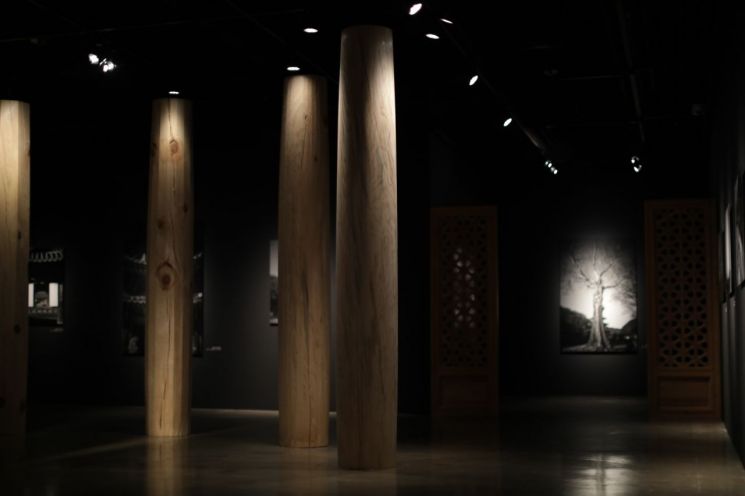
This exhibition was prepared to re-examine the traditional role of hanok craftsmen. It displays 23 black-and-white photographs maximizing the sculptural beauty of hanok, 12 pillars, traditional windows, and more.
At the center, a baehleulim pillar, considered the highlight of hanok architecture, is installed as an object. Five pillars representing the stages of baehleulim production (octagonal-16-sided-32-sided-baehleulim) vividly show the process of creating the elegant curves of hanok.
In the exhibition hall corridor, there is a special corner arranged as a timeline showing the birth of 20th-century urban hanok. It introduces Eunpyeong Hanok Village, the largest hanok complex built in the city after liberation, along with 21st-century modern hanok. New construction methods and materials used in Eunpyeong Hanok, such as lightweight tiles, 3D modeling work, and insulated walls, are exhibited as actual models.
At the corridor experience corner, visitors can try "Making a Gable Roof Hanok." Visitors can assemble a hanok model including the floor, walls, and windows, making it easy to understand the structure of hanok.
A representative of the Eunpyeong History Hanok Museum said, "We hope this new approach of a photo-object exhibition presented by a carpenter will serve as an opportunity to re-examine the beauty of hanok and the hidden role and insight of the craftsmen."
© The Asia Business Daily(www.asiae.co.kr). All rights reserved.













