More Emission Allowances Granted for Lower Greenhouse Gas Emissions
[Asia Economy Sejong=Reporter Kim Hyewon] The government will allocate more emission allowances to companies that own facilities emitting fewer greenhouse gases. Petrochemical companies producing products using low-carbon raw materials such as bio-naphtha will have their greenhouse gas reduction achievements recognized. The scope of measuring greenhouse gas reduction efficiency in the electronics industry, including semiconductors and displays, will be relaxed from 20% to 10% of total facilities annually, aligning with international standards. To activate the emission trading market and reduce price volatility, the scope and authority of market participants will be expanded by introducing securities firms' consignment trading.
On the 24th, Deputy Prime Minister and Minister of Economy and Finance Choo Kyung-ho held the first 'Emission Allowance Allocation Committee' since the launch of the Yoon Seok-yeol administration and announced the 'Emission Trading System Improvement Plan' with these details.
The emission trading system pre-allocates emission allowances, which are rights to emit greenhouse gases, to companies, allowing them to emit within that range. Companies can buy additional allowances if they lack them or sell surplus allowances in the market. Since its introduction in 2015, the system is currently in its third plan period (2021?2025), with 733 companies across 69 industries participating.
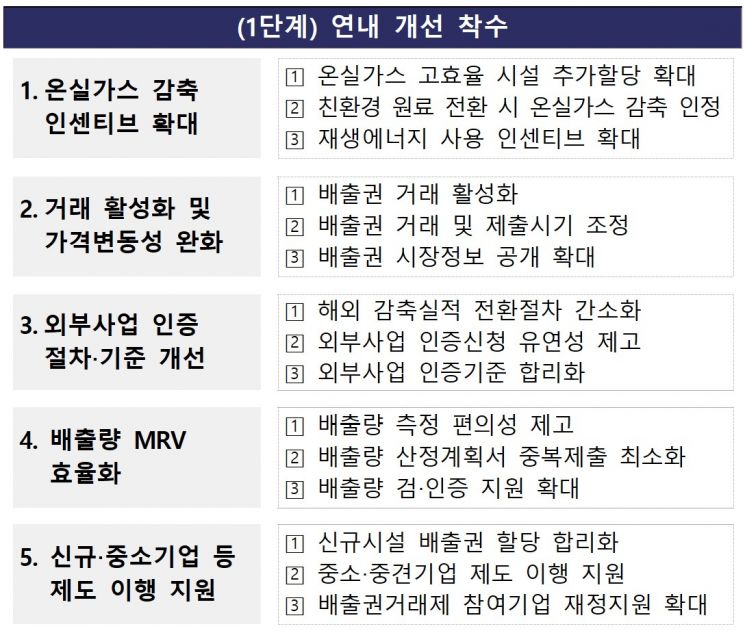
The improvement plan reflects a total of 78 improvement tasks collected from the industry after the Ministry of Environment launched the public-private 'Emission Trading System Advancement Council' in August to strengthen the effectiveness of the emission trading system, a key policy task of the new government.
In particular, this time, support measures were prepared focusing on 33 short-term tasks that can be improved immediately within the year, including inducing greenhouse gas reduction, activating the emission allowance market, reducing administrative burdens, and supporting mandatory compliance for new facilities.
When installing or expanding top-tier facilities that emit fewer greenhouse gases, more emission allowances will be allocated than before. This means that if a high-efficiency facility ranks within the top 10% in terms of the lowest greenhouse gas emissions per product produced in the industry, it will receive additional allowances. For new facilities, if emissions increase by 1.5 times or more compared to pre-allocated allowances (currently 2 times or more), additional allowances will be allocated. When acquiring and merging non-emission trading system companies, new business sites will also receive allowances. Companies whose greenhouse gas emissions increase by more than 50% but improve emission efficiency by more than 5% through replacing old facilities will also receive additional allowances.
Using low-carbon eco-friendly raw materials such as bio-naphtha to produce petrochemical products will also be recognized as greenhouse gas reduction achievements. Incentives will be provided to RE100 companies that expand recognition of greenhouse gas reductions by using electricity produced from renewable energy.
Beyond companies participating in the emission trading system, the scope of entities able to trade emission allowances, including financial institutions, will be expanded to individuals by 2025 ultimately. The intention is to induce reductions through market functions. Consignment trading by securities firms will be allowed to improve trading convenience, and various products such as futures trading will be developed to manage risks. The timing for companies with surplus allowances to sell and those lacking allowances to buy will be unified to August 10. The obligation to report calculation plans twice a year will be changed to once a year to reduce overlapping burdens.

For reduction achievements certified by the United Nations (UN) (CDM projects), the review items will be simplified when converting to offset emission allowances, and the review period will be shortened by simultaneous review by the competent authority and the Ministry of Environment. Although overseas reduction achievements before 2020 were required to apply for certification by this year, the deadline will be extended to the end of next year if there are justifiable delays such as COVID-19.
The scope of measuring greenhouse gas reduction efficiency in the electronics industry, including semiconductors and displays, will be relaxed from 20% to 10% of total facilities annually to align with international standards. Process test standards will also be established to allow the use of biomass stack automatic measurement methods (Tier 4) for waste incineration facilities.
From next year, a reduction roadmap by year and sector will be established based on the enhanced national greenhouse gas reduction target (NDC), and total allowable emissions will be set. The use limit and rollover restrictions of offset emission allowances, which the industry has continuously requested, will also be reviewed. Deputy Prime Minister Choo emphasized, "We will design policies considering the private sector to promote 'feasible carbon neutrality.'"
© The Asia Business Daily(www.asiae.co.kr). All rights reserved.













