The Bank of Korea Holds Final Monetary Policy Meeting This Year to Decide Base Rate
Baby Step Expected Considering Inflation and Financial Market Conditions
Growth Rate for Next Year May Be Revised Down from 2.1% to the 1% Range
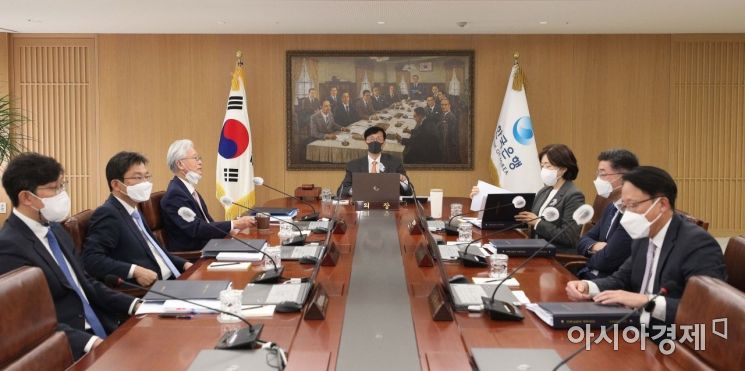 Lee Chang-yong, Governor of the Bank of Korea, is presiding over the regular Monetary Policy Committee meeting held on October 12 at the Bank of Korea in Jung-gu, Seoul. Photo by Joint Press Corps
On the morning of the 24th, the Monetary Policy Committee of the Bank of Korea will hold a meeting to decide whether to adjust the base interest rate and to set the domestic economic growth forecast. Market expectations suggest that the Bank of Korea will implement a 'baby step' (a 0.25 percentage point increase in the base interest rate) after comprehensively considering inflation trends and financial market conditions. There is also speculation that next year's growth rate may fall below 2%.
If the Monetary Policy Committee decides to raise the base rate by 0.25 percentage points at this final rate-setting meeting of the year, it will mark the first time that six consecutive increases have been made, following those in April, May, July, August, and October. Since August last year, the Bank of Korea has raised rates eight times, including two 'big steps' (0.50 percentage point increases), one of which was last month.
The U.S. Federal Reserve (Fed) has unusually implemented four consecutive 'giant steps' (0.75 percentage point increases), resulting in the interest rate gap between South Korea (3.00%) and the U.S. (3.75?4.00%) widening to a maximum of 1 percentage point. Although the Bank of Korea also faces an unavoidable steep rate hike, recent domestic inflation and the KRW-USD exchange rate have shown some stability, and the credit market is severely strained, limiting the scope for monetary policy maneuvering.
According to a recent survey conducted by the Korea Financial Investment Association targeting 100 bond market experts, 99 expect the base rate to be raised at the November Monetary Policy Committee meeting, with 7 anticipating a 0.25 percentage point increase. Since the U.S. October Consumer Price Index (CPI) increase was below expectations, there is also speculation that the Fed may slow its tightening pace, leading to analyses that the Bank of Korea does not need to implement another big step following October.
Attention is also focused on how divided the opinions of the seven Monetary Policy Committee members will be at this meeting. Last month, among the six members excluding the governor, four supported a big step, while two members (Joo Sang-young and Shin Sung-hwan) dissented in favor of a baby step. The dissenting members acknowledged that maintaining a tightening stance is desirable but expressed concerns that, considering the lag effect of monetary policy, domestic growth is expected to significantly slow down in the mid to late next year.
Interest also centers on the revised economic forecast to be announced alongside the base rate decision. In August, the Bank of Korea projected this year's growth rate at 2.6% and next year's at 2.1%. The consumer price inflation rate was forecasted at 5.2% for this year and 3.7% for next year. Experts expect the Bank of Korea to lower next year's economic growth forecast below 2%. International credit rating agency Fitch (1.9%), the Korea Development Institute (1.8%), and the Organisation for Economic Co-operation and Development (OECD) (1.8%) have already lowered their forecasts to the 1% range.
With inflation and high interest rates causing private consumption to slow, coupled with China's slowing growth and a downturn in the semiconductor industry, exports are also decelerating, making it difficult to maintain a growth rate of 2%. The escalating tensions between the U.S. and China and geopolitical uncertainties such as the Russia-Ukraine war are also burdensome to the Korean economy due to strengthened protectionism.
South Korea's economic growth rate has fallen below 2% only during the COVID-19 outbreak in 2020 (-0.7%), immediately after the global financial crisis in 2009 (0.8%), and during the International Monetary Fund (IMF) foreign exchange crisis in 1998 (-5.1%). While the market expects the Bank of Korea to present a growth forecast of 1.7?2.0% for next year, there is also speculation that the consumer price inflation forecast for next year may be slightly lowered.
© The Asia Business Daily(www.asiae.co.kr). All rights reserved.












