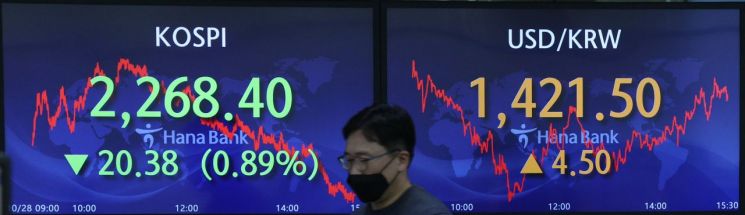
[Asia Economy Reporter Lee Seon-ae] This week, the domestic stock market is expected to attempt a technical rebound driven by expectations of a policy pivot by the U.S. Federal Reserve (Fed). However, securities firms advise that since there are no signs of a market bottom yet, it is appropriate to adopt a cautious stance with risk management rather than chasing purchases.
On the 30th, the securities industry projected the KOSPI band for this week (October 31 to November 4) to be between 2200 and 2340 points. Experts generally view this as just a moment to take a breather, with limited room for further gains. Although last week saw a successful rebound and the upward trend is likely to continue this week, it is not considered a trend reversal. Accordingly, cautious sentiment is expected to deepen ahead of the U.S. Federal Open Market Committee (FOMC) statement scheduled for November.
Kim Young-hwan, a researcher at NH Investment & Securities, said, "The recent stock market is judged to be in a technical rebound phase driven by expectations of a Fed pivot. Currently, the real economy is slowing due to Fed rate hikes, and credit risks are increasing. For this situation to resolve, there needs to be a bottom signal, such as an economic bottom being gauged or bankruptcies of marginal companies occurring and being managed."
Kim added, "However, since expectations of a Fed policy shift have risen without a bottom signal, it is more reasonable to view this as a technical rebound rather than a trend reversal. Generally, technical rebounds in the stock market recover about 50% of the previous decline. Considering the price drop from the August peak, the potential for further gains does not seem large, so risk management is more important than chasing purchases at this point."
Market participants are expected to adopt a wait-and-see attitude ahead of the November FOMC scheduled for 3 a.m. on November 3 (Korean time). If there is mention of a pace adjustment, the market rebound is expected to continue, with a possibility of a short-term overshoot.
Lee Kyung-min, head of the investment strategy team at Daishin Securities, said, "After the November FOMC meeting, changes in the probability of a rate hike at the December FOMC will determine the short-term direction of global financial and stock markets. Attention will focus on whether the probability of a 50 basis point rate hike increases as the pace adjustment issue is formalized, and whether the currently low 8% probability of a 25 basis point hike rises."
Lee added, "In this case, short-term economic data weakness and visible rate hike pace adjustments will lead to a technical rebound and a dead cat bounce in global markets including the KOSPI. The KOSPI is likely to fluctuate within a box range of 2200 to 2300 points, with 2300 points acting as resistance. Rapid sector rotation is expected during this process, but chasing purchases remains burdensome."
Han Jae-hyuk, a researcher at Hana Securities, also said, "If economic indicators do not significantly deviate from market expectations before the FOMC, the market shock related to tightening concerns may be limited due to stronger-than-expected market optimism. However, while investor sentiment may temporarily improve, fundamental issues remain unresolved. From a big-picture perspective, downward pressure will persist, so buying with a long-term investment horizon carries high risk. Given that macro issues are temporarily subdued until the FOMC, short-term trading strategies will be effective."
An Ye-ha, a researcher at Kiwoom Securities, said, "Amid the recent sharp rise in global policy rates, concerns about liquidity tightening have frequently emerged, leading to expectations of a rate hike pace adjustment. Although the possibility of a pace adjustment at the December FOMC is highlighted, uncertainty about the final rate level remains high," recommending a conservative investment strategy.
Additionally, concerns about liquidity tightening in the financial sector are analyzed as a factor that could limit the upside of the KOSPI. According to the Financial Supervisory Service, corporate bond issuance last month was 16.4 trillion won, down 20% from the previous month. This is attributed to companies hesitating to issue bonds as yields on high-grade corporate bonds (AA-rated, 3-year) surged from the mid-2% range at the beginning of the year to the 5% range.
Kim Young-hwan of NH Investment & Securities said, "The aftermath of the unpaid incident in Gangwon Province has expanded beyond project financing (PF) asset-backed commercial paper (ABCP) refinancing issues to negatively affect high-grade commercial paper (CP) procurement, raising concerns about short-term liquidity tightening. From the stock market perspective, increased corporate financing costs and ongoing liquidity tightening risks could act as burdens."
© The Asia Business Daily(www.asiae.co.kr). All rights reserved.












