Incidents of Peeping or Breaking into Homes of Women Living Alone Continue
Prevention with 'CPTED' by Applying Special Fluorescent Materials on Pipes or Painting Murals
 Recently, incidents of trespassing by climbing over walls and pipes have been occurring repeatedly. Photo by Yonhap News
[Asia Economy Culture Young Intern Reporter] Crimes of secretly peeping into or entering homes targeting female households continue unabated.
On the 11th, a post appeared on an online community describing how a man climbed over a wall and secretly peeped through a bathroom window, which was confirmed through closed-circuit television (CCTV). The victim, Ms. A, said in the post, "The window screen seemed a bit torn and I felt some movement," so she checked the CCTV again and saw a man climbing the wall and looking into my house," she said.
Ms. A's house is on the first floor but elevated by half a flight of stairs, making it difficult to see inside from outside unless one is taller than 2 meters. The man reportedly claimed during police investigation that "he was drunk."
Secretly peeping into homes can lead to further crimes. On May 10th at dawn, in a densely populated one-room area in Sejong, a man in his 20s peeped at a woman through a window and eventually broke into the house and sexually assaulted her. The man had committed similar crimes before and was sentenced to eight years in prison.
Last month, a man in his 50s, a team leader-level public official at Mapo-gu Office in Seoul, broke into a multi-family house in Bukgajwa-dong, Seodaemun-gu, Seoul, and attempted to molest the victim. The man was found to have climbed over the wall and then entered the victim’s house secretly through the bathroom window.
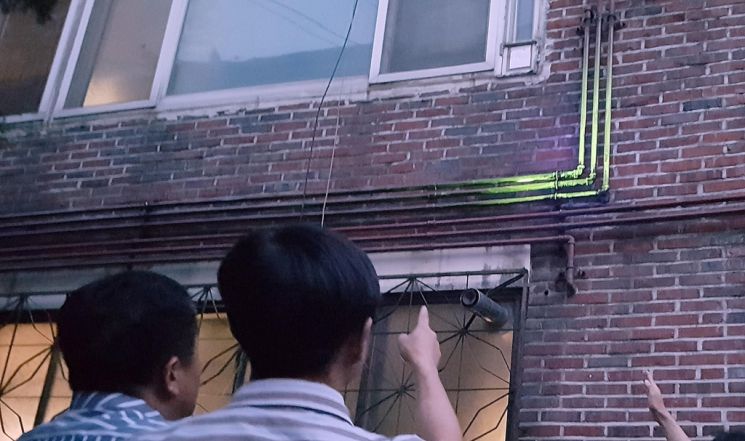
There are also cases of breaking in by climbing gas pipes. Last month in Jinju, Gyeongnam, a man in his 20s was caught by police after climbing gas pipes to break into his ex-girlfriend’s house. The man had been subject to a court-issued restraining order but violated it and stalked her using a location-tracking application.
In Yeongdeungpo, Seoul, a man was charged with attempting to break into his ex-partner’s house by climbing over the wall. A nearby resident who saw him climbing over the wall reported it, and the police arrested him on the spot. This man had also been previously charged for visiting his ex daily for two weeks in May, knocking on the front door, installing a dummy phone on the window frame, and recording audio. Despite receiving a written warning and a temporary order prohibiting him from approaching within 100 meters, he ignored it and attempted to break in.
As incidents of breaking into homes using walls and pipes occur frequently, residents say, "The home, which should be comfortable, has become uncomfortable." One netizen expressed frustration, saying, "I experienced and caught someone during my university days, but there is no way to stop it," adding, "Unless they enter through the window, the crime of breaking and entering is not established."
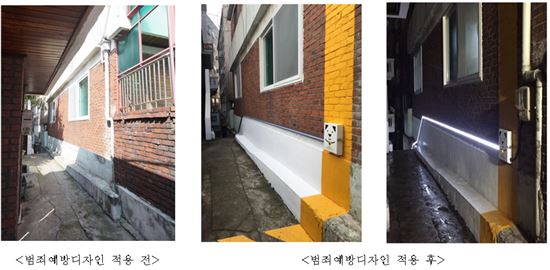 Crime Prevention Design in Gasan-dong, Geumcheon-gu. Photo by Seoul City
In response, crime prevention activities using walls have emerged. Daedeok-gu, Daejeon, applied special fluorescent substances to 235 households to prevent residential intrusion crimes. This is part of a project selected in the 'Community Policing Policy' contest, where special fluorescent substances that preserve traces of intruders and facilitate tracking are applied to walls, gas pipes, and other residential intrusion routes. It is also expected to deter criminal psychology and prevent intrusion crimes.
So-called 'CPTED' activities are also underway, such as painting murals on walls in high-crime areas to change the aging environment and reduce crime rates. CPTED (Crime Prevention Through Environmental Design) is a technique that changes urban environments to prevent crime and reduce residents’ anxiety.
Experts agree that while preventing crime is important, "the priority should be considering that victims continue to live in fear or are exposed to danger." They also emphasize that since residential intrusion, a form of stalking crime with concerns about recidivism or retaliation, occurs frequently, measures to prevent further harm and fundamental alternatives to address the dismissal of arrest warrants and stalking must be developed.
© The Asia Business Daily(www.asiae.co.kr). All rights reserved.