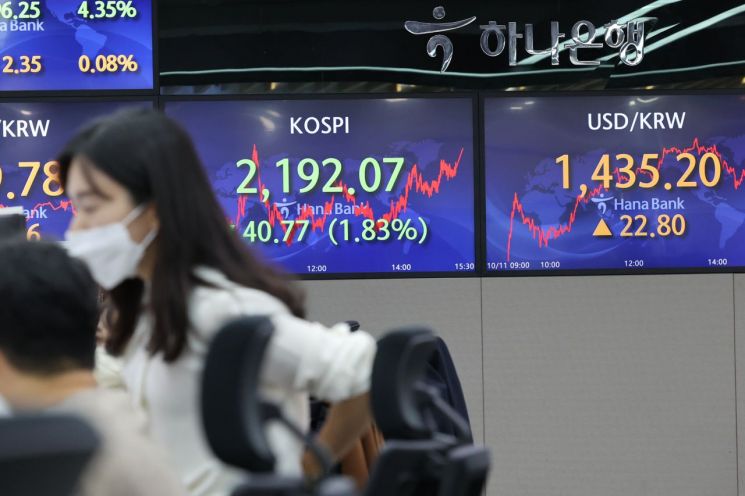
[Asia Economy Reporter Seo So-jeong] Due to the tightening measures by major countries and the geopolitical risks in Europe, foreign investors withdrew over $2.2 billion from domestic stocks and bonds.
According to the "International Finance and Foreign Exchange Market Trends" released by the Bank of Korea on the 13th, foreign investment funds in domestic stocks recorded a net outflow of $1.65 billion in September. Based on the won-dollar exchange rate at the end of September (1,430.2 won), this amounts to approximately 2.3598 trillion won. In August, foreign stock investment funds showed net inflows for the second consecutive month ($3.02 billion), but this month they reverted to net outflows.
Foreign bond investment funds also saw a net outflow of $640 million. Although the net outflow trend continued from August, the scale of outflows decreased.
The total foreign securities investment funds, combining stocks and bonds, recorded a net outflow of $2.29 billion.
The credit default swap (CDS) premium for Korean government bonds (based on the 5-year foreign exchange stabilization fund bonds) turned upward last month, averaging 40 basis points (1bp = 0.01 percentage points). CDS is a type of financial derivative that acts as insurance to compensate for losses if the issuing country or company defaults. Generally, if the economic risk of the country increases, the premium also rises.
Since last month, stock prices in advanced countries have fallen sharply. In the United States, the Federal Reserve (Fed) implemented a giant step (0.75 percentage point hike), and stocks declined due to poor corporate earnings forecasts and concerns about economic slowdown. In Japan, stock prices fell as foreign stock investment funds withdrew $20.99 billion in September amid a global decline in investor sentiment.
Emerging market stock prices also generally declined. China fell due to COVID-19 lockdowns, and Russia declined due to worsening conditions in the Ukraine conflict. On the other hand, T?rkiye rose due to increased stock investments for inflation hedging purposes, and Brazil rose on expectations of market-friendly pledges from a leading presidential candidate.
The US dollar strengthened due to increased expectations of Fed rate hikes. The Japanese yen weakened despite dollar-selling interventions for the first time in 24 years, as the Bank of Japan maintained its accommodative monetary policy. The British pound showed significant volatility following the new government's announcement of a large-scale tax cut plan and weakened amid recession concerns. The Chinese yuan also weakened due to concerns about economic slowdown and uncertainty over future economic policy directions.
The daily average fluctuation of the won-dollar exchange rate last month was 8.7 won, larger than August's 6.2 won.
© The Asia Business Daily(www.asiae.co.kr). All rights reserved.












