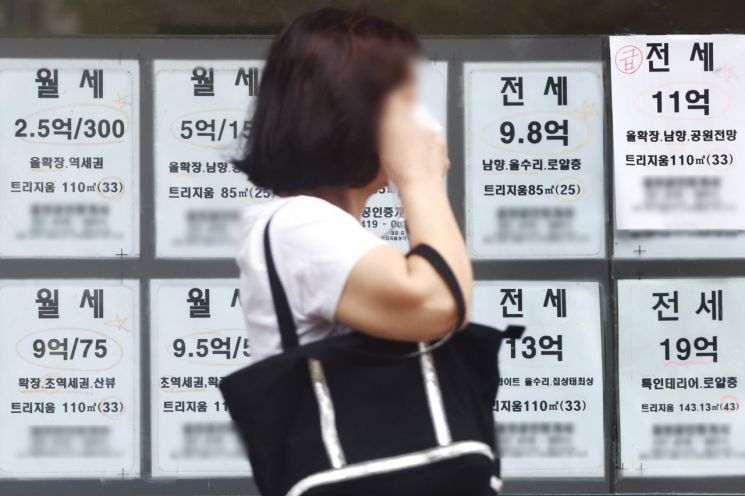
[Asia Economy Reporter Kim Min-young] As the burden of interest on jeonse loan payments increases due to interest rate hikes, more tenants are preferring monthly rent. With the preference for monthly rent becoming more pronounced, the burden on monthly rent tenants is also growing. This is because, unlike the jeonse sales market, monthly rents are rising while loan interest payments increase due to the interest rate hikes.
According to data submitted by the Korea Real Estate Board to Lee Jong-bae, a member of the National Assembly Land, Infrastructure and Transport Committee from the People Power Party, the monthly rent supply-demand index for Seoul apartments exceeded 100 for the first time this year, reaching 100.1 in August. In contrast, the jeonse supply-demand index for Seoul apartments has been declining, with 94.2 in June, 91.3 in July, and 87.7 in August.
The jeonse and monthly rent supply-demand index indicates that when the value is below the baseline of 100, there are more landlords offering rental properties than tenants seeking them, and when it is above 100, there are more tenants than landlords.
The increase in loan interest burdens due to interest rate hikes is interpreted as causing more tenants to switch from jeonse to monthly rent. As the jeonse-to-monthly rent conversion rate, which is the monthly conversion rate applied when converting jeonse deposits to monthly rent, rose to 4.26% in July, tenants are also preferring to switch to monthly rent. In fact, the proportion of monthly rent has exceeded half this year. In August, the number of monthly rent contracts with confirmed dates nationwide was 119,536, accounting for 52% of all jeonse and monthly rent transactions.
With high demand, monthly rents are also rising. The KB Real Estate Seoul apartment monthly rent index reached 103.9 in August, marking the highest level since the statistics began in December 2015. The integrated monthly rent price index for August was also 101.8, up 1.5 points from 100.3 in the same period last year.
Among types of monthly rent, the pure monthly rent, which has a relatively low deposit, shows a clear upward trend. For Seoul apartments, pure monthly rent, where the deposit is less than 12 months of rent, rose by 0.26% in August, while quasi-monthly rent (deposit between 12 and 240 months of rent) increased by 0.2%. Quasi-jeonse (deposit exceeding 240 months of rent) fell by 0.03%. By region, the pure monthly rent increase rate was highest in the northeastern areas of Seoul, including Gangbuk, Dongdaemun, and Seongbuk, at 0.45%.
Assemblyman Lee Jong-bae said, "As the preference for monthly rent continues due to interest rate hikes, the risk of reverse jeonse crises and monthly rent refugees emerging as social problems has increased," adding, "It is necessary to revise systems such as the contract renewal request right and the jeonse and monthly rent price ceiling, which were introduced during the Moon Jae-in administration and interfered with market price adjustment functions, to minimize tenant damages."
© The Asia Business Daily(www.asiae.co.kr). All rights reserved.












