Rapid Spread of Influenza in Infants and Toddlers
Dominant Strain 'A-type H3N2' with High Virulence
National Flu Vaccination Started Last Month
Experts Urge "Get Your Flu Vaccine"
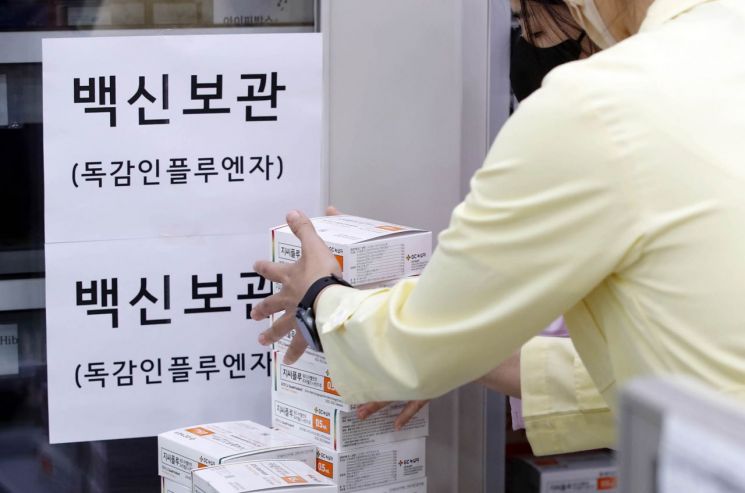 On the afternoon of the 20th of last month, one day before the free influenza vaccination, staff from the Infectious Disease Prevention Team at the vaccination room of Buk-gu Public Health Center in Gwangju are checking the quantity of vaccines to be additionally supplied to local medical institutions. [Image source=Yonhap News]
[Asia Economy Intern Reporter Kim Gunchan] Since the flu epidemic alert was issued for the first time in three years, the rate of flu infection among infants and young children has been alarming. The dominant strain leading this year's flu outbreak is 'Type A H3N2,' known as the most virulent among flu viruses. Experts advise that flu vaccination is crucial for prevention.
According to the Korea Disease Control and Prevention Agency's 'Infectious Disease Sentinel Surveillance Weekly Newsletter' on the 7th, the number of suspected flu patients per 1,000 outpatients in the 39th week of this year (September 18?24) was 4.9. Although this is lower than the 37th week (5.1), when the flu epidemic alert was issued for the first time in three years since 2019, it still meets the epidemic threshold (4.9).
In particular, the rate of flu infection among infants and young children aged 1 to 12 is rapid. Typically, the flu first spreads among infants and young children before expanding to adults. This is because infants and young children are vulnerable to the flu as the antibodies inherited from their mothers disappear and they have little history of natural infection. Looking at the suspected flu patients by age group in the 39th week, there were 7.9 cases per 1,000 outpatients for ages 1?6 and 6.4 for ages 7?12. This is more than twice the 3.3 cases observed in the 50?64 age group.
When limiting the age group to 1?6 years, the number of suspected flu patients was 7.9, an increase of 1.9 from 6.0 the previous week. Compared to before COVID-19, this is higher than the 2019?2020 flu season (6.3) and more than double the 2018?2019 season (3.7).
 Jung Ki-suk, head of the COVID-19 Special Response Team and chairman of the National Infectious Disease Crisis Response Advisory Committee, is briefing on the trends of influenza and COVID-19 cases by age group at the Government Seoul Office Building on the 26th of last month.
 [Image source=Yonhap News]
As the number of suspected flu patients this year rises again above the usual level, health authorities are closely monitoring the situation. The Korea Disease Control and Prevention Agency issued a flu epidemic alert on the 16th of last month after the number of suspected flu patients exceeded the epidemic threshold (4.9) for the first time in three years since 2019.
Im Suk-young, head of the Central Disease Control Headquarters' situation management team, explained at a briefing on the 13th of last month, "Influenza was almost nonexistent and maintained at a very low level for the past two years, but this year, since July, the incidence has shown an unusual upward trend." She added, "We think an outbreak could occur a little earlier than winter," and "There is a high possibility that influenza and COVID-19 could spread simultaneously, so we are preparing countermeasures."
The dominant strain leading this year's flu outbreak has been identified as 'Type A H3N2.' Flu viruses are broadly divided into four types: A (H1N1, H3N2) and B (Yamagata, Victoria). Type A H3N2 is a descendant of the so-called 'Hong Kong flu,' which began spreading in Hong Kong in 1968, and is known as the most virulent flu virus. It is estimated that over 100 million people worldwide were infected with this flu, and about 1 million died.
In this situation, the national flu vaccination program started on the 21st of last month. Vaccinations began with children aged 6 months to under 9 years who are receiving the flu vaccine for the first time in their lives and require two doses. Since the 5th, the program has expanded to include all children aged 6 months to 13 years and pregnant women. Children aged 6 months to 13 years receiving only one dose of the flu vaccine and pregnant women are eligible for free vaccination.
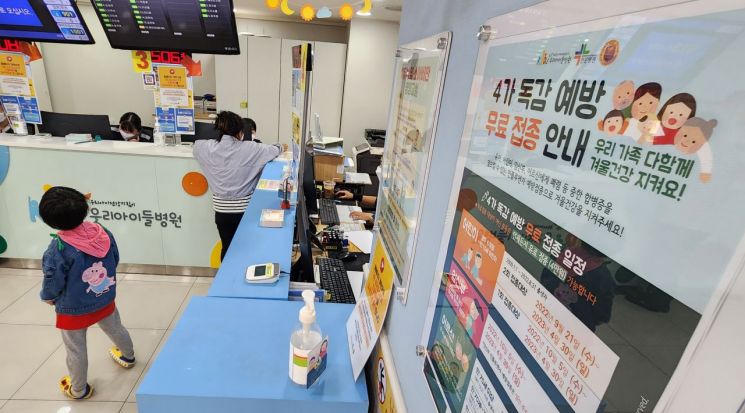 An information notice was posted at Guro Children's Hospital on the 21st of last month, when free flu vaccinations began. [Image source=Yonhap News]
With the national flu vaccination underway, experts urge people to get vaccinated and provide guidance on precautions during vaccination. Yang Seong-jun, a researcher at the Ministry of Food and Drug Safety, advised on YTN Radio's 'Wise Radio Life' on the 6th that if symptoms such as high fever or difficulty breathing occur after vaccination, one must visit a hospital immediately.
Researcher Yang said, "Infants under 6 months should not receive the flu vaccine. Depending on the manufacturing method, vaccines are divided into egg-based and cell culture vaccines. Those who have allergic hypersensitivity to eggs, chicken meat, or chicken-derived components should consult a doctor and receive the cell culture vaccine."
He added, "The injection site may become red or swollen, usually appearing immediately after vaccination and disappearing within 12 days. However, if symptoms such as high fever, difficulty breathing, hives, or dizziness occur after vaccination, you must see a doctor."
He emphasized, "The best way to prevent the flu is to get vaccinated," urging flu vaccination. He continued, "The flu season in Korea usually lasts from late November to April of the following year. It takes about two weeks after vaccination for antibodies to develop, and the vaccine's effectiveness lasts about six months, so vaccination is recommended between mid-October and early November."
© The Asia Business Daily(www.asiae.co.kr). All rights reserved.














