Preparing Various Bills Including US Troop Withdrawal in Parliament... Possibility of Approving NOPEC Bill Not Passed for Over 20 Years
[Asia Economy Reporter Park Byung-hee] The U.S. government and Congress are expected to launch comprehensive pressure against the Organization of the Petroleum Exporting Countries Plus (OPEC+) member countries that decided to cut daily crude oil production by 2 million barrels starting in November.
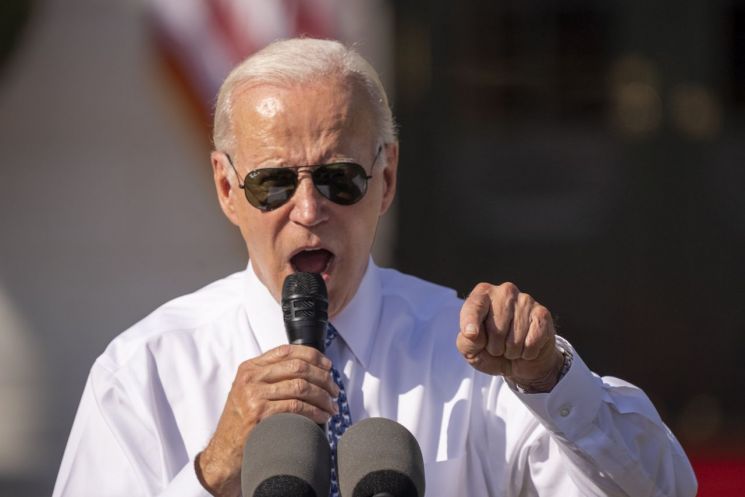
According to the Wall Street Journal (WSJ) on the 6th (local time), President Joe Biden has ordered a review of all possible responses, and Congress is preparing various legislative measures including filing a complaint with the World Trade Organization (WTO), seizing OPEC+-related assets within the U.S., and withdrawing U.S. troops and defense systems from OPEC+ member countries.
Democratic Senator Edward Markey stated that he would reintroduce the OPEC Accountability Act. This law allows the U.S. president to negotiate with OPEC+ member countries when OPEC+ discusses production cuts, and if negotiations between the U.S. president and OPEC+ fail, the U.S. Trade Representative (USTR) can initiate dispute procedures at the WTO.
Democratic Representatives Tom Malinowski, Sean Casten, and Susan Wild announced plans to introduce a bill to withdraw U.S. troops and defense systems from Saudi Arabia and the United Arab Emirates (UAE). They argued that the U.S. should not provide military assistance to countries aiding Russia.
Earlier, the White House stated that after OPEC+ announced the 2 million barrel production cut, it would discuss with Congress ways to weaken OPEC+'s control over energy prices.
As a result, the possibility of passing the anti-OPEC bill known as the No Oil Producing and Exporting Cartels Act (NOPEC) has increased. The NOPEC bill allows the U.S. Department of Justice to sue OPEC member governments and related companies in U.S. courts based on price-fixing allegations and to seize OPEC-related assets within the U.S.
The NOPEC law has been discussed in Congress for over 20 years but has not passed due to concerns about deteriorating relations with Saudi Arabia. However, with relations worsening significantly, the likelihood of NOPEC's passage has increased.
Landon Derentz, a former official at the U.S. Department of Energy, said, "The U.S. government's OPEC strategy has not changed, but as the relationship between OPEC and Russia expands, support for punitive measures has likely increased," analyzing that the chances of NOPEC passing have grown.
The NOPEC bill was recently reintroduced in Congress, led by members of the Senate Judiciary Committee. President Biden supported an early form of the NOPEC bill, the Energy Independence and Security Act, during his time as a senator in 2007.
If the NOPEC bill passes, there are concerns that OPEC+ member countries will strongly oppose it, potentially causing unpredictable situations in the crude oil market.
Matthew Reed, an analyst at consulting firm Foreign Reports, explained, "OPEC leaders take the NOPEC bill very seriously and are furious." He added, "OPEC believes it helped the U.S. by exporting 1.5 million barrels of crude oil and petroleum products daily to the U.S. this summer when the U.S. could not import Russian oil," and predicted, "If the NOPEC bill passes, OPEC may reconsider selling oil to the U.S."
The WSJ analyzed that this incident could signal the end of the uneasy d?tente (tension easing) between OPEC and the U.S.
According to the WSJ, over the past decade, the U.S. has significantly increased crude oil production, emerging as a major oil exporter that could threaten OPEC's status. Instead of competition, the U.S. and OPEC have maintained market stability through behind-the-scenes negotiations since the late Obama administration. However, relations have deteriorated significantly over the past year, increasing the likelihood of major conflicts over oil market issues.
David Goldwyn, who worked at the Departments of Energy under the Bill Clinton and Obama administrations, said, "With inflation eroding global economic growth and Europe struggling to find alternatives to Russian gas, OPEC+'s decision to cut production by 2 million barrels was an economic and diplomatic declaration of war," adding, "OPEC and the U.S. are returning to a past of long-standing hostility."
© The Asia Business Daily(www.asiae.co.kr). All rights reserved.












