Professor Team of Kwak Junyoung KIST, Kang Kibeom KAIST, and Jeong Taekmo KRICT
[Asia Economy Reporter Kim Bong-su] Domestic researchers have succeeded in developing artificial synapse semiconductor devices using two-dimensional (2D) new materials.
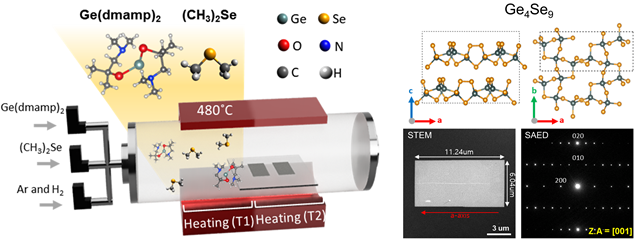
The Korea Institute of Science and Technology (KIST) announced on the 6th that Dr. Kwak Jun-young's research team at the Artificial Brain Convergence Research Division, in collaboration with Professor Kang Ki-beom's team at the Korea Advanced Institute of Science and Technology (KAIST) and Dr. Jung Taek-mo's team at the Korea Research Institute of Chemical Technology (KRICT), developed a synthesis technology for a new 2D insulating material with a novel elemental composition and created high-performance, low-power artificial synapse semiconductor devices utilizing this new material.
Recently, as the proportion of video and image data has increased, the processing of unstructured data has become a key factor in the development of future artificial intelligence (AI) systems. Accordingly, to overcome the excessive power consumption and limited information processing performance of the widely used von Neumann computing architecture, 'Neuromorphic systems' capable of high-efficiency, low-power information processing and learning are emerging as next-generation semiconductor systems.
Neuromorphic systems mimic the human brain to reduce power consumption while enhancing computing performance. To realize this, the development of high-performance next-generation semiconductor devices that can precisely emulate 'synapses'?which adjust the connection strength between neurons according to input signals?is required. Currently, silicon-based semiconductor devices consume more energy compared to biological synapses and face physical limitations in emulating highly integrated systems similar to actual neural networks.
For these reasons, active research is underway to implement high-performance artificial synapse devices by applying the intrinsic properties of materials such as oxides and organic/inorganic compounds. Alongside this, newly emerging 2D materials, which are atomically thin, offer significant advantages for high integration of semiconductor devices. Moreover, due to the unique characteristics of 2D materials themselves, they exhibit superior performance compared to conventional silicon materials, including faster switching speeds and higher charge mobility.
The joint research team developed synapse devices based on a heterojunction structure of 2D insulating new materials and 2D semiconductors, enabling efficient electron movement even at low energy levels. Utilizing these physical properties, they succeeded in developing artificial synapse devices that exhibit uniform changes in synaptic connection strength and operate at an energy level of approximately 15 fJ, similar to the energy consumption of actual human synapses. Additionally, the devices can maintain synaptic connection strength for short or long durations depending on the frequency and intensity of external stimuli, allowing for more precise emulation of human brain functions. The researchers attempted AI learning based on the developed high-performance 2D artificial synapse devices and confirmed the potential for practical neuromorphic system applications with a classification accuracy of about 88.3% on handwritten digit image data (MNIST).
Dr. Kwak Jun-young of KIST evaluated the significance of the research, stating, “As the importance of high-efficiency new material research that can serve as a silicon substitute grows in next-generation semiconductor development, the synapse devices based on the heterojunction structure of 2D insulating new materials and semiconductors presented in this study have excellent competitiveness in implementing high-level neuromorphic hardware that can precisely emulate brain operation principles.”
The research results were published in the latest issue of the internationally renowned journal ‘Advanced Materials’ (IF: 32.086).
© The Asia Business Daily(www.asiae.co.kr). All rights reserved.












