First Ruling and Opposition Parties Debate Hosted by Political Reform 2050
"End Bipartisan Hate Politics and Focus on Problem-Solving Politics"
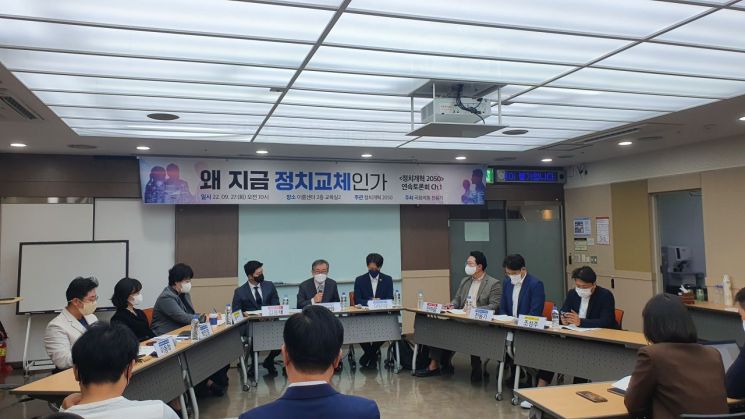
[Asia Economy Reporter Koo Chae-eun] A forum was held at the National Assembly on the theme of ‘political change’ reform, focusing on the expansion of multi-party and proportional representation systems, and the presidential runoff voting system. Politicians participating in the discussion unanimously said, “We must end ‘hate politics’ and pursue ‘problem-solving politics’” and “We need to open the door to political reform.”
On the morning of the 27th, the National Assembly held a forum titled ‘Political Reform 2050 Continuous Forum, Why Political Change Now?’ The event was hosted by Jeon Yong-gi, a member of the Democratic Party of Korea. The forum featured a presentation by Kim Tae-il, president of Jang-an University, and attendees included National Assembly member Lee Tan-hee, former Supreme Council member of the People Power Party Kim Yong-tae, emergency committee member of the Justice Party Moon Jeong-eun, the 8th Chairperson of the Busan Metropolitan Council Park In-young, former deputy chair of the Justice Party Policy Committee Cho Sung-joo, National Assembly member Jeon Yong-gi of the Democratic Party, and former chairman of the People Power Party’s Suncheon Gap branch Cheon Ha-ram.
In his congratulatory remarks, Assemblyman Lee Tan-hee said, “The current political system is like ‘gambling politics’ where the two major parties engage in hate politics, focusing all efforts on destroying each other.” He added, “Gambling politics requires going all-in with the stakes, so they pour resources into demonizing the opposing party. Livelihood and citizen safety inevitably become secondary. Such politics has no future.”
President Kim Tae-il stated, “Hate politics is not about the personal character or culture of politicians but is created by the structure and system,” adding, “However, since stakeholders are decision-makers, it is not easy.” He explained, “Judging by the current situation, the Democratic Party seems to have a stronger will for political reform, but how much of a priority it is remains to be seen. The People Power Party, with the president’s approval rating stagnant, will inevitably bring up political reform agendas as the party enters a more dynamic process.”
Former Supreme Council member Kim Yong-tae of the People Power Party emphasized, “The core of ‘political change’ is to give the nomination rights to the people and party members,” stressing, “Since each party has a higher chance of winning when nominated in relatively favorable districts, there is a problem of power alignment occurring where nomination rights exist, which must be resolved.”
Former Supreme Council member Lee Dong-hak pointed out that important decisions are delayed due to hate politics created by the two-party system. He said, “Politics has adopted the rules of a revenge drama, where victory comes from bringing down the opponent, so critical issues like ‘pension reform’ are postponed, and the burden falls entirely on future generations.”
Chairperson Park In-young said, “In the 1997 presidential election, those who voted for Roh Moo-hyun were not afraid of Lee Hoi-chang. But in this year’s presidential election, voters extremely hate and fear each other’s political leaders.” He added, “Everything, including everyday preferences, is polarized,” and said, “The problem is the extreme division in popular culture and political identity.”
© The Asia Business Daily(www.asiae.co.kr). All rights reserved.












