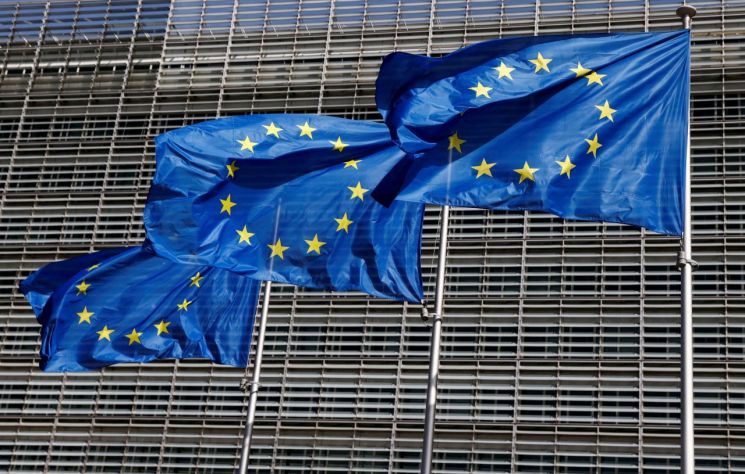
[Asia Economy Reporter Lee Ji-eun] The European Union (EU) Commission has decided to invest up to 5.2 billion euros (approximately 7.2 trillion KRW) of public funds in large-scale hydrogen projects. Amid concerns that green climate policies are retreating due to the impact of the Ukraine war, Europe is interpreted as accelerating its efforts to expand infrastructure and build a hydrogen ecosystem.
According to CNBC on the 21st (local time), the EU Commission announced that it approved the investment of up to 5.2 billion euros of public funds in the 'IPCEI Hy2Tech' project, which focuses on building hydrogen energy infrastructure. The EU expects to secure an additional 7 billion euros in private investment through this project and create 20,000 jobs.
The project involves 13 countries including Belgium, Czech Republic, Denmark, France, and Germany, with 29 companies operating in member states participating. The participating companies plan to collaborate with universities, research institutions across Europe, and up to 300 external partners.
The newly launched project will focus on the hydrogen value chain related to the entire hydrogen industry, including hydrogen production and fuel cells. First, it aims to reduce greenhouse gas emissions by replacing fossil fuels such as coal used in steel production with renewable hydrogen.
Margrethe Vestager, EU Commission Executive Vice-President, stated that through this investment, the EU will establish 3.5 GW (gigawatts) of electrolysis capacity and produce 340,000 tons of renewable energy annually. Previously, the EU announced plans to establish 40 GW of water electrolysis facilities by 2030.
Recently, the EU also announced plans to establish the European Hydrogen Bank. Ursula von der Leyen, President of the EU Commission, said on the 14th, "The European Hydrogen Bank is expected to invest 3 billion euros to build the hydrogen market," emphasizing, "We must be ready to grow the hydrogen industry from a niche market to a large scale."
The EU has been promoting the expansion of the hydrogen market while strengthening green energy policies for several years. Especially recently, concerns arose that related policies might lose momentum due to the energy crisis in Europe caused by Russia's invasion of Ukraine, but the EU is focusing on hydrogen policies. The EU expects that expanding hydrogen energy can replace up to 40 billion cubic meters (m³) of Russian gas annually.
The EU stated, "With the surge in demand for industrial hydrogen through this project, the European hydrogen market is expected to grow to an unprecedented scale," and forecasted, "15 member states plan to invest in power supply technologies for fuel cells and medium-sized vehicles." Accordingly, the growth of Korean hydrogen industry companies, which export hydrogen vehicles and hydrogen fuel cells, is also expected.
© The Asia Business Daily(www.asiae.co.kr). All rights reserved.












