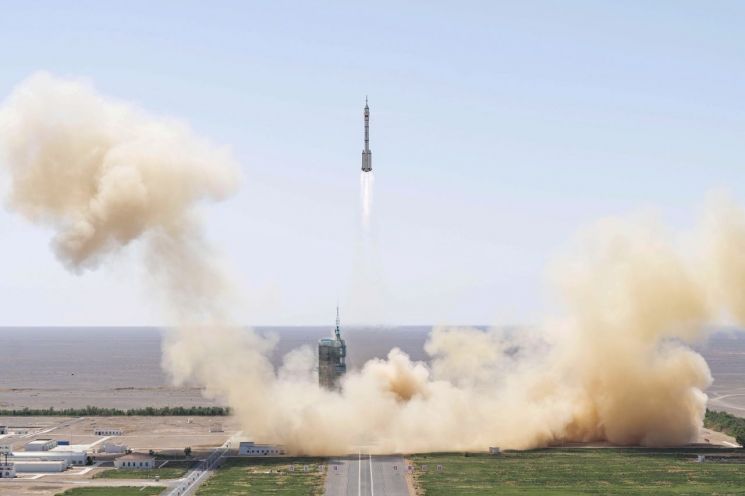
 On June 5th, Shenzhou 14, a manned spacecraft responsible for constructing the Tiangong space station, was launched from the Jiuquan Satellite Launch Center in Gansu Province, northwest China. [Image source=AP Yonhap News]
[Asia Economy Reporter Hwang Sumi] As the space industry competition intensifies worldwide, a Chinese space company is expected to start space tourism services in 2025.
According to the state-run Global Times on the 18th, CAS Space, a spin-off company from the Chinese Academy of Sciences (CAS), stated that China's private space sector has moved from the research and development (R&D) stage to a stage considering market principles.
Earlier, CAS Space began developing commercial satellite launch vehicles and spacecraft last year with the goal of providing space tourism services. According to the plan, CAS Space is developing a reusable launch vehicle capable of carrying up to seven tourists for about 10 minutes above the Karman line, which is commonly known as the boundary between Earth and space at an altitude of 100 km. The capsule carrying tourists returns to Earth using three parachutes.
Ticket prices are expected to be around 2 to 3 million yuan per seat (approximately 396 million to 594 million KRW). The media emphasized that this is cheaper than the ticket price of $450,000 per seat (about 625 million KRW) offered by the space company Virgin Galactic when it introduced its space tourism product.
Yang Yiqing, founder of CAS Space, said, "The market size of China's commercial space industry grew at an average annual rate of 22.09% from 2015 to 2020 due to intellectual property, talent development systems, and central government support," and expressed confidence that "it will catch up with the development level of the United States within 10 years." However, he added that the scale of domestic commercial space companies is still relatively small, and there are almost no companies generating profits in the rocket and satellite business yet.
Meanwhile, competition in space tourism services appears to be intensifying mainly among U.S.-based companies. Representative companies include SpaceX, founded by Tesla CEO Elon Musk, and Blue Origin, led by Amazon CEO Jeff Bezos.
In fact, space tourism has already been conducted several times. In July last year, Richard Branson, chairman of the UK’s Virgin Group, boarded the rocket plane Unity 22, which took off from Spaceport America in New Mexico, experienced space tourism by briefly crossing the Karman line, and safely returned to Earth. This was recorded as the first private commercial spaceflight.
In April, SpaceX announced the launch of the manned spacecraft Crew Dragon from Kennedy Space Center in Florida, carrying only four civilians. It is known that these passengers paid expenses amounting to 70 billion KRW.
© The Asia Business Daily(www.asiae.co.kr). All rights reserved.









![The Special Connection Between the Statue of Martyr Lee Jun in Jangchungdan Park and Mayor Oh Sehoon ③ [Current Affairs Show]](https://cwcontent.asiae.co.kr/asiaresize/319/2026012110001599450_1768957215.jpg)
