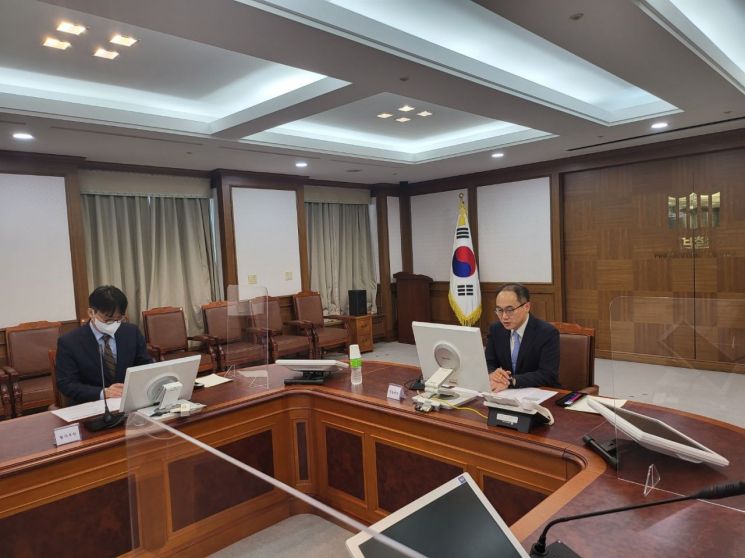
 New Prosecutor General Lee Won-seok is seen holding an emergency video conference on the afternoon of the 16th with stalking-specialized prosecutors from prosecution offices nationwide.
 Photo by the Supreme Prosecutors' Office
[Asia Economy Reporter Choi Seok-jin, Legal Affairs Specialist] On the 16th, Minister of Justice Han Dong-hoon instructed the Supreme Prosecutors' Office to take a 'strict response to stalking crimes,' prompting stalking-specialized prosecutors from prosecution offices nationwide to hold an emergency video conference to discuss response measures.
The stalking-specialized prosecutors attending the video conference agreed to prioritize protective measures for victims by actively utilizing provisional measures such as detention investigations and restraining orders to separate stalking offenders from victims when there is concern for the victim's safety.
The Supreme Prosecutors' Office announced that from 2 p.m. that day, 89 stalking-specialized prosecutors from 60 prosecution offices nationwide participated in the 'National Stalking-Specialized Prosecutors Emergency Video Conference.'
The meeting was convened to discuss strict response measures to stalking crimes following the revelation that Jeon Mo (31), the suspect in the 'Sindang Station Station Attendant Murder' case that occurred two days prior, was a defendant currently on trial for stalking crimes, the Supreme Prosecutors' Office explained.
At the meeting, newly appointed Prosecutor General Lee Won-seok directly instructed the stalking-specialized prosecutors to prioritize victim protection and respond strictly to stalking crimes.
The number of stalking cases received by the prosecution in the second quarter of this year averaged 649 per month, increasing more than fourfold within 10 months since the enforcement of the Stalking Punishment Act.
Earlier, on August 23, the Supreme Prosecutors' Office issued nationwide instructions to prosecution offices for strict response measures to stalking crimes, including ▲principled detention investigations for stalking crimes that may threaten life and body ▲actively charging stalking crimes even if initially booked under different charges when continuous or repeated harm to the victim is expected ▲thorough collection and submission of sentencing materials such as motive and actual damage.
The stalking-specialized prosecutors attending the video conference agreed to actively respond to stalking crimes through ▲meticulous investigation of factors threatening victims ▲prioritizing victim protection by actively utilizing detention investigations and provisional measures ▲holding police-prosecution councils at each level ▲strengthening case handling standards.
First, the prosecution decided to meticulously investigate factors threatening victims, such as the stalker's obsessive tendencies toward the victim, proximity of the victim's workplace or residence, and the circumstances and duration of the crime.
They also decided to prioritize victim protection by actively utilizing detention investigations and provisional measures to separate stalkers from victims when there is concern for the victim's safety.
Provisional measures are dispositions carried out by the court ex officio or upon the prosecutor's request to facilitate smooth investigation, trial, and victim protection in stalking crimes, including ▲written warnings to stop stalking ▲restraining orders prohibiting approach within 100 meters of the victim or their residence ▲prohibition of communication access to the victim ▲detention in a jail or detention center.
Additionally, the prosecution plans to hold councils with local police stations at each prosecution office level and establish active response measures through detention warrants and provisional measures, cooperating closely with the police to ensure victim protection from the early stages of investigation.
Furthermore, the prosecution will additionally strengthen case handling standards for stalking crimes and continuously improve related practices.
Meanwhile, Minister Han instructed the Supreme Prosecutors' Office to ▲thoroughly investigate factors threatening victims from the early stages of stalking cases ▲take swift provisional measures such as restraining orders and detention of perpetrators ▲ensure strict responses to stalking crimes, including active requests for detention warrants, to fully protect stalking victims.
Minister Han also instructed to promptly pursue legislative amendments to abolish the provision of stalking crimes as offenses requiring victim's withdrawal of complaint and to actively review measures to strengthen victim protection, such as tracking the perpetrator's location.
President Yoon Suk-yeol announced that he instructed the Ministry of Justice to supplement the Stalking Prevention Act on the same day.
On the morning of the same day, President Yoon said to reporters on his way to the Yongsan Presidential Office, "The news of the Sindang Station attendant stalking murder case has shocked the public greatly," adding, "Although the Stalking Prevention Act was enacted and enforced last year, there were many criticisms that victim protection was insufficient. Before leaving on a business trip, I instructed the Ministry of Justice to further supplement this system to ensure that such crimes cannot take root and to fully protect victims."
© The Asia Business Daily(www.asiae.co.kr). All rights reserved.
















