Be Careful When Contacting Contaminated Water
and Wash Exposed Skin Thoroughly
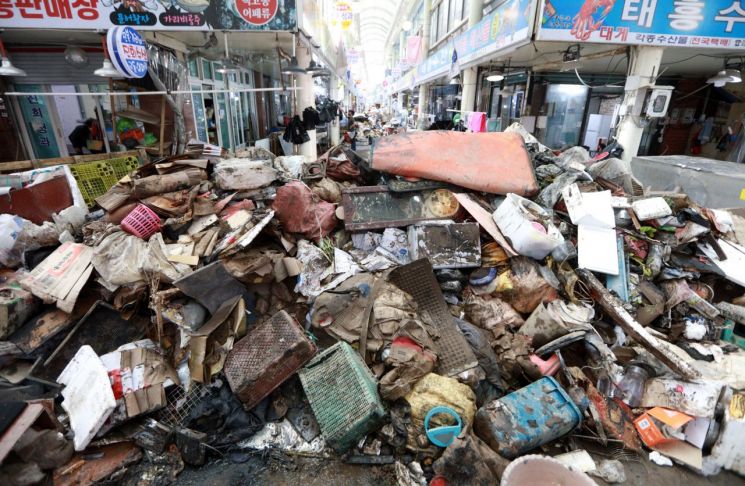 On the afternoon of the 7th, various household items and peak season goods flooded by Typhoon 'Hinnamnor' are piled up in the alley of Guryongpo Market in Pohang-si, Gyeongbuk. [Image source=Yonhap News]
[Asia Economy Reporter Lee Gwan-ju] While recovery efforts from the damage caused by Typhoon Hinnamnor, the 11th typhoon, are in full swing during the Chuseok holiday, Typhoon Muifa, the 12th typhoon, has formed. It remains to be seen whether Muifa will affect the Korean Peninsula, but this news is unwelcome given the already severe damage.
Typhoons in Korea mainly occur in August and September. Especially, typhoons in early autumn often cause significant damage. Well-known typhoons such as Hinnamnor, as well as some of the worst typhoons in history like Maemi, Gonpas which directly hit the metropolitan area in 2010, and Maysak in 2020, all made landfall on the Korean Peninsula in early September.
Typhoons themselves cause considerable loss of life and property, but they also trigger secondary damage. Various infectious diseases are a prime example. There is a high possibility of waterborne and foodborne infectious diseases (such as dysentery, typhoid fever, hepatitis A) spreading through contaminated water, as well as contact dermatitis, tetanus, and mosquito-borne infectious diseases like malaria and Japanese encephalitis. Knowing basic preventive measures is essential to avoid damage.
First, waterborne and foodborne infectious diseases occur after typhoons when contaminated water or food is touched or ingested. It is important to wash hands frequently with soap for at least 30 seconds under running water, avoid eating food that has come into contact with water or has not been refrigerated properly, and drink boiled water or safe water such as bottled water.
Additionally, diseases like leptospirosis and tetanus can occur through skin exposure or wounds during flood recovery work. Wearing waterproof protective clothing, boots, and rubber gloves is necessary, and skin exposed to water must be washed thoroughly with clean water and soap. Especially if large wounds occur during work or symptoms such as fever appear afterward, immediate medical attention is required.
After a typhoon, small puddles can form where mosquito larvae, called janggu-beolle (Culex larvae), multiply, leading to the spread of mosquito-borne infectious diseases. During flood recovery, it is important to remove risk factors where water can accumulate and mosquitoes can breed, such as empty bottles and discarded tires, and to wear long sleeves and long pants to minimize skin exposure during outdoor work. Using mosquito repellent and avoiding outdoor activities from sunset to sunrise, when mosquitoes are most active, is also necessary.
Shin Sang-yeop, Senior Research Fellow at KMI Korea Medical Institute and an infectious disease specialist, emphasized, "All water exposed outdoors after a typhoon should be considered contaminated with sewage or other pollutants," adding, "For infection prevention, it is very important to stay close to clean water and keep a distance from contaminated water."
© The Asia Business Daily(www.asiae.co.kr). All rights reserved.