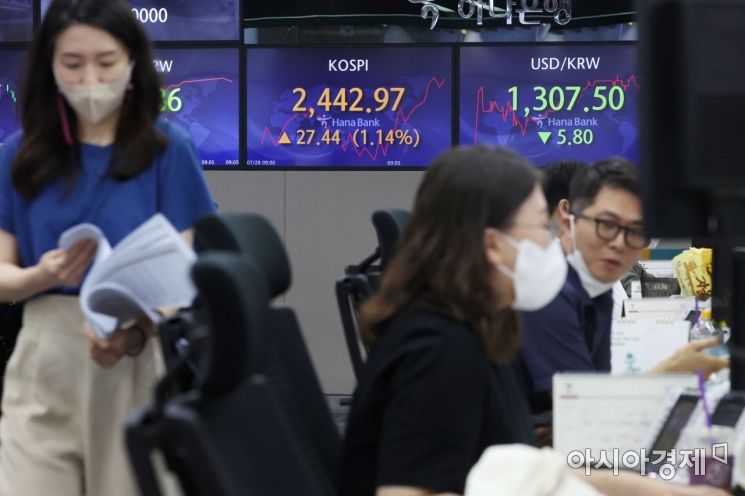
[Asia Economy Reporter Kwon Jae-hee] Recently, although the KOSPI has recovered to the 2520 level, the market capitalization ratio of KOSPI stocks held by foreigners has reached its lowest level in 13 years.
According to the Korea Exchange on the 14th, as of the 11th, the total market capitalization of the KOSPI was KRW 1,986.8 trillion, of which the market capitalization of stocks held by foreigners was KRW 606.2 trillion. This corresponds to 30.51%, the lowest level this year. It is also the lowest level in 13 years since August 13, 2009 (30.52%).
At the beginning of this year, the proportion of foreigners in the KOSPI market capitalization was 33.50%.
Due to the listing of LG Energy Solution on January 25, it rose to 34.20%, marking a yearly high, but has since shown a continuous decline.
Until mid-June, the foreign market capitalization ratio maintained the 31% range, but as the KOSPI plunged, it dropped to 30.99% on June 16, then recovered to 31.23% on the 21st of last month.
However, since the 29th of last month, it has consistently failed to break out of the 30% range. On the most recent trading day, the 12th of this month, the foreign market capitalization ratio was 30.56%.
Although the KOSPI has shown some recovery and is attempting a rebound, foreign investors' expectations for the domestic stock market appear to be low.
The KOSPI fell to 2292.01 at the close on the 6th of last month but closed at 2527.94 on the 12th of this month, rising 10.29%.
Along with the KOSPI's upward trend, foreigners net purchased KRW 2.5 trillion in the securities market last month, switching to a net buying trend unlike June (net selling of KRW 5.4 trillion). This month also shows a net buying preference of KRW 1.8 trillion.
However, from the beginning of this year until the 12th of this month, foreigners have net sold KRW 10.6 trillion in the securities market, maintaining an overall net selling position.
Since the global stock markets have remained unstable since the beginning of the year, risk-averse sentiment has increased. Additionally, the weak Korean won and the interest rate inversion between Korea and the U.S. have further reduced the attractiveness of the KOSPI to foreigners.
As preference for safe assets has increased, the strong dollar phenomenon has continued, with the USD/KRW exchange rate soaring to 1326.7 won intraday on the 15th of last month, maintaining a high level.
Although the USD/KRW exchange rate closed at 1302.4 won on the 12th of last month, showing a downward trend, it still remains above 1300 won, maintaining a high level. The sharp rise in the USD/KRW exchange rate acts as a negative factor for foreign demand.
On the 27th of last month (local time), the U.S. Federal Reserve (Fed) raised the benchmark interest rate from 1.50?1.75% to 2.25?2.50%, causing the U.S. benchmark interest rate to surpass Korea's benchmark rate (2.25%), which further increased the burden.
If Korea's interest rate falls below the U.S. rate, foreign capital is more likely to exit the Korean stock market. Foreign investors have no incentive to invest where the yield (interest rate) is lower.
The recent KOSPI rebound is considered a bear market rally (a temporary rise during a downtrend), and since the possibility of a recession has not been ruled out, the KOSPI could fall again at any time.
Labor Gil, a researcher at Shinhan Financial Investment, said, "The current rebound is likely a bear market rally," adding, "A sustained rebound is only possible after inflation peaks and concerns about recession diminish."
He continued, "It is inevitable to revise downward earnings forecasts for the third and fourth quarters," and added, "The upper band of the KOSPI is 2550, and as it approaches this level, expected returns are likely to gradually decline."
Kim Seok-hwan, a researcher at Mirae Asset Securities, also pointed out, "The inversion phenomenon among major government bond yields is still intensifying, and positive and negative economic indicators are mixed," adding, "Overall, downward pressure on stock prices is greater than upward pressure."
© The Asia Business Daily(www.asiae.co.kr). All rights reserved.

![Clutching a Stolen Dior Bag, Saying "I Hate Being Poor but Real"... The Grotesque Con of a "Human Knockoff" [Slate]](https://cwcontent.asiae.co.kr/asiaresize/183/2026021902243444107_1771435474.jpg)














