Democratic Party Euljiro Committee and Justice Party Pledge Joint Response to Paris Baguette Incident
Two Parties Face Choice Between Opposition Cooperation and Self-Reliance
Disagreement Over National Audit on Presidential Office and Residence Private Contract Controversy
Democratic Party: "Will Submit National Audit Around President Yoon's 100-Day Inauguration"
Justice Party: "Need to Hold Operations Committee First... Political Strife Inappropriate in National Disaster Situation"
[Asia Economy Reporter Naju-seok] After losing the presidential election, will the Democratic Party of Korea and the Justice Party, now in the opposition, choose the path of opposition cooperation or go their separate ways? It seems the Justice Party has concluded to approach issues on a case-by-case basis.
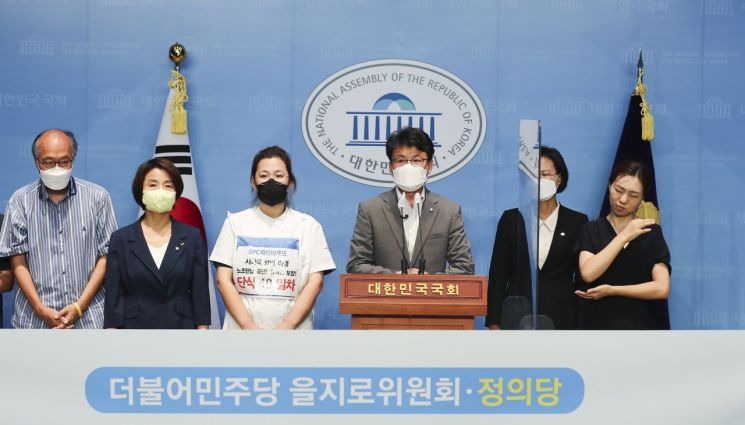
On the 12th, the Democratic Party of Korea and the Justice Party announced joint action regarding the SPC Group labor-management conflict that surfaced last December. Lee Eun-joo, Emergency Committee Chair of the Justice Party; Jin Sung-jun, member of the Democratic Party’s Euljiro Committee and floor deputy leader; Kang Eun-mi, Justice Party member; and representatives from the Korean Confederation of Trade Unions’ Textile, Food, and Beverage Union Paris Baguette branch held a press conference urging the fulfillment of SPC’s 2017 social agreement.
Previously, the Democratic Party’s Euljiro Committee and the Justice Party reached a social agreement in 2017 concerning SPC’s illegal dispatch of bakery workers. The agreement stipulated that SPC would employ bakery workers through a subsidiary instead of direct employment and pay wages to subsidiary-hired bakery workers at the same level as regular employees at headquarters. However, the Paris Baguette branch claimed that even after three years, the promises were not kept, and union members were pressured to withdraw, leading to hunger strikes and other protests.
Despite prolonged hunger strikes and protests, the issue remained unresolved, prompting the Democratic Party and the Justice Party to promise a parliamentary-level response. Both parties, as signatories to the agreement, announced plans for parliamentary actions such as national audits and requests for special labor inspections. The decision to join forces reflects the gravity of the issue and their shared responsibility as parties that signed the 2017 agreement to responsibly resolve the matter.
The joint response from both parties indicates a shift in the previously strained relationship between them. During the previous administration, there were some cooperative efforts, but relations gradually deteriorated. Especially during the general election, the relationship worsened significantly when the Democratic Party created a satellite party contrary to the initial agreement. In the recent presidential election, the Democratic Party lost by a margin of 0.73 percentage points, and there were complaints that the outcome might have been different if a unified candidate had been agreed upon with the Justice Party.
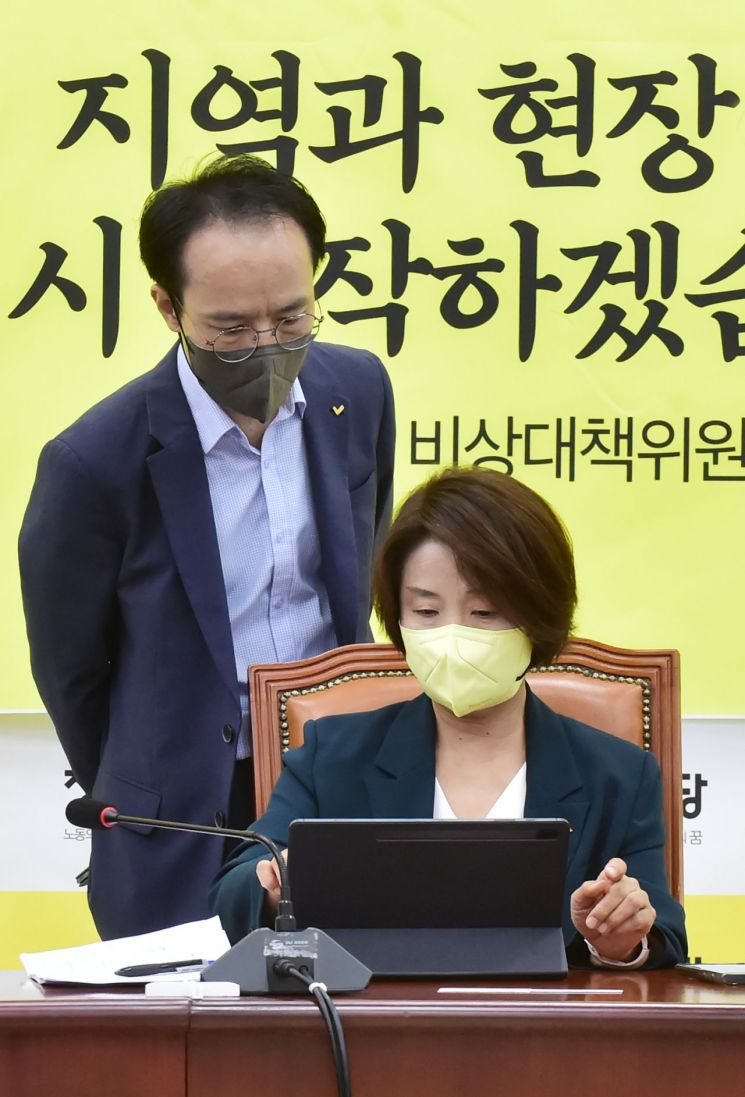 Eunju Lee, Emergency Response Committee Chair of the Justice Party, is talking with spokesperson Dongyoung Lee at the Emergency Response Committee meeting held at the National Assembly in Yeouido, Seoul on the 8th.
 [Image source=Yonhap News]
In fact, for the Justice Party, setting the distance from the Democratic Party was a bigger issue, as it directly relates to the party’s future prospects. Following repeated defeats in the presidential and local elections, there were calls to break away from the previous “second fiddle” strategy. Han Seok-ho, Emergency Committee member and chair of the “Justice Party 10-Year Evaluation Committee,” stated at the Justice Party emergency committee meeting on the 11th of last month, “In the clear inequality and injustice of the ‘Cho Kuk incident,’ the Justice Party branded itself with the ‘Democratic Party second fiddle stigma.’ The result was consecutive election defeats in the general, presidential, and local elections.” He further declared, “The newly starting second term of the Justice Party must break away from the ‘Democratic Party dependency strategy’ and the ‘sea of the masses strategy.’”
Therefore, the announcement of cooperation between the Democratic Party and the Justice Party on issues like the SPC matter is noteworthy. As both parties are now in the opposition, there are more strategic and tactical points for cooperation in government oversight and other areas.
However, the path to opposition cooperation remains distant. For example, the Democratic Party plans to submit a request for a national audit around President Yoon Suk-yeol’s 100th day in office regarding suspicions of private contracts for construction at the presidential office and residence. The Justice Party, however, holds a negative stance on this matter.
Lee Dong-young, spokesperson for the Justice Party, said, “The Justice Party’s position is that since the National Assembly has been organized, this issue should first be examined through the National Assembly’s Steering Committee and relevant standing committees. If further problems arise, then a national audit can be considered. We have a different view on conducting a national audit without first examining the issue in the Steering Committee.” He added, “Given the severe flood damage and the forecast of more rain, a national crisis situation, it is undesirable for a national audit to escalate partisan conflict between the ruling and opposition parties. The National Assembly’s politics should focus on people’s livelihoods, especially flood response measures.” Internally, the Justice Party finds it difficult to agree to a national audit in terms of procedure and timing.
© The Asia Business Daily(www.asiae.co.kr). All rights reserved.













