Expectations of 'Inflation Peak' with US Consumer Price Index Release
Next Month's Fed Move Seen as Big Step, Not Giant Step
However, It's Still Hard to Confirm Inflation Has Peaked
Korea Faces Continued Price Instability... Inflation Around Chuseok in Focus
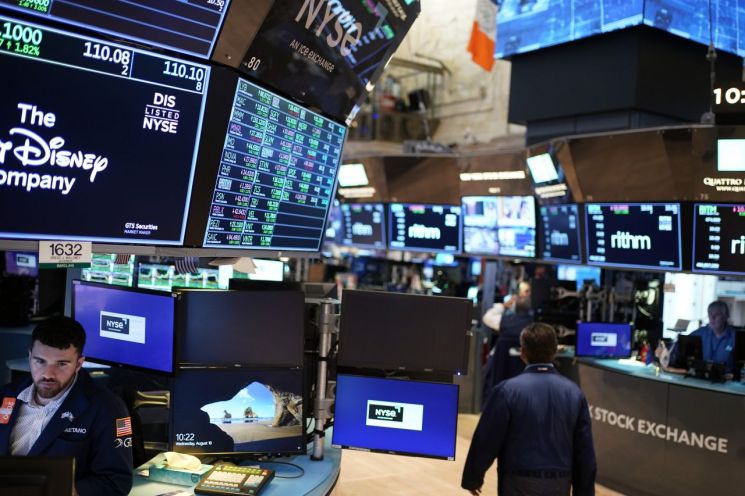 On the 10th (local time), traders are at work on the trading floor of the New York Stock Exchange (NYSE) in the United States.
 [Image source=Yonhap News]
The U.S. consumer price inflation rate for July has significantly slowed, drawing attention to future changes in South Korea's inflation and monetary policy. As expectations grow that U.S. inflation has peaked, the focus is on whether the Bank of Korea will shift its emphasis from inflation to economic growth and begin to moderate the pace of interest rate hikes.
However, judging from July's inflation rate alone, it is difficult to conclude that U.S. inflation has peaked, and given that domestic inflation remains steep, uncertainty surrounding inflation and monetary policy direction is expected to remain high.
According to financial markets on the 11th, the U.S. Department of Labor announced on the 10th (local time) that the July Consumer Price Index (CPI) inflation rate (year-on-year) was 8.5%, lower than Wall Street's forecast of 8.7%, fueling expectations that inflation has peaked.
If U.S. inflation stabilizes, the Federal Reserve's rate hike increments could also shrink, which may lead to some stabilization of the U.S. dollar. In fact, on that day, the won-dollar exchange rate opened at 1,297.0 won, down 13.4 won from the previous trading day, and has been fluctuating around 1,300 won in the morning session. This contrasts with the recent sharp depreciation of the won and the exchange rate hitting new highs. A stable exchange rate lowers import prices, which positively affects domestic inflation stability.
If inflation peaks as the market expects, the burden of the interest rate gap between Korea and the U.S. will ease, allowing the Bank of Korea to also moderate the pace of rate hikes. The Bank of Korea has stated it will gradually raise the base rate by 0.25 percentage points, but depending on domestic and external factors, the possibility of a 'big step' (a 0.50 percentage point increase) is not ruled out.
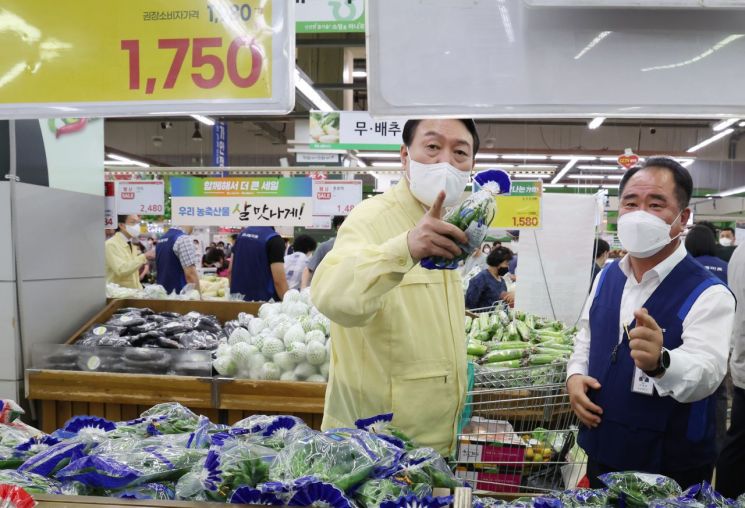 President Yoon Suk-yeol is checking the price tags while inspecting the vegetable price situation at Hanaro Mart Yangjae Branch in Yangjae-dong, Seocho-gu, Seoul on the 11th. [Image source=Yonhap News]
However, some argue that July's U.S. inflation data alone does not confirm that inflation has peaked or that the Fed's rate hike stance will change. Hye-yoon Lim, a researcher at Hanwha Investment & Securities, said, "There is a confirmed signal of a peak-out in U.S. consumer prices," but added, "Considering the limited downside of international oil prices and strong wage growth pressures, it is difficult for the Fed to turn around immediately."
Before the Federal Open Market Committee (FOMC) meeting next month, which will decide U.S. interest rates, August inflation and employment data will be released, making it difficult to gauge the Fed's policy shift.
In particular, South Korea may see consumer price inflation rise further, especially in agricultural products, due to recent heavy rains, raising concerns that the inflation peak could be delayed. This could increase pressure for interest rate hikes in Korea regardless of U.S. inflation trends.
Jun-kyung Ha, a professor of economics at Hanyang University, said, "While international oil and commodity prices have stabilized, core inflation in the U.S. is still ongoing," adding, "There is significant uncertainty." Professor Ha noted, "It is difficult to gauge the monetary policy direction of the Fed or the Bank of Korea based on one month's data alone; we need to observe whether other data support this trend."
© The Asia Business Daily(www.asiae.co.kr). All rights reserved.












