Over 100,000 Reports of Extreme Suicides Last Year
Reviewing Suicide Prevention System and Detailed Psychological Analysis by Type
[Asia Economy Reporters Jang Sehee and Yoo Byungdon]Last month, on March 30, a man in his 30s, Mr. A, took his own life by jumping from a high-rise apartment in Buyeo-gun, Chungnam Province, due to despair over his situation. It was reported that Mr. A had been suffering from financial difficulties after failing to secure a job for a long time. In June, the family of Jo Yuna, who went missing in Wando, also made an extreme choice following a failed cryptocurrency investment. At that time, the family’s total debt was about 100 million won. In December last year, Mr. Jung, who ran a Chinese restaurant in Seoul, committed suicide after his business revenue sharply declined, leading to ongoing financial hardship.
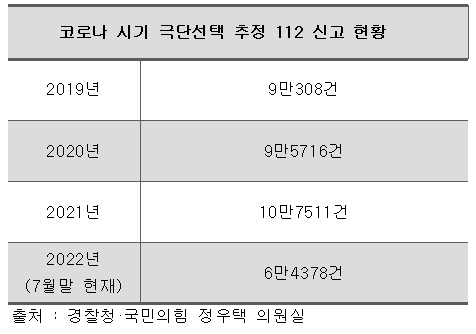
According to the “Suicide Presumed 112 Report Status” submitted by the National Police Agency to the office of Rep. Jeong Woo-taek of the People Power Party on the 10th, a total of 64,378 reports were received from January to the end of July this year. By year, the numbers were 90,308 in 2019, 95,716 in 2020, and 107,511 in 2021. Last year, the number surpassed 100,000 for the first time. Analysts suggest that cases of extreme choices are occurring one after another as people cannot endure the prolonged economic difficulties caused by COVID-19.
A police official said, "Most of the cases involved people experiencing economic problems or living alone," adding, "Previously, reports were mostly from elderly people living alone, but recently, there have been occasional reports of extreme choices among people in their 20s and 30s." A man in his 20s warned his family the day before that he would die at the Han River in Seoul, prompting firefighters and police to respond and rescue him.
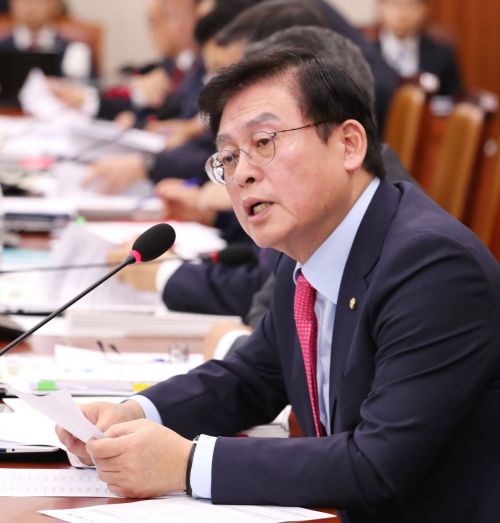
According to the results of a psychological autopsy conducted by the Ministry of Health and Welfare in collaboration with the Korea Life Respect Hope Foundation, among 103 people who died by extreme choice, 57.3% (59 people) experienced stress related to economic situations before their deaths. Stress caused by debt (44.1%) was the highest, followed by income reduction (20.3%) and persistent poverty (16.9%). Other stress factors included loss of basic livelihood security, investment failures, and burdens from family financial demands. Psychological autopsy is a process of identifying mental and behavioral factors presumed to have caused death by conducting in-depth interviews with the deceased’s family and friends. Rep. Jeong Woo-taek stated, "This is an indicator showing that people’s livelihoods have been extremely difficult in recent years," and emphasized, "There is a need to review the suicide prevention system and provide economic recovery support."
Experts say it is necessary to analyze the social background behind the increase in extreme choices. Professor Lee Woong-hyuk of Konkuk University’s Department of Police Science said, "Extreme choices reflect the health of a society," adding, "Since the current society is ‘ill,’ the government must actively diagnose the causes, categorize types, and prepare countermeasures. Psychological counseling should be expanded beyond workplaces and families, and regular surveys should be increased." According to an analysis by the Ministry of Health and Welfare of the ‘OECD Health Statistics 2022’ released earlier this month, South Korea’s suicide mortality rate was the highest among OECD countries at 25.4 per 100,000 people in 2019. Professor Lim Myung-ho of Dankook University’s Department of Psychology analyzed, "When major social problems occur, vulnerable groups are more severely affected," adding, "As employment difficulties worsened and the wealth gap widened due to COVID-19, feelings of loss and frustration increased, leading to more attempts at extreme choices."
© The Asia Business Daily(www.asiae.co.kr). All rights reserved.