Choosing a Flight Route with Longer Distance but 25% Higher Fuel Efficiency
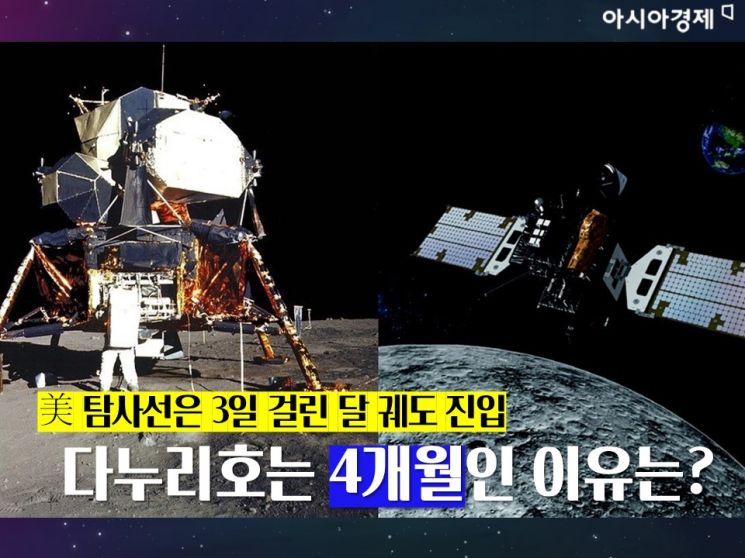 Unlike Apollo 11, which entered lunar orbit in about three days, Danuri, Korea's first lunar orbit explorer, is scheduled to enter the moon's orbit over the course of four months. / Photo by Song Hyundo, Asia Economy intern reporter
[Asia Economy Reporter Lim Juhyung, Intern Reporter Song Hyundo] South Korea's first lunar orbiter, 'Danuri,' is scheduled to launch on the 5th, drawing attention to the 'lunar orbit insertion time' of Danuri. The U.S. lunar probe 'Apollo 11,' launched in the 1960s, entered lunar orbit in just 3 days (75 hours), whereas Danuri is expected to enter orbit over a period of four months. We explored the reasons why Danuri, equipped with cutting-edge technology, enters lunar orbit at a much slower pace than the American probe from half a century ago.
◆ Danuri stops by a 'space rest area' before reaching the Moon
The reason Danuri takes a long time to reach the Moon lies in its flight trajectory.
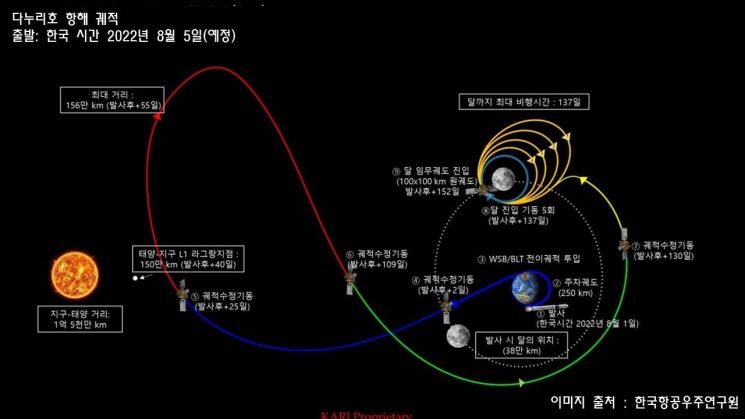 Danuriho enters the lunar orbit by following a trajectory called the 'WSB (Weak Stability Boundary)'. The photo shows the navigation path of the WSB. / Photo by Hangwoo Research Institute
Apollo 11 reached the Moon using a 'direct transfer trajectory,' meaning the probe was sent straight to the Moon. If the probe is launched when the Earth and Moon are closest, it can reach the Moon within 3 to 5 days. However, this method relies heavily on the probe's propulsion, resulting in enormous fuel consumption.
In contrast, Danuri is planned to travel along a trajectory called the 'WSB (Weak Stability Boundary).' This orbit passes through the Lagrange point 'EL1,' located about 1.5 million km from Earth, before entering lunar orbit. EL1 is a point where Earth's gravity and the Sun's gravity balance each other, allowing the probe to stay in place without consuming fuel, earning it the nickname 'space rest area.'
Because Danuri travels a trajectory approximately ten times longer than the 340,000 km distance Apollo 11 covered to reach lunar orbit, it takes about four months to arrive.
◆ Why did Danuri choose a longer trajectory?
Originally, the Korea Aerospace Research Institute (KARI) adopted the 'Phase-Locked Transfer (PLT)' trajectory for Danuri instead of the WSB method. The PLT method involves orbiting Earth multiple times to gain momentum before reaching the Moon, taking about 20 days. Although it consumes more fuel than the direct transfer trajectory used by Apollo 11, it offers the advantage of increased launch vehicle stability.
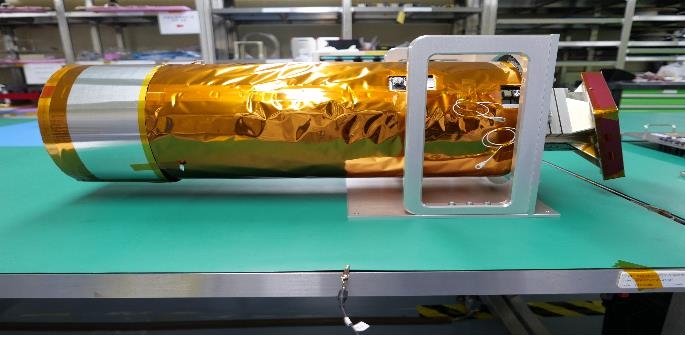 Shadow camera developed by NASA. The Danuri spacecraft's total weight increased after equipping this camera. / Photo by Yonhap News
The issue was the probe's weight. NASA requested KARI to equip Danuri with a permanent shadow region camera (Shadow Camera) to measure shadows on the lunar surface, increasing Danuri's total weight from the initial 550 kg to 678 kg. A heavier probe inevitably consumes more fuel. Therefore, KARI had to find a flight trajectory that would consume less fuel while allowing the probe to travel farther. As a result, the WSB method, which passes through the space rest area, was adopted as an alternative. The WSB method is known to improve Danuri's fuel efficiency by about 25% compared to the PLT method.
◆ Shadow Camera installation lays the foundation for the Artemis program
The reason NASA and KARI chose a flight trajectory taking over four months to accommodate the Shadow Camera is that this camera will serve as the starting point for future lunar exploration projects.
Currently, the United States is promoting the 'Artemis' program, aiming to send a manned spacecraft to the lunar surface by 2025. This program involves 22 countries worldwide, including South Korea and the U.S., as well as various private companies.
The Shadow Camera onboard Danuri can investigate shadows on the lunar surface to detect traces of water and, once Danuri enters lunar orbit, will orbit the Moon 12 times a day and a total of 4,380 times a year, transmitting valuable information to NASA. Danuri thus acts as the 'vanguard' of lunar exploration plans occurring about half a century after the Apollo program.
© The Asia Business Daily(www.asiae.co.kr). All rights reserved.














