Realizing a Safe Digital Power
Training 2,000 Elite Security Experts
Supporting Startups of 25 Outstanding Security Companies
[Asia Economy Reporter Lim Hye-seon] As digital innovation accelerates, the importance of cybersecurity is being emphasized, and the government plans to train 100,000 cybersecurity talents by 2026.
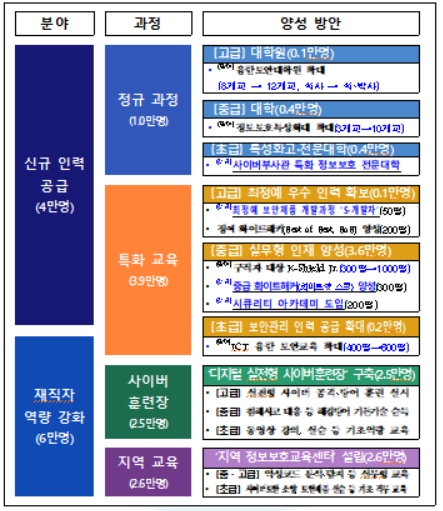
The Ministry of Science and ICT announced on the 13th that it will cultivate 100,000 practical cybersecurity personnel (40,000 new personnel and 60,000 in-service capacity enhancement training) and nurture 2,000 elite experts to realize a safe digital powerhouse. It will also actively support the establishment of 25 outstanding security startups. The Ministry of Science and ICT explained, "We will simultaneously pursue quantitative expansion of personnel responding to the demand of the cybersecurity industry and qualitative enhancement of personnel such as elite white-hat hackers and security developers," adding, "We plan to expand the educational base so that anyone can receive cybersecurity education and grow."
Establishing an Elite Talent Training System
Cyber personnel refer to those engaged in activities responding to cyberattacks, such as developing security products and services to protect information assets, establishing and managing security policies, and incident response. The number of cybersecurity personnel will expand from 124,000 this year to 163,000 in 2026, creating a demand for about 40,000 new personnel. This reflects the industry's voice about the shortage of experts with specialized knowledge due to the decrease in universities operating cybersecurity courses.
The Ministry of Science and ICT will establish a full-cycle elite talent training system from cybersecurity development to response. First, in response to changes in the cyber environment such as cloud and virtual convergence economy, it will expand and reorganize convergence security graduate schools and information security specialized universities. The number of information security specialized universities will increase from the current three to ten by 2026, and convergence security graduate schools will increase from eight to twelve.
To improve the quality of talent training, the support target for graduate schools will be expanded (from master's to master's and doctoral), and the proportion of research and development led by universities with participation from companies and research institutes will increase to 30%.
A 'Security Academy,' where companies lead the entire process from 'talent selection → practical training → employment' and the government supports the project, will also be introduced. To cultivate top-tier development personnel, a new 'S-Developer' course will be established to select IT development personnel and support security education and startups. A 'Whitehat School' course will also be created to lower entry barriers for white-hat hackers and provide a talent ladder for promising security personnel.
Establishing a Continuous Training System and Global Linkage Foundation
To expand the base, a continuous training system and a global linkage foundation will be established. The practical 'Cyber Training Center' will be expanded so that anyone can easily receive security education, and education will be supported in collaboration with regional universities centered on regional education centers to nurture local security talents. A 'Regional Information Security Council' consisting of local governments and industry-academia will be formed to create a virtuous cycle structure for nurturing local talents and fostering regional cyber industries.
As a follow-up to the Korea-US summit, overseas advancement of cybersecurity personnel will be promoted through personnel exchanges between US cybersecurity-related agencies and domestic incident response agencies. A 'K-Cyber Global Talent Network (tentative name)' will also be established to support talent development in developing countries and overseas expansion of domestic companies.
To respond to cybercrime, new courses in cyber operations and investigations will be established at junior colleges, universities, and graduate schools. According to the National Police Agency, the number of cybercrime cases increased from 131,734 in 2017 to 234,098 in 2020. The 'Cyber Talpiot' program will be introduced to select outstanding personnel and support their service in military cybersecurity fields and employment. A 'Cyber Reserve Force' will be created to organize civilian personnel as reserve forces for the cyber army. A regional base cybersecurity education system linked with local universities will also be established to enhance the capabilities of information security officers in national public institutions.
Meanwhile, the 11th Information Security Day commemorative ceremony was held at the Pangyo Information Security Cluster in Gyeonggi Province on the same day. President Yoon Seok-yeol attended the event.
© The Asia Business Daily(www.asiae.co.kr). All rights reserved.












