[New Interest Rate Nomad②]
Investors Roaming Banks Seeking High-Interest Savings and Deposits
Rising Expectations Amid Additional Interest Rate Hikes
"Waiting for Better Products"
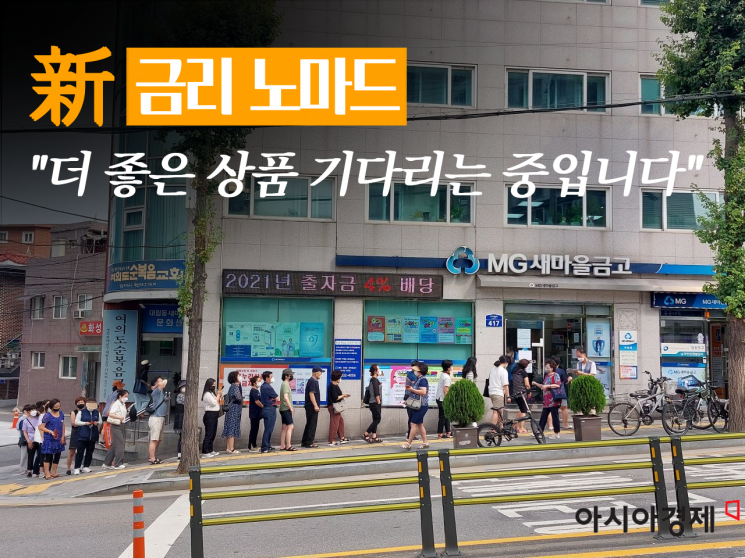 ▲At 9 a.m. on the 12th, customers are waiting in front of Saemaeul Geumgo in Daerim-dong, Guro-gu, Seoul to open savings accounts.
[Asia Economy Reporters Minwoo Lee and Nayoung Shim] #Park Seyoung (35, pseudonym), an office worker living in Suwon, recently found herself in a dilemma over the 100 million KRW cash she received upon the maturity of her deposit. Although special deposit products offering high interest rates of 3-4% are being launched one after another, the base interest rate has been steadily rising. She felt that subscribing to deposit products early might cause losses during the interest rate hike period, but holding onto the money made her feel like time was just passing by. Ultimately, Park decided to put 20 million KRW into a special 1-year savings product with a 3.6% interest rate, and the remaining 80 million KRW into demand deposit accounts (parking accounts) with interest rates of 2.2% and 2.0%, respectively, planning to reconsider after three months.
The reason why the number of 'interest rate nomads' is increasing is that while bank deposit and savings interest rates are steadily rising, asset markets are collapsing. Since the Bank of Korea took a 'big step' by raising the base interest rate by 0.5 percentage points (p) on the 13th, interest in deposits and savings has increased even more.
Professor Kim Daejong of the Department of Business Administration at Sejong University said, "The three major elements of investment are profitability, safety, and liquidity. Given that the stock and virtual asset markets have fallen by 30-80% from their peaks, the recent trend in deposits and savings aligns with these three elements." He added, "Since the U.S. plans to continue raising interest rates to keep inflation around 2%, the preference for deposits and savings is likely to continue at least until the end of this year, and possibly into next year."
◆ Money Moves to Banks According to Interest Rates
According to the financial sector on the 14th, the balance of deposits and savings at the five major commercial banks?KB Kookmin, Shinhan, Hana, Woori, and NH Nonghyup?increased by 21.2341 trillion KRW in the first half of this year alone. In particular, whenever the Bank of Korea's Monetary Policy Committee raised the base interest rate by 0.25%p in January, April, and May this year, the deposit and savings balances at the five major banks jumped significantly.
The month-over-month increases were 19.9375 trillion KRW in May and 11.2895 trillion KRW in January. In contrast, in February, when the base rate was held steady despite the Monetary Policy Committee meeting, and in March, when no meeting was held, deposit and savings balances decreased by 595.2 billion KRW and 6.091 trillion KRW, respectively. This shows that funds flowed into bank deposit products in line with rising interest rates. Considering that regional banks, savings banks, and Saemaeul Geumgo (community credit cooperatives) in the secondary financial sector are even more actively offering high-interest deposit products, the amount of funds flowing into deposits and savings is expected to be even larger.
In fact, deposit and savings interest rates have risen by more than 1 percentage point compared to a year ago. According to the Bank of Korea, as of May, the fixed deposit interest rate at deposit banks was 1.95%, and the fixed savings interest rate was 2.06%. During the same period last year, these rates were 0.82% and 1.14%, respectively.
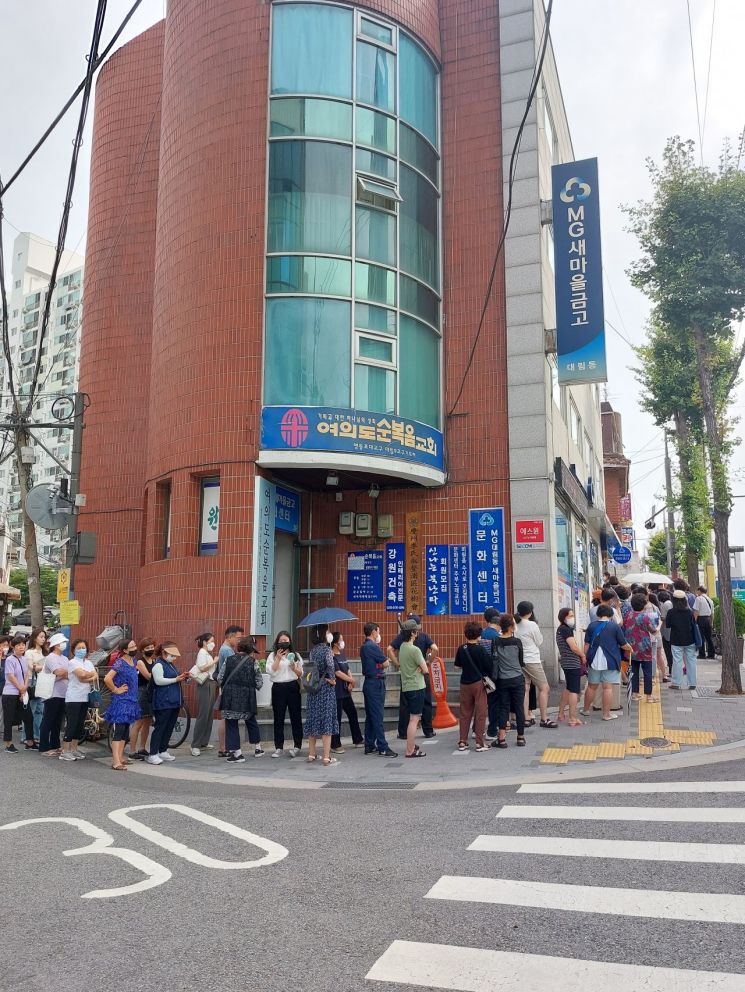 ▲At 9 a.m. on the 12th, customers are waiting in front of Saemaeul Geumgo in Daerim-dong, Yeongdeungpo-gu, Seoul to open savings accounts.
◆ Falling Stock Market... Deposits and Savings Sold Out
The sluggish stock market has also fueled the 'money move' into deposits and savings. The KOSPI index, which rose to the 3300 level last year, fell to 2292.01 on the 6th, marking the lowest closing price of the year. Investor sentiment has cooled as well. Customer deposits, which serve as standby funds for stock purchases, stood at 54.414 trillion KRW as of the 8th, down 20.693 trillion KRW compared to the year's high on January 27. Considering that the deposits and savings balance at the five major banks increased by 21.2341 trillion KRW in the first half of this year, a large-scale money move from the stock market to banks has taken place.
This is evident from the fact that special deposit products continue to sell out. K Bank's 'CodeK Free Savings,' offering an annual interest rate of 5%, sold out within ten days of its launch last month. Woori Bank's '2022 Woori Special Fixed Deposit,' with a maximum annual interest rate of 3.2%, also reached its limit within six days of release. Since the Bank of Korea raised the base interest rate by an additional 0.5%p, funds aiming for further increases in deposit and savings product interest rates are expected to pour in.
Soyong So, an economist at Shinhan Bank, said, "Although concerns about economic downturn are increasing, central banks have no choice but to prioritize stabilizing inflation," and predicted, "The Bank of Korea will raise the base interest rate to around 2.75-3.00% this year."
◆ "Hope It Rises More"... Money Move Waiters
Following the big step, expectations of further interest rate hikes by the Bank of Korea have increased, leading to a rise in 'money move waiters.' Office worker Kim Minseong (41, pseudonym) is constantly checking articles about special savings products from secondary financial institutions whenever he has time. He invested his funds in a U.S. S&P 500-tracking exchange-traded fund (ETF) at the beginning of the year, but it had fallen 8.05% by this month. Then, a colleague mentioned that he had subscribed to a 5% interest savings product at a savings bank, which piqued Kim's interest. When he went to consult about opening a savings account at a savings bank, he was told, "Better savings products will be available after mid-July." Immediately, he handed his business card to the bank clerk and earnestly asked to be contacted when the products are launched. Kim said, "These days, friends also share information about high-interest deposit and savings products in group chats."
As soon as the Bank of Korea took the big step, commercial banks quickly reflected this. Hana Bank decided to raise the base interest rates on 30 deposit and savings products (8 deposit products and 22 savings products) by up to 0.9%p starting from the 14th. Accordingly, the 'My Home Double-Up Savings,' which applies double the interest rate at maturity when subscribed simultaneously with the housing subscription savings, now offers a maximum 1-year maturity interest rate of 5.5% per annum. Woori Bank also decided to raise interest rates on 21 fixed deposits and 25 savings products by up to 0.8%p on the same day. This is expected to create deposit products with interest rates in the 3% range and savings products in the 4% range.
Experts advise that subscribing to short-term rather than long-term products is more effective. Kim Haksoo, team leader at Hana Bank Apgujeong PB Center, said, "Recently, wealthy clients have been subscribing to ultra-short-term deposits of 1 to 3 months or, if they already hold foreign currency, they also subscribe to foreign currency fixed deposits for ultra-short terms." He added, "It is better to keep deposit cycles short, and besides that, short-term bonds of 3 to 4 months recently offer interest rates around 4% per annum, so considering investment in them is also advisable."
© The Asia Business Daily(www.asiae.co.kr). All rights reserved.













