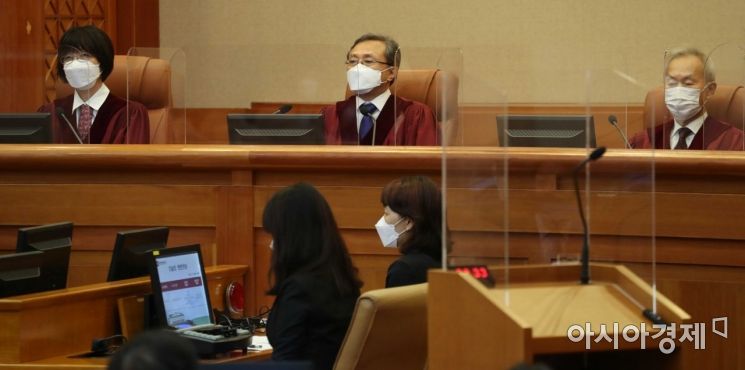
[Asia Economy Reporter Kim Daehyun] The first public hearing on the constitutional dispute over the "Complete Prosecution Reform Act" (검수완박법) filed by the People Power Party was held on the 12th at the Constitutional Court. The People Power Party argued that the law seriously infringed on the constitutional and legal rights of members of the National Assembly to deliberate and vote. On the other hand, the National Assembly contended that there was no infringement on the rights to deliberate and vote, and thus the petition to nullify the declaration of passage of the Complete Prosecution Reform Act should be dismissed.
At 2 p.m. in the grand courtroom, the Constitutional Court held the first public hearing on the case in which the People Power Party filed a constitutional dispute against the Speaker of the National Assembly and the Chairperson of the Legislation and Judiciary Committee, claiming that their rights to deliberate and vote on the bill were violated. The court heard opinions from both the National Assembly and the People Power Party.
The Constitutional Court is separately reviewing constitutional disputes filed by the People Power Party and the Ministry of Justice and prosecution related to the Complete Prosecution Reform. The case heard on this day was filed in April by People Power Party lawmakers Yoo Sang-beom and Jeon Ju-hye against the Speaker of the National Assembly and the Chairperson of the Legislation and Judiciary Committee.
Lawmaker Jeon emphasized that Min Hyung-bae, who left the Democratic Party, should not have been appointed as a member of the agenda adjustment committee. Jeon stated, "Min was a member of the Democratic Party who proposed the Complete Prosecution Reform bill in February last year," and "Min, who also participated in the bill proposed as the party line of the Democratic Party in April, is a party with a vested interest."
He added, "Min participated as a member of the second negotiation group, i.e., the opposition party's quota on the adjustment committee, which can only be seen as an attempt to favor the Democratic Party, and it is highly illegal and unconstitutional for a person with a vested interest to be part of the opposing side's agenda adjustment committee."
Lawmaker Jeon also argued that the agenda adjustment committee did not meet the important requirement of sufficient discussion. He said, "The agenda adjustment committee ended in 17 minutes, and the meeting itself was seriously defective to the point of non-existence," and "The People Power Party immediately requested the election of the agenda adjustment committee chairperson as soon as the committee started, but then-acting chair Kim Jin-pyo ignored this and proceeded with the committee."
Jeon pointed out serious problems with the Complete Prosecution Reform bill that passed through the agenda adjustment committee. He noted that the bill submitted to the plenary session was different from the bill adjusted and amended by the floor leaders of the People Power Party and the Democratic Party, Kwon Seong-dong and Park Hong-geun. He argued that the identity between the plenary submission and the amended bill could not be recognized.
Jeon claimed, "The Legislation and Judiciary Committee's resolution was different from the bill submitted to the plenary session, and the amendment was unilaterally submitted by the Democratic Party and forcibly passed," and "The Complete Prosecution Reform Act seriously violates the principles of parliamentary democracy, due process, and the fundamental rights of the people, making it unconstitutional and illegal."
Min left the Democratic Party on April 20, and on April 26, Park Kwang-on, Chairperson of the Legislation and Judiciary Committee, appointed Democratic Party lawmakers Kim Nam-guk, Kim Jin-pyo, Lee Soo-jin, People Power Party lawmakers Yoo Sang-beom and Jeon Ju-hye, and the independent Min as adjustment committee members. The bill was passed in the agenda adjustment committee in 17 minutes that day, and subsequently passed the full committee and plenary session.
In response, the National Assembly argued that there was no infringement on the voting and deliberation rights of members of the National Assembly and that the bill was passed in accordance with the Constitution and laws. The National Assembly's representative stated, "The petitioners participated substantially in the deliberation and voting, only abstaining from the vote, so there is no infringement," and "Even in cases where the right to deliberate and vote was partially recognized in disputes against the Speaker, there has been no precedent of invalidating the declaration of passage of a bill."
He added, "Min's departure from the Democratic Party and appointment to the agenda adjustment committee are inherent rights of the National Assembly as a state institution and committee chair to organize its own meetings within the scope of parliamentary autonomy, and are highly political acts," and "If there is no violation of the National Assembly Act, the public should respect that, and it is inappropriate to subject this itself to judicial review."
Judges repeatedly posed questions to both sides. Justice Lee Jong-seok cited a constitutional dispute filed by former Bareunmirae Party lawmaker Oh Shin-hwan in 2019 against the Speaker of the National Assembly, which was dismissed, and asked the respondent side, "At that time, the Constitutional Court said that the principle of free mandate is not always paramount," and "Is the current Speaker taking a different stance from the previous case?"
When the Speaker's side said, "It is the most respected part of representative democracy that lawmakers act according to their own judgment for the public good," Justice Lee pointed out, "Isn't there a procedural defect in appointing a person who left the party with the intention of creating a 4-to-2 adjustment committee structure as an adjustment committee member?" He also asked, "If the principle of free mandate of lawmakers is respected, is it acceptable for lawmakers' decision-making acts to violate the Constitution and laws?"
Justice Lee Mi-sun asked about the meaning of the People Power Party's initial agreement to the Speaker Park Byeong-seok's mediation proposal on the Complete Prosecution Reform bill on April 22. The People Power Party side argued, "There are many agreements based on the Speaker's mediation proposal in the National Assembly," and "We judged that making an agreement does not legally impose an obligation, and later the agreement was broken due to problems with the Complete Prosecution Reform Act."
The hearing concluded after about 2 hours and 40 minutes. Park Jumin, a Democratic Party lawmaker who appeared as a witness, said, "I do not know what Min's purpose was in leaving the party, but if Min sincerely thought leaving was necessary and decided so, can it really be called a trick resignation?" Lawmaker Jeon said, "I got the impression that the justices are not taking the issue of disguised resignation lightly."
Meanwhile, a public hearing on the constitutional dispute filed last month by the Ministry of Justice and prosecution, which challenges the constitutionality of the Complete Prosecution Reform Act itself, is also expected to be held soon.
A Constitutional Court official said, "We will continue the review based on the contents of the public hearing," and "It has not yet been decided whether to issue a ruling before the law's enforcement date of September 10 or whether to consolidate the case with the Ministry of Justice's constitutional dispute case."
© The Asia Business Daily(www.asiae.co.kr). All rights reserved.












