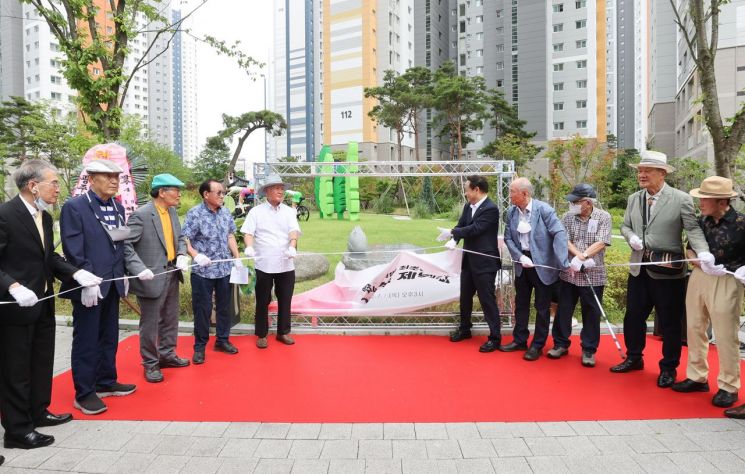
[Asia Economy Honam Reporting Headquarters Reporter Park Jin-hyung] Dong-gu, Gwangju Metropolitan City announced on the 8th that it installed a commemorative stone at the site of the boarding house of Gwangju High School students who first discussed the Gwangju protests during the April 19 Revolution and held an unveiling ceremony on the 7th.
The April 19 Revolution, which broke out in 1960 in response to the fraudulent March 15 election under the Syngman Rhee regime, was a democratic uprising that overthrew the dictatorship through citizens' resistance. In the Gwangju area, high school students, centered around Gwangju High School, led the protests.
The unveiling ceremony was held with the attendance of Dong-gu Mayor Im Taek and guests including Kim Byung-wook, Kim Seon-dam, and Lee Hong-gil, who led the protests at the time. Since the site of the boarding house (499 Gyelim-dong) is now where the Gyelim-dong Grand Central Apartments stand, the commemorative stone was installed in the landscaped space between apartment buildings 103 and 113, where the boarding house used to be.
The location where the commemorative stone was installed was the boarding house of Gwangju High School students Kim Chung-eon, Lee Hong-gil, and Ha Seong-su. Secret meetings were held there by third-year students from the same school?Kim Dong-woon, Kim Byung-wook, Kim Seon-dam, Kim Chung-eon, Park Sang-wook, Park Cheong-myeong, Shin Gang-sik, Lee Hong-gil, Jo Byung-soo, Ji Bu-il, Choi Su-cheon, Ha Seong-su, Hong Gap-gi?and Jeon Man-gil, a third-year student from Jodaebu High School. They first discussed the April 19 Revolution in Gwangju and the next day opened the curtain on the Gwangju April 19 Revolution.
Dong-gu produced the commemorative stone based on “Cheongchun-ui Hyeol (Youth’s Righteous Blood),” a record of the progress and circumstances of the April 19 Revolution by the late Kim Jae-hee, a former reporter of Jeonnam Ilbo (now Gwangju Ilbo), and testimonies from students who participated in the protests.
The commemorative stone was designed by artist Na Sang-ok, who also designed the May 18 Democratization Movement Memorial Tower. The stone measures 2.6 meters in width and 0.8 meters in height. It features an explanation of the site’s significance and a lotus flower carving on one side, symbolizing the spirit of the April 19 Revolution that blossomed democracy.
Dong-gu Mayor Im Taek said, “The April 19 Revolution is a foundational history of democracy that overthrew the dictatorship through the power of students and citizens. We installed this to honor the courage and righteousness of the Gwangju High School students who led the protests in Gwangju at that time. I hope this place will serve as an opportunity for citizens passing by to reflect once again on the meaning of the April 19 Revolution.”
© The Asia Business Daily(www.asiae.co.kr). All rights reserved.












