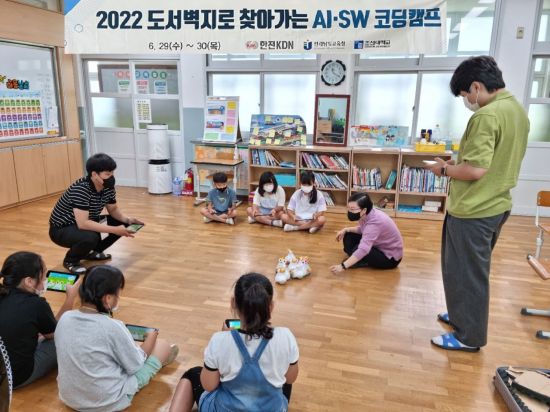
[Asia Economy Honam Reporting Headquarters Reporter Yoon Jamin] Chosun University SW-Centered University Project Group, the first software-centered university in the Honam region, successfully concluded the ‘2022 AI·SW Coding Camp Visiting Remote Island Areas’ program.
According to Chosun University on the 7th, the coding camp held over two days from the 29th of last month was conducted for students of Hwayang Elementary School and Anil Elementary School in Yeosu, Jeollanam-do, under the theme ‘Living with Changing SW (Software) and AI (Artificial Intelligence).’
The coding camp was designed to help kindergarten and elementary students understand AI·SW and develop computational thinking skills that enhance logical thinking and problem-solving abilities, in line with the changes of future society and the era of the 4th Industrial Revolution.
This program is annually operated by Professor Cho Youngjoo of the Chosun University SW-Centered University Project Group and the faculty, in collaboration with the Jeollanam-do Office of Education and KEPCO KDN, to expand the base of SW and AI in remote island and isolated areas that are underserved in AI·SW education.
Additionally, from the 3rd to 5th cohorts of student instructors produced by the nation’s first industry-academia-government project, the SW Education Instructor Training Course, (Ha Taejun, Ma Jian, Jeon Eunmin, Kim Junhyun, Kim Yongsu, Lee Sunghyun, Researcher Noh Chisang) delivered easy-to-understand and enjoyable robot coding classes to elementary students, operating as a virtuous cycle model for spreading AI·SW values with great significance.
Professor Cho Youngjoo, the supervising professor, said, “Hwayang Elementary School is a small school with 36 students from grades 1 to 6, and Anil Elementary School, including its branch, has 19 students in total, but the will and heart of students, teachers, and parents who want to lead AI·SW are no less than any other school. Due to the characteristics of remote island areas, to conduct robot coding classes presented in textbooks, students usually have to go on external experiential learning trips, but due to various circumstances, it is difficult to carry out such external experiences. We are grateful to the teachers, principal, and vice principal who strive to provide AI·SW education opportunities to all students,” he said.
He added, “Seeing the students command the robots and dance and talk with them according to the commands was a very rewarding time. We will continue to prepare educational content steadily and strive to enable more students to participate in schools so that no competency gaps arise among students in AI·SW underserved areas in the future.”
© The Asia Business Daily(www.asiae.co.kr). All rights reserved.

![Clutching a Stolen Dior Bag, Saying "I Hate Being Poor but Real"... The Grotesque Con of a "Human Knockoff" [Slate]](https://cwcontent.asiae.co.kr/asiaresize/183/2026021902243444107_1771435474.jpg)














